
Vatican City 🇻🇦
Country in Europe
Introduction
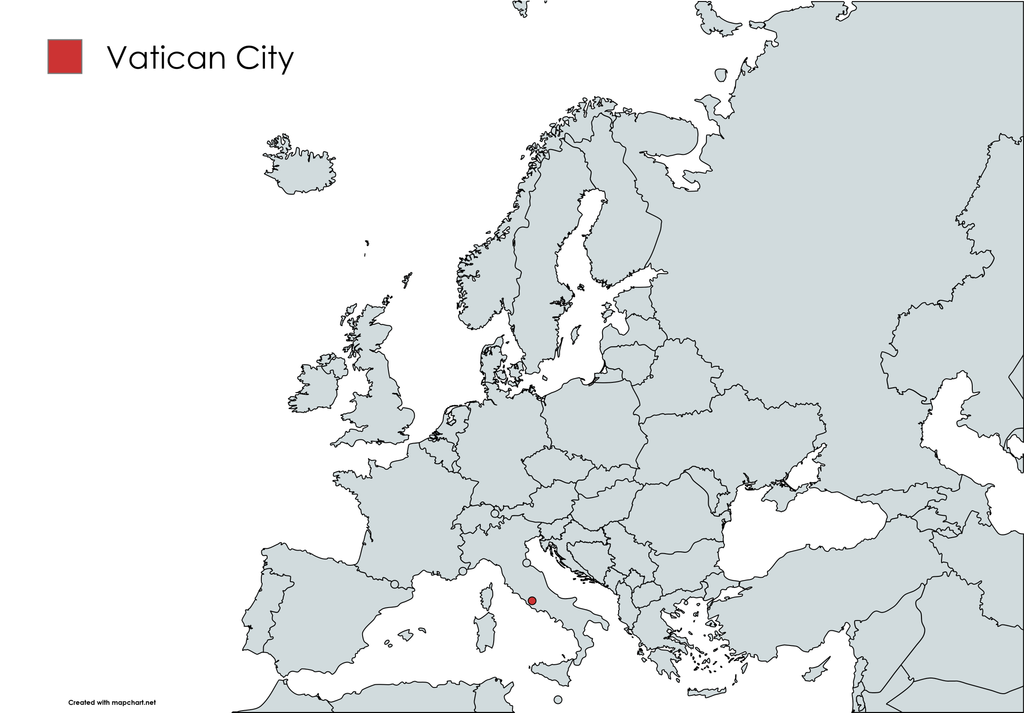
Vatican City, officially the Vatican City State, is a landlocked sovereign city-state located within Rome, Italy. With an area of just 0.44 km² (0.17 sq mi) and about 882 inhabitants, it is the smallest country in the world by both territory and population. It is an elective absolute monarchy headed by the Pope. Vatican City provides the territorial basis for the Holy See, the supreme governing authority of the Catholic Church, which exercises its sovereign functions through the Vatican City State and represents the Catholic Church in international affairs.
The Vatican uses the euro and issues its own coins and postage stamps, which are particularly valued by collectors. It also publishes L’Osservatore Romano and operates Vatican Radio, which broadcasts internationally in several languages. Since 1984, the entire state has been a UNESCO World Heritage Site.
| Official name | Stato della Città del Vaticano (Vatican City State) |
| Capital | None |
| Government | Elective absolute monarchy |
| Area (km² / sq mi) | 0.44 / 0.17 |
| Population | 882 (2024) |
| Official language(s) | Italian, Latin |
| Demonym(s) | Vatican |
| Currency | Euro (€) |
| Anthem | “Inno Pontificio” |
| Flag | 🇻🇦 |
| Flag meaning | The yellow and white design represents the colors of the Papal States; the keys symbolize Saint Peter and the papal tiara represents papal authority. |
History of Vatican City
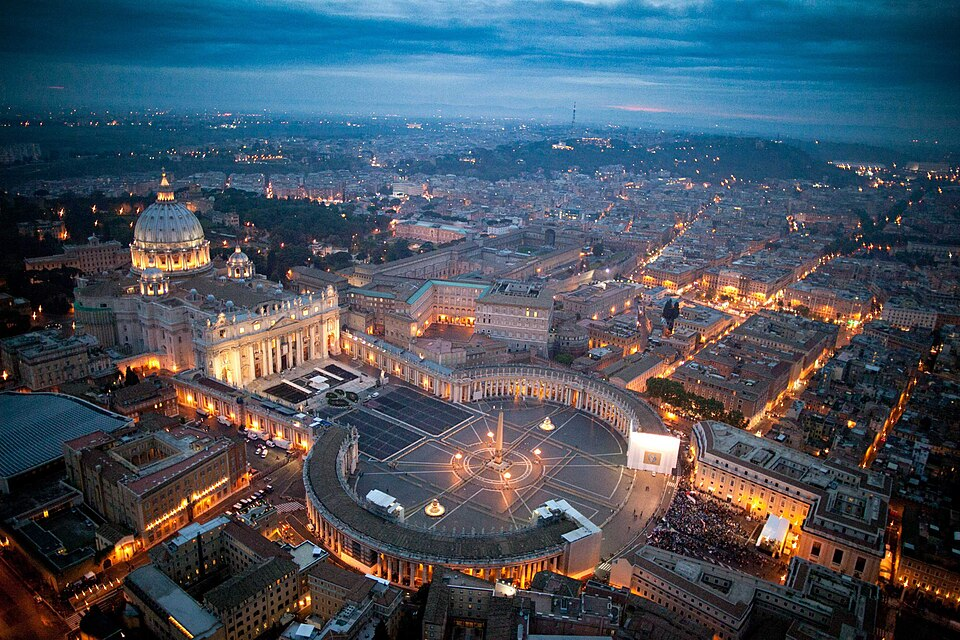
The name Vatican originates from the Roman term Ager Vaticanus, which referred to a marshy area on the western bank of the Tiber, outside ancient Rome. Because of its frequent flooding and its proximity to Veii, a major Etruscan enemy, the area was initially considered an unhealthy and unattractive part of the city.
Under the Roman Empire, the territory was drained and developed with gardens and villas. Emperor Caligula built a circus there, later completed by Nero. Known as the Circus of Nero, it became associated with the persecution of Christians after the Great Fire of Rome in AD 64. Christian tradition holds that Saint Peter was crucified there, while the Vatican Obelisk, originally brought from Egypt, is the most prominent surviving monument connected with the ancient circus.
A large Roman necropolis stood nearby, containing numerous tombs and pagan religious monuments. In AD 326, Constantine built the first St. Peter’s Basilica over what was believed to be Saint Peter’s tomb. The growing importance of the basilica gradually transformed the surrounding area, which later received the Leonine Walls for protection against attacks.
The popes subsequently became both religious and temporal rulers of the extensive Papal States, although the Vatican was not always their residence. After periods at the Lateran Palace, in Avignon, and at the Quirinal Palace, the popes settled permanently in the Vatican following the capture of Rome by Italian forces in 1870. The annexation ended papal territorial rule and created the long-standing Roman Question, during which the pope remained inside the Vatican and rejected Italian sovereignty over the city.
The dispute was resolved by the Lateran Treaty of 1929, signed between the Holy See and Italy. It established Vatican City as an independent state, formally coming into existence on 7 June 1929. During World War II, Vatican City maintained neutrality despite the German occupation of Rome and the Allied advance. The Vatican was generally respected as neutral territory, although Pope Pius XII strongly opposed the bombing of Rome and sought to protect the city and its population.
After the war, Vatican institutions were progressively reorganized. In 1970, most military corps were abolished, leaving the Swiss Guard, while the Gendarmerie became a civilian security force. The 1984 concordat further revised relations with Italy, ending Catholicism’s status as the country’s official state religion. Later developments included the construction of the Domus Sanctae Marthae in 1995, which caused some controversy because of concerns about its impact on views of St. Peter’s Basilica.
Geography of Vatican City
The territory of Vatican City occupies Vatican Hill and the surrounding area historically known as the Vatican Fields. Within its small territory lie some of the most important buildings of the Catholic Church, including St. Peter’s Basilica, the Apostolic Palace, the Sistine Chapel, the Vatican Museums, and the Vatican Gardens. Before becoming an independent state in 1929, the area belonged to the Roman district of Borgo.
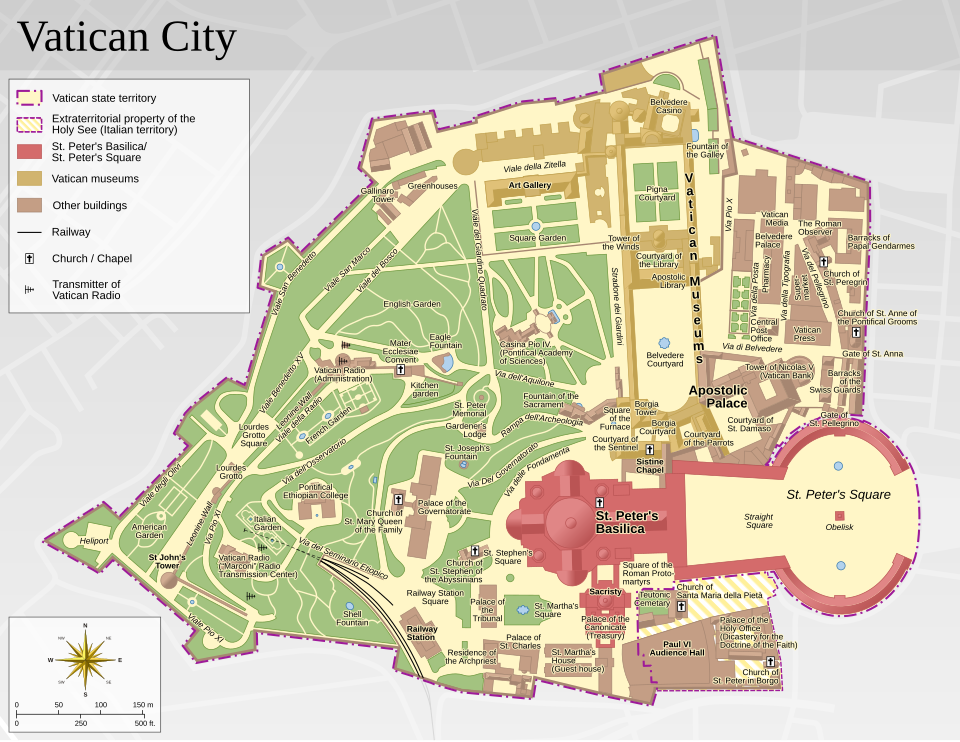
The present boundaries were established by the Lateran Treaty of 1929. Much of the border follows existing walls and buildings, while other sections are marked by specially constructed walls. St. Peter’s Square forms part of the Vatican territory, although its boundary with Italy is marked only by a white line. The square is connected to Rome through Via della Conciliazione, the monumental avenue built after the Lateran Treaty.
Several important properties belonging to the Holy See lie outside Vatican City, within Italian territory. These include the Papal Palace of Castel Gandolfo and Rome’s major basilicas, which enjoy extraterritorial status under the Lateran Treaty. They remain Italian territory but are protected from ordinary Italian jurisdiction and serve functions essential to the Holy See.
There are generally no passport controls between Italy and Vatican City. St. Peter’s Square and Basilica are freely accessible, while the Vatican Museums require admission and most other areas have restricted access. The Vatican Gardens, covering roughly half of the state’s territory, were developed from medieval orchards and vineyards and were progressively transformed into landscaped gardens during the Renaissance and Baroque periods.
Climate
Vatican City has the same Mediterranean climate as Rome, classified as Csa under the Köppen climate system. Winters are generally mild and relatively rainy, particularly from autumn through spring, while summers are typically hot and dry, lasting from May to September. Local conditions can vary slightly because of the St. Peter’s Basilica, its elevation, fountains, and extensive paved areas.
Society of Vatican City
Demography
As of 2024, Vatican City has 882 residents, while a further 372 Vatican citizens live outside the state. Its population consists primarily of people who reside there because of their office, position, employment, or ecclesiastical role, rather than through birth. Vatican citizenship is not acquired by birth but is mainly linked to permanent residence and official status within the state. It is generally held alongside another citizenship, meaning Vatican citizens retain the nationality of their country of origin. The population therefore includes people of several nationalities, with Italian and Swiss origins particularly prominent, partly because of the presence of the Swiss Guard.
Languages
Vatican City has no officially designated language, although Italian is the main language used in its legislation, official communications, and everyday life. This differs from the Holy See, which primarily uses Latin for authoritative official documents. Within the Swiss Guard, Swiss German is used for commands, while guards may take their oath in German, French, Italian, or Romansh. The official websites of both Vatican City and the Holy See are mainly available in Italian, alongside versions in numerous other languages.
Religion
Roman Catholicism is the only religion officially associated with Vatican City, which is the territorial center of the Catholic Church and the seat of the Pope. With 100% of its population identifying as Roman Catholic, Vatican City is the only country in the world with an entirely Catholic population.
Economy of Vatican city
The economy of Vatican City was initially supported by the 1929 Financial Convention, through which Italy provided the Holy See with financial compensation following the annexation of the former Papal States and the confiscation of Church property. Today, the state’s finances rely mainly on investments, property and other assets, donations from the faithful, and contributions from dioceses around the world, together with revenues from services such as museums, stamps, and coins.
Financial assets are administered primarily through APSA (Administration of the Patrimony of the Apostolic See), under the supervision of the Holy See‘s financial institutions. Vatican coins and postage stamps are particularly important to collectors and constitute a notable source of revenue. The state also benefits from certain free supplies, exemptions, and other economic advantages provided by Italy.
Culture of Vatican City
Vatican City is one of the world’s most important centers of art, culture, and religious heritage, with an exceptionally high concentration of historic monuments and artworks. The entire territory of Vatican City is recognized as a UNESCO World Heritage Site, together with several extraterritorial properties of the Holy See in Rome.
Among the artists associated with St. Peter’s Basilica are Donato Bramante, Pinturicchio, Michelangelo, and Gian Lorenzo Bernini, whose contributions helped shape the architectural and artistic identity of the Vatican. The basilica itself, together with the monumental St. Peter’s Square and Bernini’s colonnade, remains one of the principal symbols of the Catholic Church and a major destination for pilgrims and visitors.
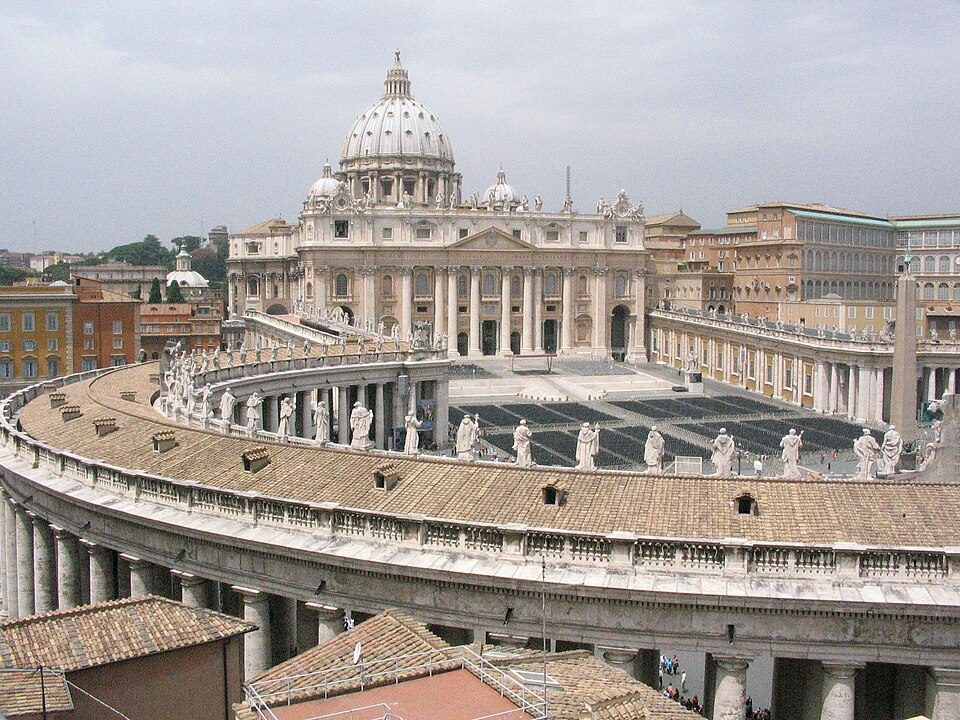
The Vatican Palace complex contains more than a thousand rooms and houses important Church institutions, museums, historic chapels, and the Vatican Apostolic Library. Particularly famous are the Sistine Chapel, decorated with Michelangelo’s celebrated frescoes, and the Raphael Rooms. The library preserves around 1.6 million printed books and approximately 500,000 manuscripts and other historical objects, including rare and ancient works.
The Vatican Museums contain extensive archaeological and artistic collections, including the Gregorian Egyptian and Etruscan Museums, Pio-Clementine Museum, Chiaramonti Museum, and Vatican Pinacoteca.
The Vatican also has a tradition of scientific research, particularly through the Vatican Observatory, which conducts astronomical and astrophysical research, including studies of exoplanets, planetary bodies, stars, galaxies, and cosmology. Its main modern observational research is carried out using the Vatican Advanced Technology Telescope in Arizona.
Vatican City maintains several important media and publishing institutions. L’Osservatore Romano is the principal Vatican newspaper and is published in multiple languages, while Vatican Radio broadcasts Catholic-related news and programs internationally. Together, these institutions contribute to the Vatican’s role as a major center for the preservation, study, and international dissemination of religious, artistic, historical, and intellectual heritage.
Cuisine of Vatican City
Vatican cuisine does not constitute a clearly defined culinary tradition of its own. As a very small state surrounded entirely by Italy and populated by people from different countries, Vatican City has developed a food culture that is largely based on Italian and Roman cuisine. The limited number of public dining establishments also means that there is no extensive independent restaurant culture within the state.
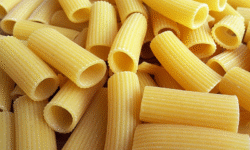
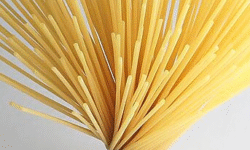
Italian dishes, particularly those associated with Roman cooking, are therefore among the most commonly prepared foods. Pasta, pizza, soups, meat, fish, and seafood are widely represented, with recipes often incorporating ingredients such as vegetables, and various types of shellfish.
Because the Vatican community includes people from many different national backgrounds, its everyday food habits also reflect international influences. In particular, the culinary traditions of the popes and Vatican personnel have contributed Polish, German, Argentine, and Swiss elements to local meals. The Swiss Guard has also played a role in maintaining particular dishes and eating traditions within the Vatican.
A dish strongly connected with the Vatican is Fettuccine alla Papalina, a pasta recipe traditionally considered a variation of Pasta alla Carbonara (Carbonara). According to the traditional account, it was created after Cardinal Eugenio Pacelli, who later became Pope Pius XII, requested a special dish from the restaurant supplying food to the Vatican. The cook adapted the Roman recipe by replacing guanciale with prosciutto crudo, adding onion, and using Parmigiano Reggiano DOP instead of Pecorino Romano DOP (Roman Pecorino PDO), producing a milder and more delicate sauce while retaining the character of Roman pasta cuisine.
Administrative and geo-cultural divisions of Vatican City
Due to its extremely small territory, Vatican City is divided neither administratively nor geo-culturally.
Traditional recipes of Vatican City
(Only recipes unique to the area or strongly associated with it and rarely found elsewhere are included)
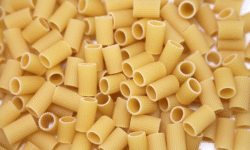
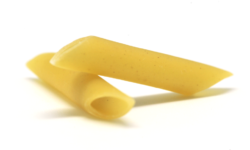
Traditional products of Vatican City
(Only products unique to the area or strongly associated with it and rarely found elsewhere are included)
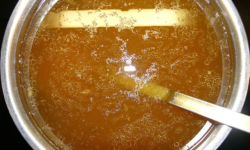
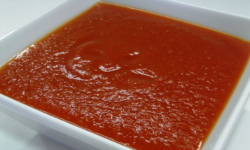
Recipes commonly prepared in Vatican City
(Only products specific to this territorial level, and not already covered at a broader administrative or geocultural level, are included)



Products commonly consumed in Vatican City
(Only recipes specific to this territorial level, and not already covered at a broader administrative or geocultural level, are included)




Source(s):
https://it.wikipedia.org/wiki/Citt%C3%A0_del_Vaticano
https://en.wikipedia.org/wiki/Vatican_City
Photo(s):
1. Map created with https://www.mapchart.net
2. lafiguradelpadre Congreso, CC BY 2.0 https://creativecommons.org/licenses/by/2.0, via Wikimedia Commons
3. Vatican City, CC BY-SA 4.0 https://creativecommons.org/licenses/by-sa/4.0, via Wikimedia Commons
4. Alberto Luccaroni User:Luccaro, CC BY-SA 3.0 http://creativecommons.org/licenses/by-sa/3.0/, via Wikimedia Commons