
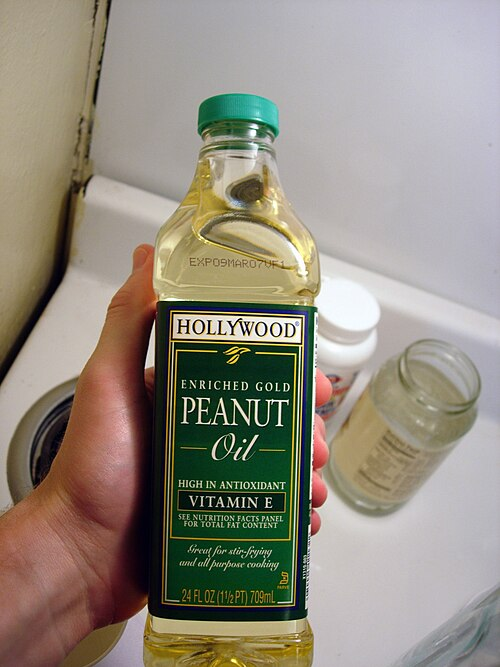
Refined peanut oil
Food, Plant source foods, Vegetable oils and derivatives, Peanut oil
Consumption area(s) We couldn’t find any reliable data on the availability of this product/recipe, but it is presumably mainly consumed in: Algeria 🇩🇿, Angola 🇦🇴, Burkina Faso 🇧🇫, Cameroon 🇨🇲, China 🇨🇳, Ghana 🇬🇭, Guinea 🇬🇳, Guinea-Bissau , Italy 🇮🇹, Ivoiry Coast 🇨🇮, Laos 🇱🇦, Lebanon 🇱🇧, Malawi 🇲🇼, Myanmar 🇲🇲, Netherlands 🇳🇱, Nicaragua 🇳🇮, Niger 🇳🇪, Nigeria 🇳🇬, Rwanda 🇷🇼, San Marino 🇸🇲, Senegal 🇸🇳, Sierra Leone 🇸🇱, Tonga 🇹🇴, United Arab Emirates 🇦🇪, Vatican City 🇻🇦, Zimbabwe 🇿🇼
- Saponifiable fraction: ~99%
- Saturated fatty acids: ~16.9%, including 8–14% palmitic acid, 1.5–5% stearic acid, 2–4% behenic acid, and ~1.5% arachidic acid (plus 1–2% lignoceric acid)
- Unsaturated fatty acids: ~78–80%, including 35–69% oleic acid, 0.5–1.5% gadoleic acid, and 13–35% linoleic acid
- Unsaponifiable fraction: ~1%
- Carotenoids, chlorophyll, sterols, tocopherols
Chemical/physical properties:
- Smoke point: 230–235°C
- Density: 0,911–0,925 kg/l a 15 °C
Introduction
Refined peanut oil—also known as refined groundnut oil or refined arachis oil—is a vegetable oil obtained from peanuts through extensive refining processes that remove proteins, impurities, odor compounds, and most of its natural flavor components. As a result, it is typically very light in color, often pale yellow to nearly colorless, and has an almost completely neutral taste and aroma.
Description of refined peanut oil
Because of its neutral sensory profile, refined peanut oil is widely used in commercial food preparation and industrial frying applications, where it does not interfere with the flavor of the final dish. It is particularly common in American, Chinese, Indian, and Southeast Asian cuisines, especially in settings that require large-scale deep-frying or repeated heating cycles.
One of the main functional advantages of refined peanut oil is its high smoke point, which is typically around 230 °C. This makes it especially suitable for high-temperature cooking methods such as deep-frying, stir-frying, and wok cooking, where thermal stability is essential. Its fatty acid composition contributes to good oxidative stability, allowing it to resist degradation and rancidity better than many other common vegetable oils under prolonged heating.
In terms of shelf life, refined peanut oil is relatively stable when properly stored. Kept in a sealed container, away from light and heat, it can remain usable for many months and often up to one or two years without significant quality loss. Although the refining process removes most allergenic peanut proteins, highly sensitive individuals may still need to exercise caution, even though refined peanut oil is generally considered much less likely to trigger allergic reactions than unrefined peanut oils.
Production methods for refined peanut oil
Refined peanut oil is produced from dried peanuts that undergo a series of industrial processing steps designed to maximize yield, ensure safety, and standardize quality. After harvesting, peanuts are typically subjected to a drying phase lasting approximately two to four weeks, reducing their moisture content from around 40% to about 5–7%. Once adequately dried, the kernels—containing roughly 45% oil content—are mechanically shelled and separated from their outer husks.
The kernels are then cleaned using sieves to remove debris and foreign materials, followed by crushing in roller mills. The resulting mash is processed through mechanical pressing systems, usually screw presses, to extract crude peanut oil. However, in the case of refined peanut oil, this crude extract does not represent the final product.
To achieve refined peanut oil, the crude oil undergoes a multi-stage refining process that typically includes degumming, neutralization, bleaching, and deodorization. These steps remove free fatty acids, phospholipids, pigments, and volatile compounds responsible for odor and flavor. The final product is a highly purified oil characterized by a very neutral sensory profile, consistent chemical composition, and improved storage stability.
In industrial production, additional solvent extraction using n-hexane may be applied to the press cake to maximize oil recovery. The solvent is subsequently removed via distillation, and the resulting oil is also subjected to refining. Although efficient, solvent-extracted oils still require full refining to meet standards for edible refined peanut oil.
Uses of refined peanut oil
Thanks to its high smoke point, refined peanut oil shows excellent thermal stability and is particularly well suited to high-temperature cooking methods such as deep-frying, stir-frying, and other intensive heat applications. As a result, it is widely used in commercial frying operations and in various Asian culinary practices, especially within Chinese cuisine and wok-based cooking techniques, where consistent heat performance and neutral flavor are essential.
Nutritional facts table
Please note that nutritional values can vary slightly depending on peanut varieties
| Nutrients | Per 100 g |
| Calories (kcal) | 899 |
| Total fat (g) | 99.9 |
| ———Saturated fat (g) | 16.9 |
| Cholesterol (mg) | 0 |
| Sodium (mg) | 0 |
| Total carbohydrates (g) | 0 |
| ———Dietary fiber (g) | 0 |
| ———Total sugar (g) | 0 |
| Protein (g) | 0 |
Recipes that use this product as an ingredient:

Photo(s):
1. Adam Engelhart, CC BY-SA 2.0 https://creativecommons.org/licenses/by-sa/2.0, via Wikimedia Commons