
Black mustard
Species of Brassica
Food, Plant source foods, Plants (Plantae), Flowering plats (angiospermae), Mesangiosperms, Eudicots, Core eudicots, Superrosids, Rosids, Malvids (Eurosids II), Brassicales (Cruciales), Brassicaceae (Cruciferae), Brassica
Species name: Brassica nigra
Consumption area(s): We were unable to find reliable data on the distribution of this product, but it is presumably consumed mainly in the following countries: Afghanistan 🇦🇫, Albania 🇦🇱, Algeria 🇩🇿, Andorra 🇦🇩, Armenia 🇦🇲, Austria 🇦🇹, Azerbaijan 🇦🇿, Belgium 🇧🇪, Belarus 🇧🇾, Bosnia and Herzegovina 🇧🇦, Bulgaria 🇧🇬, China 🇨🇳, Croatia 🇭🇷, Cyprus 🇨🇾, Czech Republic 🇨🇿, Egypt 🇪🇬, Eritrea 🇪🇷, Ethiopia 🇪🇹, France 🇫🇷, Georgia 🇬🇪, Germany 🇩🇪, Greece 🇬🇷, Hungary 🇭🇺, India 🇮🇳, Iran 🇮🇷, Iraq 🇮🇶, Ireland 🇮🇪, Israel 🇮🇱, Italy 🇮🇹, Kazakhstan 🇰🇿, Lebanon 🇱🇧, Libya 🇱🇾, Liechtenstein 🇱🇮, Luxembourg 🇱🇺, Moldova 🇲🇩, Monaco 🇲🇨, Montenegro 🇲🇪, Morocco 🇲🇦, Netherlands 🇳🇱, North Macedonia 🇲🇰, Palestine 🇵🇸, Poland 🇵🇱, Romania 🇷🇴, San Marino 🇸🇲, Serbia 🇷🇸, Slovakia 🇸🇰, Slovenia 🇸🇮, Spain 🇪🇸, Syria 🇸🇾, United Kingdom 🇬🇧, United States 🇺🇸, Switzerland 🇨🇭, Tunisia 🇹🇳, Turkey 🇹🇷, Ukraine 🇺🇦, Vatican City 🇻🇦
Note: For better understanding, please read the article on flowering plants (angiospermae) first. If you come across unfamiliar words, you can click on any highlighted term to open the glossary with definitions of key botanical terms.
Introduction
Black mustard (Brassica nigra), is an annual plant originating from the cooler areas of North Africa, temperate Europe, and parts of Asia. It is primarily cultivated for its dark brown to black seeds, which are widely used as a culinary spice.
Description of the plant
The plant is mostly hairless, with only a few hairs present on the branches and petioles. The root is short, slender, and white in color. The stem grows 50–120 cm tall, with an angular, hollow structure and it can be simple or branched.
Leaves are all petiolate and rough to the touch. The lower leaves are large and pinnate, with ovate lobes, a central segment noticeably larger than the 2–4 lateral segments, all irregularly toothed. The upper leaves are lanceolate, and mostly simple, but with shallow, irregular teeth along the margins.
Flowers are tetramerous, regular, and small. Initially, the inflorescence is corymb-like, transforming into a raceme as the axis elongates, forming a wide, loose panicle. Peduncles are 2–3 mm long, with free, spreading sepals that are light green. The yellow corolla is less than 1 cm wide, composed of four whole petals arranged in a cross alternating with the sepals. The androecium has six stamens, two of which are shorter lateral ones, all with slender, free filaments and bilocular anthers. The gynoecium consists of an oblong ovary with two chambers formed by two fused carpels, a membranous septum dividing the cavity, and a short style topped with a stigma with two lobes.
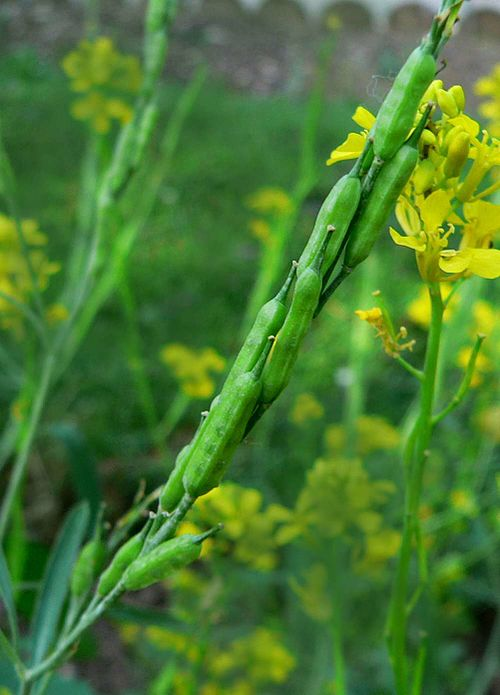
The fruit is a silique, approximately 2 cm long, attached along the rachis, ending in a 2–3 mm beak. It is narrow, almost quadrangular in cross-section, with a prominent median dorsal protrusion on the valves containing numerous seeds, which are arranged in a single row per locule.
Description of the edible parte (seeds)
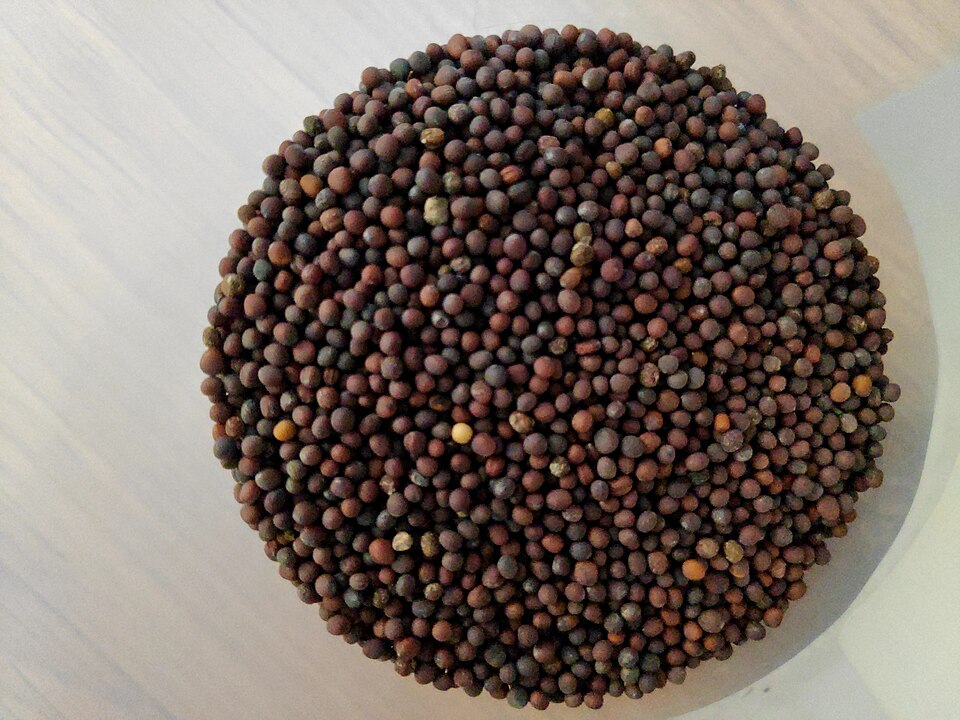
The seeds are very small and slightly elongated, measuring about 1–1.5 mm in diameter. They display a reddish-brown coloration, which may appear lighter or darker, and this variation in shade can even occur on the same plant. Their outer surface is marked by a fine network of extremely delicate ridges, forming a reticulate pattern that is usually barely visible to the naked eye.
History of black mustard as food
The use of black mustard as a condiment dates back more than two thousand years. As early as the 1st century AD, the Roman writer Columella referred to it in his works, describing the plant as a valuable culinary ingredient. At that time, not only the seeds but also the leaves were utilized; they were preserved in vinegar to extend their shelf life and enhance their flavour.
During the 13th century in France, the seeds were crushed and used to prepare a distinctive mixture. They were combined with grape must to create a strong, pungent paste known as “moût-ardent”, meaning “burning must”, a name inspired by its sharp taste. From this preparation developed the French term “moutarde”, which later gave rise to the English word mustard, now widely used to refer to this spice.
From the mid-20th century onward, black mustard has gradually lost popularity compared with brown mustard, largely because certain brown mustard cultivars allow for more efficient mechanical harvesting.
Uses of black mustard
The spice is typically obtained by grinding the seeds of the plant after the seed coats have been removed. These tiny, hard seeds, about 1 mm in size, range in colour from dark brown to black. Although they possess a strong, pungent taste, they have little noticeable aroma. In Indian cuisine, the seeds are widely used, especially in curry preparations, where they are known as rai. They are often added to hot oil or ghee, causing them to crackle and release a nutty flavour. The seeds also contain a high proportion of fatty oil, mainly oleic acid, which is commonly used as a cooking oil in India under the name “sarson ka tel.”
Beyond the seeds, young leaves, buds, and flowers are also edible. In Ethiopia, where the plant is grown as a vegetable crop, the shoots and foliage are typically cooked and eaten, while the seeds continue to serve as a culinary spice. In the Amharic language, the plant is called senafitch.
Nutritional facts table of the seeds
Since nutritional values can vary slightly depending on the cultivar, the figures provided below represent general averages.
| Nutrients | Per 100 g |
| Calories (kcal) | 508 |
| Total fat (g) | 36 |
| ———Saturated fat (g) | 2 |
| Cholesterol (mg) | 13 |
| Sodium (mg) | 0 |
| Total carbohydrates (g) | 28 |
| ———Dietary fiber (g) | 12 |
| ———Total sugar (g) | 6.8 |
| Protein (g) | 26 |
Recipes that use this product as an ingredient:

Photo(s):
1. Pancrat, CC BY-SA 3.0 https://creativecommons.org/licenses/by-sa/3.0, via Wikimedia Commons
2. Gaurav Dhwaj Khadka, CC BY 4.0 https://creativecommons.org/licenses/by/4.0, via Wikimedia Commons