
Chianti DOCG (appellation) (Chianti CGDO)
Food, Plant source foods, Alcoholic beverages, Fermented alcoholic beverages, Wines, Ordinary wines
Main characteristics: Red wines or Rosé wines, Still wines
Consumption area(s): Italy 🇮🇹
Production area (s): Asciano, Arezzo, Bagno a Ripoli, Barberino Val d’Elsa, Bucine, Capannoli, Capolona, Capraia e Limite, Carmignano, Casole d’Elsa, Casciana Terme, Castelfiorentino, Castelfranco di Sopra, Castelnuovo Berardenga, Castiglion Fibocchi, Cavriglia, Cerreto Guidi, Certaldo, Cetona, Chianciano, Chianni, Chiusi, Civitella in Val di Chiana, Colle Val d’Elsa, Crespina, Dicomano, Empoli, Fauglia, Fiesole, Figline e Incisa Valdarno, Firenze, Foiano della Chiana, Gambassi Terme, Impruneta, Lajatico, Lamporecchio, Larciano, Lari, Lastra a Signa, Laterina, Londa, Lorenzana, Loro Ciuffenna, Lucignano, Marciano della Chiana, Monsummano Terme, Montaione, Montalcino, Montale, Monte San Savino, Montepulciano, Monteriggioni, Monteroni Val d’Arbia, Montelupo Fiorentino, Montemurlo, Montespertoli, Montevarchi, Montopoli Valdarno, Murlo, Palaia, Peccioli, Pelago, Pergine Valdarno, Pienza, Pian di Sco, Pistoia, Poggio a Caiano, Poggibonsi, Ponsacco, Pontassieve, Pontedera, Quarrata, Radicondoli, Rapolano Terme, Reggello, Rignano sull’Arno, Rufina, San Casciano dei Bagni, San Casciano in Val di Pesa, San Gimignano, San Miniato, Santa Luce, Sarteano, Scandicci, Serravalle Pistoiese, Siena, Signa, Sinalunga, Sovicille, Subbiano, Tavarnelle Val di Pesa, Terranuova Bracciolini, Terricciola, Torrita di Siena, Trequanda, Vinci
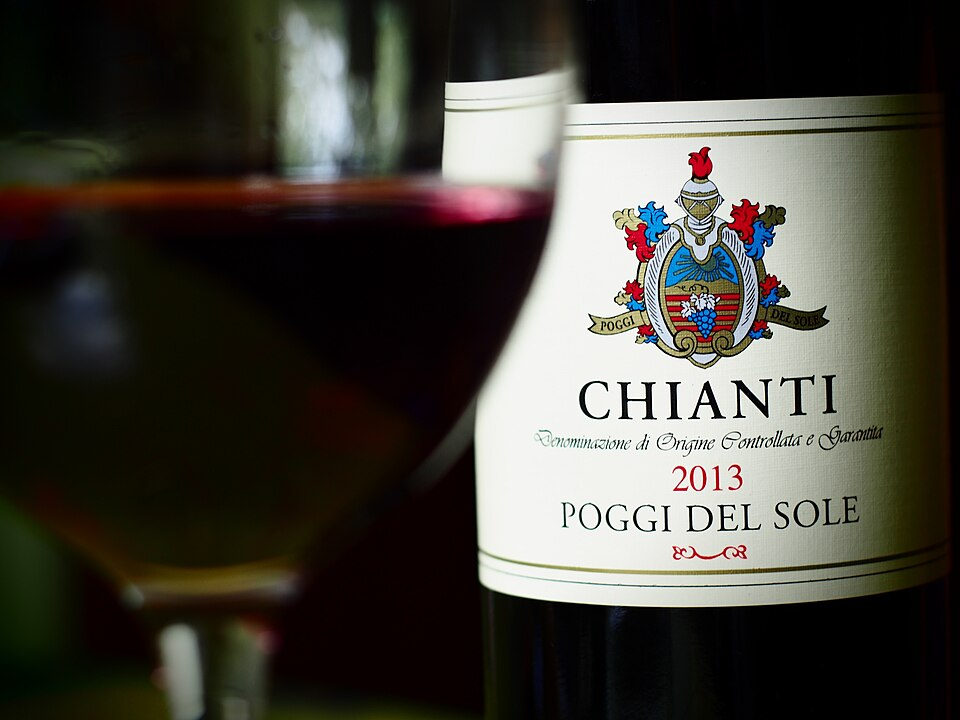
Charateristics of the wine
- Maximum grape yield (t/ha): 9-11 (depending on the wine type or the subzone)
- Minimum natural alcoholic strength % vol.: 10.5-11.5 (depending on the wine type or the subzone)
- Minimum total alcoholic strength % vol.: 11.5-13 (depending on the wine type or the subzone)
- Minimum total acidity: 4.0 g/l
- Minimum non-reducing extract: 16-25 g/l (depending on the wine type or the subzone)
- Grape-to-wine yield: 70
- Maximum wine yield per hectare (hl): 63-77 (depending on the wine type or the subzone)
- Minimum vine density: 4,100-4,500 vines/ha (depending on the wine type or the subzone)
- Release date: From December 1 of the harvest year to September 1 of the following year (depending on the wine type or the subzone)
Introduction
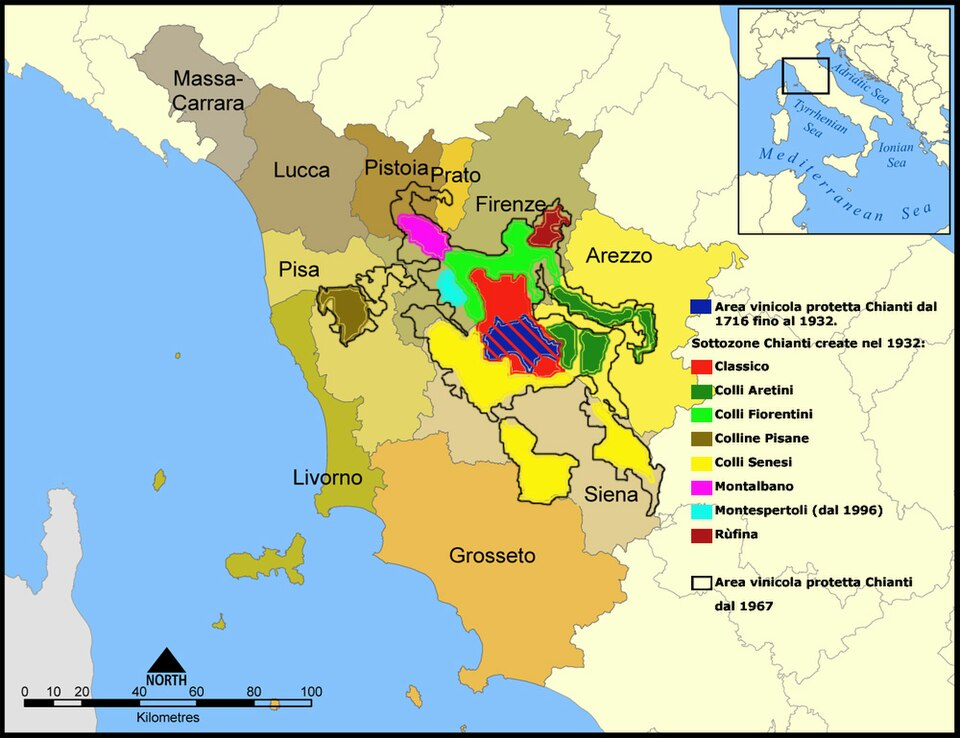
Chianti DOCG covering a broad, predominantly hilly production area in central Tuscany. The denomination was first established as a DOC in 1967 and obtained DOCG status in 1984. Its production area extends across parts of the provinces of Arezzo, Florence, Pistoia, Pisa, Prato and Siena, and is divided into eight recognised subzones: Colli Aretini, Colli Fiorentini, Colli Senesi, Colline Pisane, Montalbano, Montespertoli, Rufina and Terre di Vinci.
The name Chianti DOCG therefore identifies not a single uniform wine, but a family of wines sharing a common geographical origin and regulatory framework. Under the current production specification, the denomination includes Chianti, Chianti Riserva, Chianti Rosé and Chianti Superiore, while the first three may also carry one of the recognised geographical subzone names. These distinctions determine differences in grape composition, production yields, analytical characteristics, ageing requirements and release dates.
Description of Chianti DOCG
The production area occupies the central part of Tuscany, mainly in hilly landscapes influenced by the Apennine system. The specification describes a varied geological environment, including pre-Apennine ridges, Pliocene hills, deposits of the Valdarno Superiore and alluvial formations. Soils may range from clay and clay containing skeletal material to medium-textured and sandy soils, generally with moderate fertility. Vineyards are therefore traditionally located on hillsides whose position and orientation are considered suitable for producing grapes with the characteristics required by the denomination.
The climate is classified within the inner-hill climate of Tuscany, ranging from humid to sub-humid and characterised by a summer water deficit. Average annual rainfall is approximately 867 mm, with July normally being the driest month, while August is generally the warmest, with average temperatures exceeding 23°C. The combination of summer dryness, warmth and adequate sunlight contributes to controlled water stress in the vines and is considered an important factor in the quality and character of the grapes.
For the traditional red wines, Sangiovese must account for 60–100% of the vineyard’s grape composition. Other grape varieties suitable for cultivation in Tuscany may complete the blend. White-berried varieties may not exceed 10%, either individually or collectively, while Cabernet Franc and Cabernet Sauvignon may together account for no more than 15%, reduced to 10% in Chianti Colli Senesi.
The authorized complementary black grape varieties include: Abrusco, Aleatico, Alicante, Alicante Bouschet, Ancellotta, Barbera, Barsaglina, Bonamico, Bracciola nera, Cabernet Franc, Cabernet Sauvignon, Calabrese, Caloria, Canaiolo Nero, Canina nera, Carignano, Carmenere, Cesanese d’Affile, Ciliegiolo, Colombana nera, Colorino, Foglia Tonda, Gamay, Groppello di S. Stefano, Groppello Gentile, Lambrusco Maestri, Malbech, Malvasia nera, Malvasia Nera di Brindisi, Malvasia Nera di Lecce, Mammolo, Mazzese, Merlot, Montepulciano, Mondeuse, Petit Verdot, Pinot Nero, Pollera nera, Prugnolo Gentile, Pugnitello, Rebo, Refosco dal Peduncolo Rosso, Sagrantino, Sanforte, Schiava Gentile, Syrah, Tempranillo, Teroldego, and Vermentino Nero.
The authorized complementary white grape varieties comprise: Albana, Albarola, Ansonica, Biancone, Canaiolo Bianco, Chardonnay, Clairette, Durella, Fiano, Grechetto, Greco, Incrocio Bruni 54, Livornese Bianca, Malvasia Bianca di Candia, Malvasia Bianca Lunga, Malvasia Istriana, Manzoni Bianco, Marsanne, Moscato Bianco, Müller-Thurgau, Orpicchio, Petit Manseng, Pinot Bianco, Pinot Grigio, Riesling Italico, Riesling renano, Roussane, Sauvignon, Sémillon, Traminer Aromatico, Trebbiano Toscano, Verdea, Verdello, Verdicchio Bianco, Vermentino, Vernaccia di S. Gimignano, and Viognier.
Chianti Rosé follows a different ampelographic rule: Sangiovese must represent at least 60%, while the remaining proportion may consist, up to 100% of the blend, of authorised Tuscan varieties. These include Cabernet Franc, Cabernet Sauvignon, Canaiolo, Chardonnay, Ciliegiolo, Colorino, Malvasia Bianca Lunga, Merlot, Montepulciano, Pinot Grigio, Sauvignon, Syrah, Trebbiano Toscano, Vermentino and Vernaccia di San Gimignano.
The denomination places quantitative limits on vineyard production in order to control the concentration and quality of the grapes. For new vineyards with a density above 4,000 vines per hectare, maximum yields range from 9 to 11 tonnes per hectare depending on the subzone and specific production criteria. Vineyards planted at densities below 4,000 vines per hectare are subject to separate, lower yield limits, and the average production may never exceed 3 kg of grapes per vine
The specification requires new vineyards to have at least 4,100 vines per hectare, increased to 4,500 vines per hectare in Chianti Rufina. The producer has considerable freedom in choosing the training system, planting layout and pruning method, provided that these choices do not alter the characteristic qualities of the grapes and wine. The use of a horizontal-roof training system such as the tendone is expressly prohibited. Forced cultivation practices are also forbidden, although emergency irrigation is permitted.
At consumption, the traditional red Chianti DOCG is expected to show a lively ruby colour, becoming increasingly garnet with ageing. Its aroma is intense, sometimes recalling violet, while the palate is dry, savoury and slightly tannic, developing greater softness and a velvety character with maturation. Wines subjected to the traditional governo all’uso Toscano may display greater liveliness and roundness. Chianti Riserva and Superiore maintain this general sensory identity while meeting higher analytical requirements, particularly for alcohol and non-reducing extract.
Chianti Rosé has a fundamentally different sensory profile. It must display a pale pink colour, whose precise hue can vary according to the varieties used. The aroma is delicate but distinctly fruity, reflecting the primary varietal aromas, while the palate is dry, fresh, pleasant and balanced between acidity and polyphenolic structure.
History of Chianti DOCG
The earliest references to a wine called Chianti date back to the 14th century, when viticulture was already established in the Chianti hills near Florence. Earlier, around 1250, a military alliance known as the Lega del Chianti was formed between the towns of Castellina, Gaiole, and Radda, a historical origin that eventually influenced the wine’s name and identity. One of the first written mentions, from 1398, even describes Chianti as a white wine, although other contemporary documents also refer to red versions of the same name.
The first formal attempt to regulate and classify Chianti occurred in 1427, when Florence introduced a tax system for wines from the surrounding countryside, including the broader “Chianti” area. A major turning point came in 1716, when Cosimo III de’ Medici officially defined a restricted production zone including the original league villages, Greve, and a small nearby hillside area, marking the first legally recognised boundaries of Chianti production.
This limited designation remained in place until 1932, when the Italian state significantly expanded the region to include additional surrounding towns, and it was further enlarged in 1967, eventually transforming Chianti into a vast wine-producing area across central Tuscany. Over time, the wine’s identity evolved from a strictly local product into one of Italy’s most widely produced denominations.
By the 18th century, Chianti was clearly recognised as a red wine, although its exact composition remained inconsistent. Historical writings suggest that grapes such as Canaiolo, Sangiovese, and others like Mammolo and Marzemino were commonly cultivated in the region. The modern identity of Chianti, however, began to take shape thanks to Bettino Ricasoli, who promoted a Sangiovese-based blend that laid the foundation for later formulations.
Before Ricasoli’s influence, blends were often dominated by Canaiolo, with Sangiovese and Malvasia Bianca Lunga playing secondary roles. Although Ricasoli is frequently credited with a precise formula, historical evidence does not fully confirm the commonly cited proportions. Over time, winemaking practices diverged, sometimes replacing grapes or altering blends, which led to confusion about the so-called “Ricasoli recipe”. In 1967, DOC regulations loosely reflected his concept by allowing a Sangiovese base with a portion of white grapes such as Malvasia and Trebbiano.
A major regulatory milestone occurred in 1984, when Chianti was elevated to full DOCG status (effective from the 1985 harvest). Later, in 1996, the historic central subzone of Chianti Classico became a fully independent DOCG with its own distinct regulations, officially separating its administration from the broader Chianti DOCG.
The late 19th century brought severe disruption due to vineyard diseases like oidium and phylloxera, followed by economic instability after Italian unification. Many workers emigrated abroad, while those who remained often replanted with high-yield varieties, including Trebbiano and resilient Sangiovese clones. In the post–World War II period, global demand for inexpensive wine encouraged mass production, which further lowered quality standards and damaged Chianti’s reputation, with some blends containing significant amounts of neutral white grapes like Trebbiano.
By the late 20th century, Chianti had become widely associated with its traditional bottle encased in straw, the fiasco, symbolising mass-market wine. At the same time, however, innovative producers began operating outside DOC rules, creating higher-quality wines that became known as the “Super Tuscans”. These winemakers challenged regulations by using 100% Sangiovese, or by blending with international varieties such as Cabernet Sauvignon and Merlot, and by introducing modern techniques like aging in new oak barrels.
Production method for Chianti DOCG
Production begins with grapes harvested from vineyards meeting the geographical, varietal and agronomic requirements of the denomination. The grape yield must remain within the limits prescribed for the relevant typology or subzone, and the grapes must reach the required minimum natural alcoholic strength. For new vineyards, full authorised production is reached from the fourth vegetative year, while production in the third year may not exceed 60% of the applicable maximum.
The grapes are then transported to the winery and processed according to the traditional winemaking practices recognised for Chianti DOCG. The specification permits only local, fair and consistent oenological practices. Importantly, the disciplinary document does not prescribe a single universal fermentation temperature, maceration duration, yeast strain, vessel type or extraction regime. These parameters therefore remain part of the producer’s technical choices, provided that the resulting wine complies with the denomination’s requirements.
Where the different grape varieties are vinified separately, the individual wines must subsequently be assembled into the definitive Chianti blend before the producer requests analytical and organoleptic certification and, in any case, before the wine leaves the producer’s winery. This ensures that the final certified product corresponds to the composition declared for the denomination.
One of the traditional techniques specifically recognised by the specification is the governo all’uso Toscano. This consists of a slow secondary fermentation of newly racked wine using slightly dried grapes belonging to the grape varieties authorised for the relevant wine. The technique can contribute additional liveliness and roundness to the finished red wine. It is, however, not permitted for Chianti Rosé.
Enrichment is permitted when carried out according to the applicable Italian rules, but it does not remove the 70% maximum grape-to-wine yield requirement. Any authorised enrichment products exceeding that yield must be accompanied by the removal of an equivalent quantity of original Chianti DOCG from the relevant production accounting, subject to the conditions established by the specification.
After vinification, the wine follows the maturation regime appropriate to its final designation. Chianti Riserva requires at least two years of ageing, calculated from 1 January following the vintage.
For wines carrying a subzone reference, the grapes must be harvested and vinified within the respective delimited production territory. Vinification, ageing, bottling and any required bottle refinement may nevertheless take place in authorised wineries outside the grape-production area, provided that they are located within the provinces and neighbouring areas specifically permitted by the specification.
Finally, the finished wine must be packaged in containers appropriate to the traditional character of a quality wine. Where the traditional Tuscan fiasco is used, only the prescribed traditional form is permitted and used fiaschi are prohibited. Chianti Rosé cannot be bottled in a fiasco. For wines carrying the Riserva designation, only a flush-fitting closure is permitted; crown caps and pull-off capsule systems are prohibited for all Chianti DOCG wines.
Classification of Chianti DOCG
Based on its subzones and specific production criteria, Chianti DOCG is categorized into:
- Chianti DOCG (Chianti CGDO)
- Chianti Riserva DOCG (Reserve Chianti GCDO)
- Chianti Rosé DOCG (Rosé Chianti CGDO)
- Chianti Superiore DOCG (Superior Chianti CGDO)
- Chianti Colli Aretini DOCG
- Chianti Colli Aretini Riserva DOCG
- Chianti Colli Aretini Rosé DOCG
- Chianti Colli Fiorentini DOCG
- Chianti Colli Fiorentini Riserva DOCG
- Chianti Colli Fiorentini Rosé DOCG
- Chianti Colli Senesi DOCG
- Chianti Colli Senesi Risvera DOCG
- Chianti Colli Senesi Rosé DOCG
- Chianti Colline Pisane DOCG
- Chianti Colline Pisane Riserva DOCG
- Chianti Colline Pisane Rosé DOCG
- Chianti Montalbano DOCG (Montalbano Chianti CGDO)
- Chianti Montalbano Riserva DOCG (Montalbano Reserve Chianti CGDO)
- Chianti Montalbano Rosé DOCG (Rosé Montalbano Chianti CGDO)
- Chianti Montespertoli DOCG
- Chianti Montespertoli Riserva DOCG
- Chianti Montespertoli Rosé DOCG
- Chianti Rufina DOCG
- Chianti Rufina Riserva DOCG
- Chianti Rufina Rosé DOCG
- Chianti Terre di Vinci DOCG
- Chianti Terre di Vinci Riserva DOCG
- Chianti Terre di Vinci Rosé DOCG
Nutritional facts table
Nutritional values are not specified in the guidelines. You may refer to the average nutritional facs table for standard ordinary wine.
Source(s):
https://it.wikipedia.org/wiki/Chianti_DOCG
https://en.wikipedia.org/wiki/Chianti
http://catalogoviti.politicheagricole.it/scheda_denom.php?t=dsc&q=1022
Photo(s):
1. Petar Milošević, CC BY-SA 4.0 https://creativecommons.org/licenses/by-sa/4.0, via Wikimedia Commons
2. User:Kattivik, CC BY-SA 3.0 http://creativecommons.org/licenses/by-sa/3.0/, via Wikimedia Commons