
Tuvalu 🇹🇻
Country in Oceania
Introduction
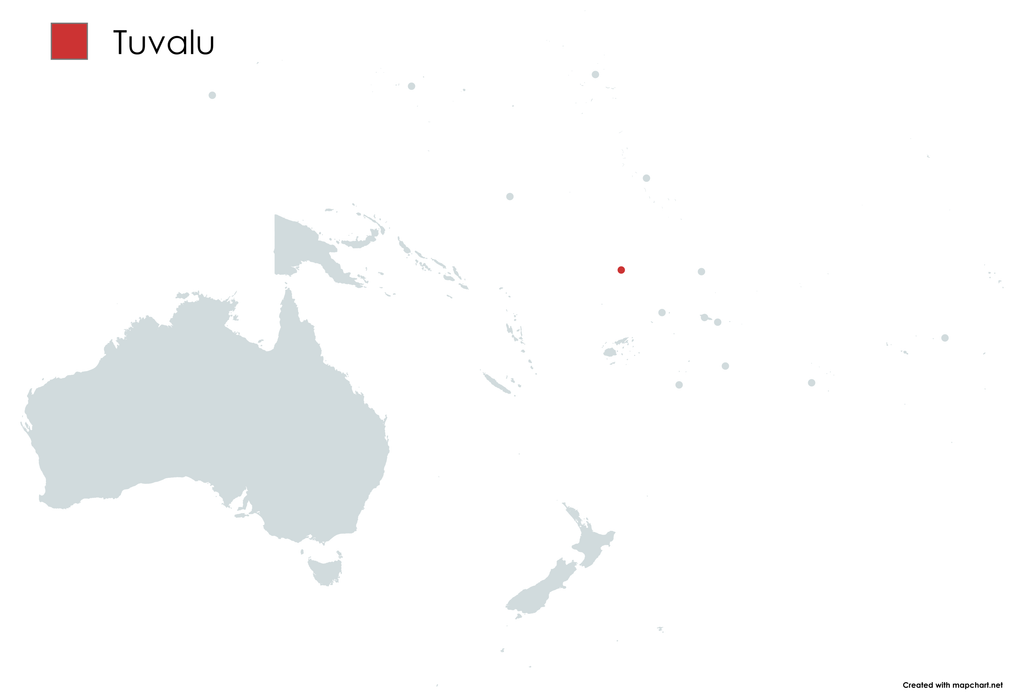
Tuvalu is an archipelagic country in Polynesia, within Oceania, located in the central Pacific Ocean roughly halfway between Hawaii and Australia. It is surrounded by several Pacific island groups and countries, including Kiribati, Nauru, Vanuatu, Fiji, Samoa, Tokelau, and Wallis and Futuna. The country consists of three reef islands and six atolls, scattered between approximately 5° and 10° south latitude and 176° and 180° east longitude, all west of the International Date Line. With a land area of only 25.14 km² (9.71 sq mi), Tuvalu is the fourth-smallest country in the world, after Vatican City, Monaco, and Nauru.
| Official name | Tuvalu |
| Capital | Funafuti |
| Government | Constitutional monarchy |
| Area (km² / sq mi) | 26.26 (10.14) |
| Population | 10,643 (2022) |
| Official language(s) | Tuvaluan and English |
| Demonym(s) | Tuvaluan |
| Currency | Australian dollar (AUD) and Tuvaluan dollar (TVD) |
| Anthem | “Tuvalu mo te Atua” (Tuvalu for the Almighty) |
| Flag | 🇹🇻 |
| Flag meaning | The light-blue field represents the Pacific Ocean; the Union Jack reflects Tuvalu’s historical ties with the United Kingdom, while the nine yellow stars represent the country’s nine main islands. |
History of Tuvalu
Tuvalu’s population descends from Polynesian migrations into the Pacific, which began roughly 3,000 years ago. Regular canoe voyages connected the islands with neighbouring Samoa and Tonga. Eight of the nine islands were traditionally inhabited, giving rise to the name Tuvalu, meaning “eight standing together.” Traditional stories differ between islands, with ancestral origins variously associated with Samoa and Tonga, while the creation myth of te Pusi mo te Ali attributes the formation of the islands to an eel and a flounder.
European contact began in 1568, when Spanish explorer Álvaro de Mendaña sighted Nui, followed by further European voyages during the 18th and early 19th centuries. British, French, Russian, Dutch and American navigators gradually charted the islands, while whalers and traders began visiting them. From the 1850s, European traders established settlements on several islands, although their presence declined by the early 20th century. Scientific expeditions also visited Tuvalu, notably the United States Exploring Expedition in 1841 and the Royal Society’s coral-reef drilling expeditions of 1896–1898, which investigated the geological formation of atolls and produced important ethnographic and photographic records.
Christianity arrived in 1861, when the Polynesian missionary Elekana reached Nukulaelae after drifting across the Pacific. Protestant missionaries subsequently expanded their activities, and by 1878 Christianity was well established throughout the islands. Samoan missionaries played an important role in the development of the local language and music. During the same period, Tuvalu was affected by the blackbirding trade: in 1862–1863, Peruvian ships forcibly or deceptively recruited islanders for labour in Peru, causing severe population losses on several islands.
In 1892, Britain established a protectorate over the Ellice Islands, which were subsequently administered together with the Gilbert Islands. The territory became the Gilbert and Ellice Islands Crown Colony in 1915. During the Second World War, the Ellice Islands supported the Allied war effort. American forces established military facilities and airfields on Funafuti, Nanumea and Nukufetau, while local inhabitants assisted with construction and logistics. Funafuti served as an important staging base for operations against Japanese-held islands in the Gilbert Islands.
After the war, decolonisation and self-government gradually transformed the territory. A 1974 referendum supported separate administrations for the Gilbert and Ellice Islands, and Tuvalu became a separate British Crown Colony in 1975, with its own administration established in 1976. The Tuvaluan dollar was introduced in 1976 alongside the Australian dollar. On 1 October 1978, Tuvalu achieved independence, with Toaripi Lauti becoming its first prime minister.
Since independence, Tuvalu has strengthened its international presence, joining the United Nations in 2000. Rising sea levels and climate change have become major national concerns; in 2022, the government announced plans to preserve Tuvalu’s cultural heritage through a digital representation in the metaverse. In 2023, Tuvalu and Australia signed the Falepili Union, addressing climate change, security and climate-related mobility, including an Australian pathway for 280 Tuvaluan citizens per year to relocate to Australia. In 2025, Tuvalu also ratified the High Seas Treaty, reinforcing its commitment to protecting marine ecosystems.
Geography of Tuvalu
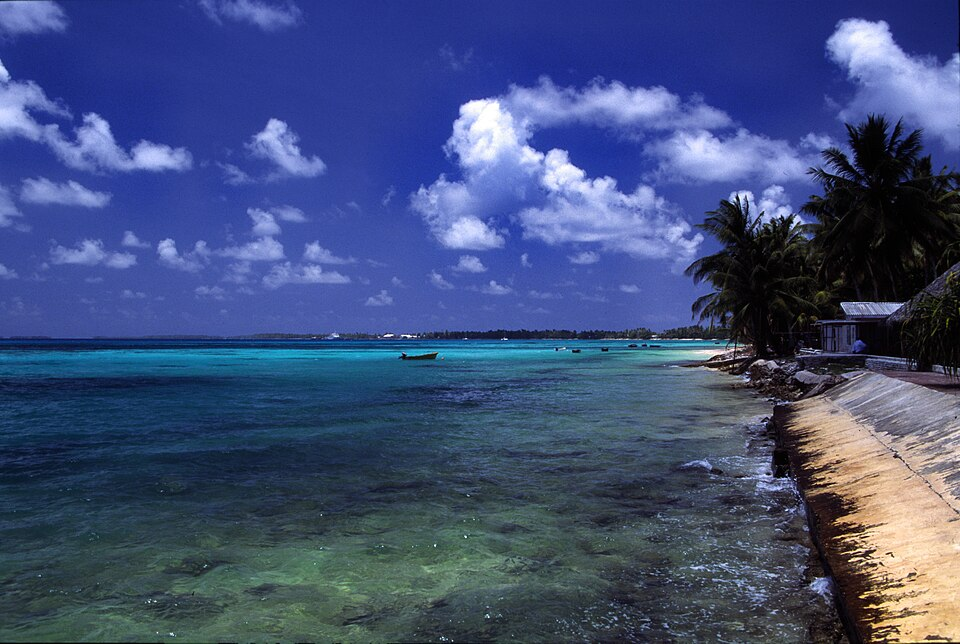
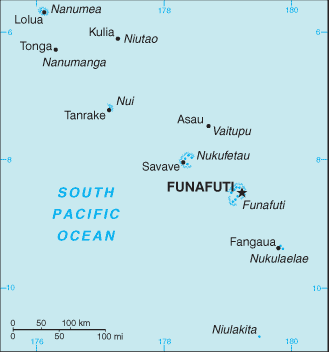
Tuvalu is a low-lying volcanic archipelago made up of three reef islands—Nanumanga, Niutao and Niulakita—and six true atolls: Funafuti, Nanumea, Nui, Nukufetau, Nukulaelae and Vaitupu. Its highest point, on Niulakita, reaches just 4.6 m (15 ft) above sea level, making the islands particularly vulnerable to storm surges, cyclones and sea-level rise. Despite their low elevation, Tuvalu’s islands have experienced some net growth in land area through the redistribution and accumulation of sediment. Funafuti, the largest atoll, surrounds a large central lagoon, while Tuvalu’s marine environment supports a rich diversity of coral-reef species.
Vegetation is dominated by cultivated coconut woodland, while native broadleaf forest occupies a much smaller proportion of the land. Human activity has significantly altered parts of Funafuti: during World War II, coral was excavated to build the airport and other infrastructure, creating borrow pits that affected freshwater resources and shoreline dynamics. More recently, these pits have been filled with dredged lagoon sand, increasing usable land, while further coastal reclamation and adaptation projects have created elevated platforms intended to remain above projected sea levels and storm waves.
Tuvalu faces major environmental pressures, including coral bleaching, declining fish stocks, pollution, inadequate sanitation and plastic waste. Rising ocean temperatures have damaged coral reefs, prompting restoration programmes designed to strengthen coastal ecosystems. Population pressure has also increased demand for marine resources, although the Funafuti Conservation Area protects part of the lagoon from fishing.
Climate change poses an especially serious threat because most of Tuvalu’s land lies only a few metres above sea level. Rising seas contribute to coastal flooding, saltwater intrusion and contamination of freshwater, particularly during unusually high tides. Although studies have found that some islands have actually increased in area through sediment accumulation, this does not necessarily mean that they have gained additional habitable land.
Tuvalu has therefore developed adaptation programmes, including the National Adaptation Programme of Action and the Tuvalu Coastal Adaptation Project, which focus on strengthening coastlines, improving water security, protecting agriculture and fisheries, and preparing communities for climate-related hazards. The country has also pursued international action on climate change, including calls for a transition away from fossil fuels.
Because of its extremely low elevation, Tuvalu is highly exposed to tropical cyclones and storm surges. Major storms have repeatedly damaged homes, crops, infrastructure and freshwater supplies; Cyclone Pam in 2015, for example, caused extensive flooding and agricultural losses. The impact of cyclones is intensified when they coincide with exceptionally high tides. King tides, or unusually high perigean spring tides, can themselves flood low-lying areas and become even more damaging when combined with sea-level rise, storms or La Niña conditions.
Freshwater is another major challenge. Rainwater harvesting is the country’s principal source of drinking water, while only a few islands possess reliable groundwater supplies. On Funafuti, desalination plants supplement rainwater during shortages, although their operation and water distribution are costly. Tuvalu has also introduced national water-management policies and programmes to improve storage and access to safe water. In terms of sanitation, efforts have focused on composting toilets and improved sewage treatment, since leaking septic systems can contaminate the freshwater lens beneath the atolls as well as surrounding marine waters.
Climate
Tuvalu has two main seasons: a wet season from November to April, locally known as Tau-o-lalo, and a dry season from May to October. The wetter months are generally marked by strong westerly winds and heavy rainfall, while the dry period is influenced by more moderate easterly winds and consistently warm tropical temperatures. The climate is also affected by El Niño and La Niña, which result from variations in Pacific Ocean temperatures. El Niño generally raises the likelihood of tropical storms and cyclones, whereas La Niña is associated with a greater risk of drought. Rainfall is typically substantial, with the islands receiving around 200–400 mm (8–16 in) per month, although precipitation varies according to these large-scale Pacific climate patterns.
Society of Tuvalu
Demography
Tuvalu has a small population, which rose from 9,561 in 2002 to 10,645 in 2017, before reaching 10,643 in the 2022 census. More recent estimates indicate a decline to around 9,316 people in 2026. The population is overwhelmingly Polynesian, although approximately 5.6% are Micronesian, particularly Gilbertese-speaking communities on Nui. Life expectancy is higher for women than men, at about 70.2 and 65.6 years, respectively, according to 2018 estimates.
Population movements have long been influenced by employment, family connections and opportunities abroad rather than solely by climate change. Between 1947 and 1983, some Tuvaluans from Vaitupu settled on Kioa in Fiji, where their descendants later obtained Fijian citizenship. More recently, New Zealand and Australia have become the main destinations for migration and seasonal employment.
Tuvaluans have access to several migration and seasonal-work programmes in Australia and New Zealand. New Zealand introduced the Pacific Access Category, providing a quota of places for Tuvaluan migrants, while seasonal employment schemes offer opportunities in horticulture, viticulture and other industries. Australia has similarly provided seasonal work opportunities, particularly in agriculture, fisheries and tourism.
The possibility of treating climate-related displacement as a form of refugee status has also been debated. In 2014, a Tuvaluan family successfully obtained residence in New Zealand, although the decision was based on humanitarian circumstances and family integration, rather than recognition as climate refugees. Earlier, a claim by a Kiribati citizen seeking refugee protection because of environmental change had been rejected, as the circumstances did not meet the legal requirements of the 1951 Refugee Convention.
A major development came with the Falepili Union, signed by Tuvalu and Australia in November 2023. Among other commitments, the agreement established a pathway allowing Tuvaluan citizens to migrate to Australia in response to climate-related impacts, making climate mobility an increasingly important element of Tuvalu’s relationship with Australia.
Languages
Tuvalu has two national languages: Tuvaluan and English. Tuvaluan belongs to the Ellicean branch of the Polynesian languages and is related to languages such as Hawaiian, Māori, Tahitian, Samoan and Tongan. It is particularly close to several Polynesian outlier languages found in Micronesia and northern and central Melanesia. Its vocabulary has also been influenced by Samoan, largely because many Christian missionaries active in Tuvalu during the late 19th and early 20th centuries came from Samoa.
Tuvaluan is spoken by virtually the entire population, while a Micronesian language closely related to Gilbertese is traditionally used on Nui, reflecting the atoll’s distinct linguistic heritage. Although English has official status, it is not widely used in everyday conversation; Tuvaluan is the main language of parliament and official functions.
Religions
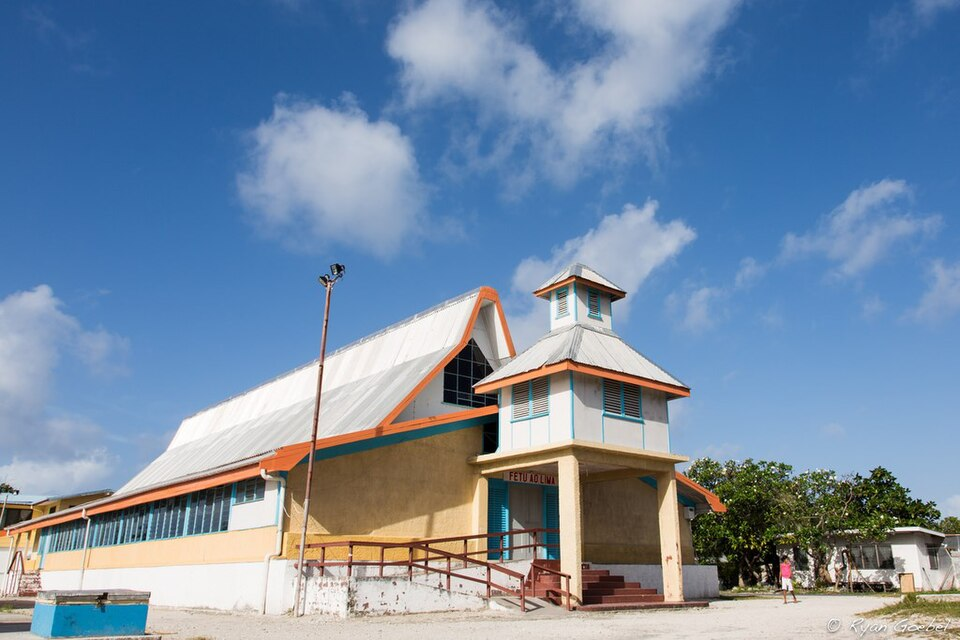
Tuvalu is overwhelmingly Christian, with the Congregational Christian Church of Tuvalu, rooted in the Calvinist tradition, serving as the country’s state church. Around 86% of the population belonged to it according to the 2022 census. Its official status is largely ceremonial, giving it the privilege of conducting special religious services during major national occasions. Other Christian denominations include the Tuvalu Brethren Church (3%), Seventh-day Adventists (2%), and the Catholic community (1%).
The country’s Constitution guarantees freedom of religion, including the right to practise or change one’s faith, to decline religious instruction or ceremonies at school, and to refuse oaths or affirmations that conflict with one’s beliefs. The largest non-Christian religion is the Baháʼí Faith, followed by about 1% of the population, with communities on Nanumea and Funafuti. The Ahmadiyya Muslim Community has around 50 members, or approximately 0.4% of the population.
Before the arrival of Christianity, Tuvaluans practised forms of animism and ancestor worship, with religious traditions differing between islands. The vaka-atua, or traditional priests, played an important role in these belief systems. The spread of Christianity during the 19th century largely replaced the worship of ancestral spirits and traditional deities, bringing the islands’ earlier religious practices to an end.
Economy of Tuvalu
Tuvalu has the smallest GDP of any sovereign state and an economy constrained by its small population, limited resources and exposure to external shocks. Growth was relatively strong between 1996 and 2002, averaging about 5.6% annually, but later slowed. After significant contractions during the COVID-19 pandemic, GDP recovered by 7.9% in 2023, with growth expected to moderate to around 2.1% in 2026. The economy remains vulnerable to climate change, emigration and global economic conditions.
The main economic activities are fishing, government services and remittances from Tuvaluans working abroad, particularly in Australia and New Zealand. Seafaring is also important, with many adult men employed on foreign merchant ships, while agriculture is mainly subsistence-based, focusing on coconuts and pulaka. Government revenues come largely from fishing licences, the Tuvalu Trust Fund and the “.tv” internet domain, supplemented by postal services, the ship registry and international development assistance.
The Tuvalu Trust Fund, established in 1987 with support from the United Kingdom, Australia and New Zealand, provides an important financial reserve whose returns can help fund government expenditure. Tuvalu is classified by the United Nations as a least developed country, reflecting its limited economic opportunities and high vulnerability to environmental and external economic shocks. The country has sought continued international assistance for climate-change adaptation.
Tourism is still limited because of Tuvalu’s remoteness. Funafuti is the main destination, as it has the country’s only airport and hotel facilities, although tourist infrastructure remains modest. Ecotourism, particularly in the Funafuti Conservation Area, is an important attraction. The outer islands can be reached by the passenger-cargo vessels Nivaga III and Manu Sina, which also provide access to local guesthouses.
Culture of Tuvalu
Traditional Tuvaluan architecture relied heavily on locally available plants, including pouka, ngia, miro, tonga and fau, while coconut fibre, ferra and pandanus were used for ropes and other materials. Buildings were traditionally assembled without nails, with components tied together using hand-plaited sennit rope made from dried coconut fibre. European contact introduced nails, iron and corrugated metal roofing, while modern construction mainly uses imported timber and concrete. Community buildings and churches are often coated with lase, a white substance produced by burning dead coral and mixing the resulting powder with water.
Tuvaluan traditional art is particularly associated with women’s handicrafts, using cowrie shells, mats, fans and crochet (kolose). Decorative clothing—including titi skirts, teuga saka tops, headbands and bracelets—is still worn during traditional performances. Traditional motifs also appear in everyday objects such as canoes and fishing hooks. Contemporary artists have also incorporated issues such as climate change into their work.
Traditional music and dance include fakaseasea, fakanau and especially the fatele, which is performed during community celebrations and important occasions. Tuvaluan musical culture combines older Polynesian traditions with more contemporary influences.
Much of Tuvalu’s traditional community structure remains important. Families traditionally have specific responsibilities, or salanga, such as fishing, building houses and defending the community, with these skills passed between generations. Most islands also have a community-owned shop called a fusi, while the falekaupule or maneapa serves as the traditional meeting hall for discussing important matters, holding weddings and organising community celebrations. Falekaupule also refers to the island’s council of elders, whose decisions are based on aganu, the traditional customs and culture of the island.
The paopao is Tuvalu’s traditional single-outrigger canoe, generally carved from a single log and historically capable of carrying several people. Different islands developed distinctive designs: the canoes of Vaitupu and Nanumea were mainly adapted for paddling across reefs, whereas those of Nui were designed for sailing on its lagoon and featured a distinctive double-ended hull and longer outrigger booms for greater stability.
Cuisine of Tuvalu
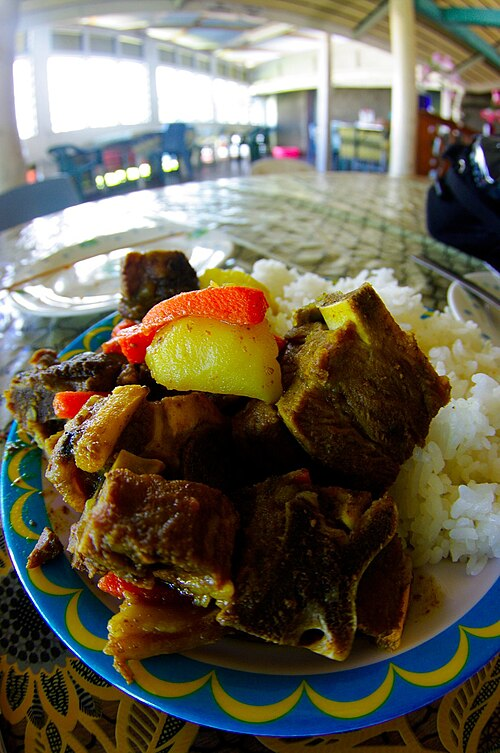
Tuvaluan cuisine is shaped by the islands’ Pacific environment, with coconut, seafood and locally grown crops forming its traditional foundation. Although each island has some dietary differences, food culture generally reflects the availability of marine resources and crops adapted to the atoll environment. British colonial influence also introduced some foreign foods and culinary practices.
History
Tuvalu’s relative isolation limited the influence of neighbouring cuisines, while its period as a British colony introduced some British elements. A major change occurred during and after World War II, when American forces brought large quantities of imported food, including canned products. This encouraged greater consumption of rice, corned beef and sugar and contributed to the decline of traditional agriculture. Rising sea levels and saltwater intrusion now threaten pulaka cultivation, while changing eating habits have also reduced reliance on traditional foods. The growing consumption of imported, sugary and processed foods has been associated with increasing diabetes, hypertension and cardiovascular disease.
Common ingredients
Coconut is central to Tuvaluan cooking and is consumed as flesh, water, milk or cream, while coconut syrup and fermented sap (toddy) are also used. Pulaka, a swamp crop related to taro, is an important source of carbohydrates and is traditionally cultivated in large pits filled with composted soil. Other staple crops include bananas, breadfruit and taro. Fish and other seafood provide the main source of protein, supplemented by coconut crab, birds and pork. Rice and other imported foods have become increasingly common, particularly on Funafuti.
Common dishes
Pulaka is normally cooked, often in an earth oven, because its raw corms are toxic. Regional preparations include tulolo, made from beaten pulaka pulp with coconut cream, and fakapapa and tulolo pulaka, which use different preparations of the corm. Fekei consists of grated pulaka wrapped in its leaves, steamed and combined with coconut cream. Palusami, also known as samoa, is made from taro leaves filled with coconut cream, lime juice and onion, and is commonly served with taro or breadfruit. Puleleti is a sweet prepared from dried coconut and coconut syrup.
Culinary traditions and customs
Food remains closely connected to community celebrations. Pork, for example, is especially associated with fateles, traditional celebrations featuring singing and dancing. Diets vary between the islands: Funafuti has greater access to seafood and meat, whereas the outer islands rely more heavily on traditional crops such as taro and pulaka. Coconut-based desserts are also traditionally prepared using coconut milk or cream instead of animal milk.
Administrative and geo-cultural divisions of Tuvalu
Due to its extremely small territory, Tuvalu is not divided into distinct geocultural regions, as geographical and cultural differences within the country are too limited to justify such subdivisions.
Administratively, however, Tuvalu is divided into 9 districts:
- Funafuti
- Nanumanga
- Nanumea
- Niulakita
- Niutao
- Nui
- Nukufetau
- Nukulaelae
- Vaitupu
Traditional recipes of Tuvalu
(Only recipes unique to the area or strongly associated with it and rarely found elsewhere are included)
Traditional products of Tuvalu
(Only products unique to the area or strongly associated with it and rarely found elsewhere are included)
Recipes commonly prepared in Tuvalu
(Only products specific to this territorial level, and not already covered at a broader administrative or geocultural level, are included)
Products commonly consumed in Tuvalu
(Only recipes specific to this territorial level, and not already covered at a broader administrative or geocultural level, are included)

Source(s):
https://en.wikipedia.org/wiki/Tuvalu
https://en.wikipedia.org/wiki/Tuvaluan_cuisine
Photo(s):
1. Map created with https://www.mapchart.net
2. Stefan Lins, CC BY-SA 2.0 https://creativecommons.org/licenses/by-sa/2.0, via Wikimedia Commons
3. CIA, Public domain, via Wikimedia Commons
4. Jobas, CC BY-SA 4.0 https://creativecommons.org/licenses/by-sa/4.0, via Wikimedia Commons
5. INABA Tomoaki, CC BY-SA 2.0 https://creativecommons.org/licenses/by-sa/2.0, via Wikimedia Commons