
Micronesia (geo-cultural region)
Introduction
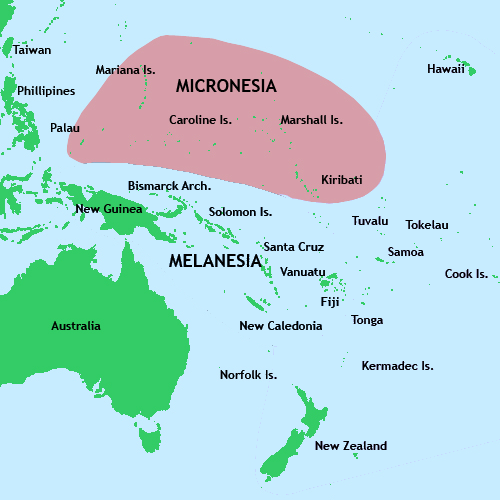
Micronesia is a subregion of Oceania comprising around 2,000 small islands in the north-western Pacific Ocean. It has historical and cultural links with Maritime Southeast Asia, Polynesia and Melanesia, as well as the wider Austronesian world. The region has a tropical marine climate and includes four main island groups: the Caroline, Gilbert, Mariana and Marshall Islands, along with several smaller islands. Despite its established name, Micronesia is not a unified geographical, ethnic, linguistic or cultural region. Its populations are diverse, with different societies connected mainly through their broader Austronesian heritage.
History of Micronesia
The Northern Mariana Islands were among the earliest parts of Oceania settled by Austronesian peoples, who arrived from the Philippines around 1500 BCE. Their subsequent migrations spread southward through the Bismarck Archipelago and Solomon Islands, then toward Vanuatu, Fiji, and New Caledonia, contributing to the origins of the Polynesian peoples. Other Austronesian groups later reached Palau and Yap, while around 200 BCE further settlers from Island Melanesia established communities across eastern Micronesia.
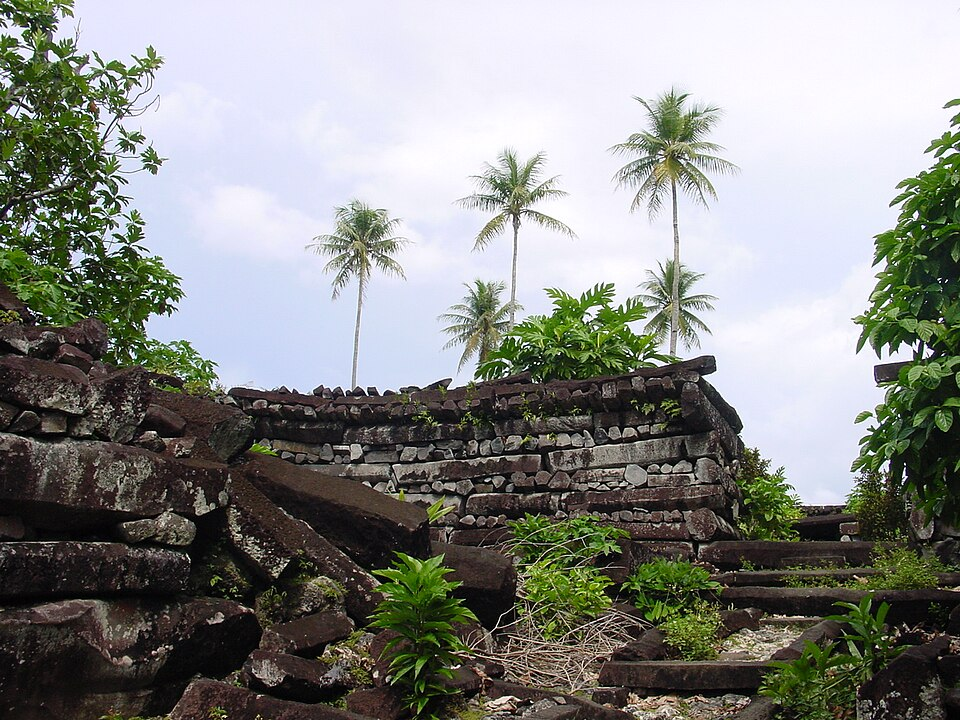
Around 800 CE, another migration from Southeast Asia reached the Marianas, inaugurating the Latte period. These inhabitants constructed monumental structures supported by distinctive stone pillars and reintroduced rice cultivation, although rice initially remained a ceremonial and prestigious crop rather than a staple food. In central Micronesia, major megalithic complexes were subsequently built, including Nan Madol on Pohnpei from about 1180 CE and the Leluh complex on Kosrae around 1200.
European contact began in 1521, when the expedition of Ferdinand Magellan reached the Marianas. During the following century, European voyages gradually explored other parts of Micronesia, including the Caroline Islands, Yap, and the Marshall Islands. From the early 17th century, Spain established colonial control over Guam, the Northern Marianas, and the Caroline Islands, incorporating them into the Spanish East Indies administered from the Philippines. Christian missionaries arrived mainly during the 19th century, contributing to the conversion of many island populations.
Following the Spanish–American War, Spain transferred its remaining Micronesian possessions to Germany through the German–Spanish Treaty of 1899. Germany consequently controlled the Caroline and Mariana Islands, while Nauru had already been annexed. By the beginning of the 20th century, Micronesia was divided among the United States, Germany, and Britain, with their respective territories including Guam and Wake Island, the Marshall and Caroline Islands, Nauru, and the Gilbert Islands.
During World War I, Germany’s Pacific possessions were seized and later transformed into League of Nations mandates. Nauru was administered under an Australian mandate, while most of Germany’s former Micronesian territories were assigned to Japan as the South Seas Mandate. During World War II, Japanese forces occupied several islands, including Nauru and Banaba, before Japan’s defeat brought a major political reorganization of the region. The former Japanese mandate subsequently became a United Nations Trust Territory, administered by the United States. Nauru became independent in 1968. Today, most of Micronesia consists of independent states, although several territories remain under U.S. administration.
Geography of Micronesia
The Caroline Islands form a widely dispersed chain of roughly 500 small islands, situated east of the Philippines and north of New Guinea. They are divided mainly between the Federated States of Micronesia, occupying the eastern part of the archipelago, and Palau in the west. The Gilbert Islands, belonging to Kiribati, consist of 16 atolls and coral islands arranged roughly from north to south, with the equator separating their northern and southern sections. Tarawa, the country’s capital, is among the most important islands of the group.
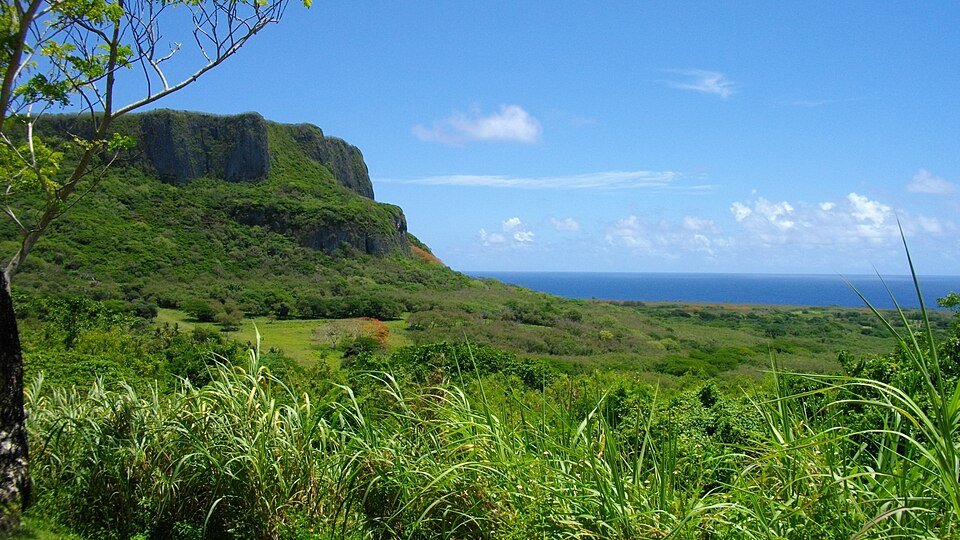
The Mariana Islands form a curved chain of 15 volcanic islands, created by the movement and subduction of tectonic plates along one of the world‘s most active volcanic boundaries. Their political history reflects successive colonial powers: Guam became a U.S. possession in 1898, while Spain transferred the remaining islands to Germany in 1899. After World War I they passed to Japan under a League of Nations mandate, and after World War II they entered the U.N. Trust Territory administered by the United States. In 1976, the Northern Mariana Islands established a political union with the United States and became a commonwealth, with their inhabitants receiving U.S. citizenship.
The Marshall Islands lie east of the Federated States of Micronesia and north of Nauru and Kiribati. They contain 29 low-lying atolls and five isolated islands, traditionally grouped into the Ratak and Ralik Chains, meaning roughly “sunrise” and “sunset.” The country is a presidential republic in free association with the United States, with an economy based largely on services, fishing, and agriculture. Most of its atolls are inhabited. Bikini Atoll is particularly notable for the extensive nuclear weapons testing conducted there by the United States during the 20th century, which destroyed or severely altered several islands.
Nauru is a very small, oval-shaped island republic in the southwestern Pacific, covering only about 21 km² (8 sq mi). Located south of the equator, it is surrounded by a coral reef and has a narrow, relatively fertile coastal zone. Its extremely limited land area makes it one of the world‘s smallest countries by territory.
Wake Island is a small coral atoll north of the Marshall Islands and is administered as an unincorporated U.S. territory. Access is restricted and the island is managed by the U.S. Air Force. Although Micronesians may have reached it in prehistoric times, there is no clear evidence of permanent settlement, and it is therefore generally excluded from the region on ethnocultural grounds.
Most Micronesian islands are coral atolls, which developed around volcanic islands as coral reefs continued growing while the underlying volcanoes gradually subsided. Pohnpei is an important exception because its central volcanic structure remains above sea level and is surrounded by coral reefs. Yap has a different geological origin, consisting partly of uplifted volcanic and metamorphic rocks shaped by complex tectonic activity around the Yap Trench.
Micronesia also contains distinctive endemic wildlife. The Yap Islands, for example, support several bird species found nowhere else or within very restricted areas, including the Yap monarch and Olive white-eye. The islands are also home to the endangered Yap flying fox, a locally endemic bat.
Climate
Micronesia has a tropical marine climate, moderated by seasonal northeast trade winds. Temperatures remain relatively stable throughout the year, with little seasonal variation. The region is generally hot and humid, with daytime temperatures of around 30–32 °C (86–90 °F) and nighttime lows of approximately 23–25 °C (73–77 °F). The dry season usually extends from December or January through June, while the rainy season occurs from July until November or December. Depending on their location, some islands may also experience typhoons during the wetter part of the year.
Society of Micronesia
Demography
The population of Micronesia is made up of numerous ethnic groups with diverse origins, although they share a broader Micronesian cultural heritage. Historical migrations have created strong connections with peoples from Melanesia, the Philippines, Southeast Asia, and Polynesia, while genetic evidence also indicates some Japanese ancestry among Micronesian populations. The region additionally contains significant Asian communities, as well as smaller populations of European origin.
The Carolinian people are traditionally believed to descend from migrations originating in Southeast Asia and Indonesia several thousand years ago. Their language, Carolinian (Refaluwasch), has around 5,700 speakers. Carolinian society traditionally places strong importance on matriarchal structures and respect for elders, particularly women serving as family matriarchs. Most Carolinians are Roman Catholic. Significant migration to Saipan began in the early 19th century, when Carolinian islanders moved there by canoe following the severe decline of the local Chamorro population under Spanish rule.
The Chamorro people are the indigenous population of the Mariana Islands, particularly Guam and the Northern Mariana Islands. Their ancestors are generally thought to have arrived from Southeast Asia around 2000 BCE and are closely related to Austronesian populations in the Philippines, Taiwan, and the Caroline Islands. The Chamorro language belongs to the Malayo-Polynesian branch of the Austronesian language family. Centuries of Spanish colonial rule left a strong linguistic influence, with numerous Spanish loanwords entering Chamorro and Spanish numerals replacing the traditional counting system.
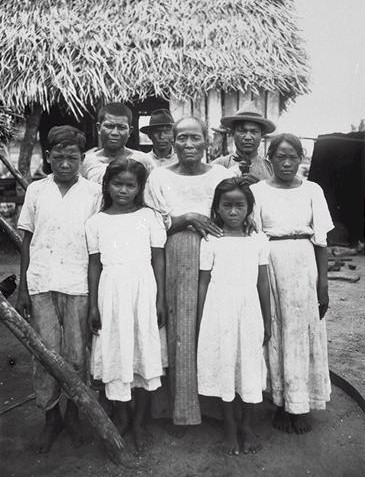
The Chuukese are one of the largest ethnic groups in Micronesia and constitute roughly 48% of the population of the Federated States of Micronesia. They originate from the islands and atolls of Chuuk, historically also known as Truk, and speak the Chuukese language.
The Nauruan people inhabit the island nation of Nauru and have a complex ancestry that is not fully established. They are generally considered to represent a mixture of different Pacific populations, possibly including Polynesian and Melanesian groups who reached the island through ancient maritime migrations.
The Kaping people, or Kapings, live on the extremely remote Kapingamarangi Atoll in the Federated States of Micronesia. Around 3,000 people are associated with the community, whose isolated home lies approximately 320 km (200 mi) from the nearest point of immigration. The atoll has historically lacked regular air connections, making travel difficult and contributing to its geographical isolation. The community speaks Kapingamarangi, while migration for education from the 1970s onward led to the establishment of Kaping communities on Pohnpei.
Languages
The main linguistic group in Micronesia consists of the Micronesian languages, which belong to the Oceanic branch of the Austronesian family. They ultimately developed from Proto-Oceanic, itself descended from earlier Austronesian languages through Proto-Malayo-Polynesian. This group includes Marshallese, Gilbertese, Kosraean, and Nauruan, together with the larger Chuukic–Pohnpeic subgroup, which contains eleven languages.
In the eastern Federated States of Micronesia, Nukuoro and Kapingamarangi are notable as western outliers of the Polynesian language branch, showing the wider linguistic connections between Micronesia and Polynesia. Two other important languages, Chamorro and Palauan, have a different classification. Although they are spoken in Micronesia, they are Malayo-Polynesian languages outside the Oceanic branch: Chamorro is spoken mainly in the Mariana Islands, while Palauan is the principal indigenous language of Palau.
Religions
Christianity is by far the main religion in Micronesia, followed by around 93% of the population. Among Christians, approximately 55% are Catholic and 42% Protestant, while smaller communities belong to other Christian denominations. Other faiths, including Baháʼí, Buddhism, Hinduism, Judaism, and Islam, are also present.
Traditional Micronesian mythology consists of diverse indigenous belief systems rather than a single shared religion. Different island groups developed their own gods, spirits, mythical beings, and legends, reflecting the cultural diversity of the region. In 2014, around 2.7% of the population was estimated to follow folk religions. Notable traditional traditions and myths are found particularly in the Federated States of Micronesia, Nauru, and Kiribati.
Economy of Micronesia
Micronesia’s economy relies heavily on fishing rights, particularly agreements that allow foreign fleets to catch tuna in its waters. Japan still operates some longline fishing vessels, but foreign fishing crews generally contribute little to local economies because they bring most of their supplies with them. Other important sources of revenue include government assistance, especially from the United States, and compensation funds such as the US$150 million trust fund established for people displaced from Bikini Atoll after nuclear testing. Mineral resources are limited, although phosphate deposits, especially in Nauru, have been economically important.
Many Micronesians have the right to live and work in the United States, making remittances from relatives abroad an important source of household income. Other personal earnings mainly come from government employment and jobs in local businesses such as shops and restaurants.
Tourism is concentrated largely on scuba diving, with visitors attracted by coral reefs, dramatic underwater walls, and World War II shipwrecks. The main diving destinations include Palau, Chuuk, Yap, and Pohnpei. Private yachts also visit the region, although their numbers are too small to represent a major economic sector. Copra production, once more important, has declined as global prices have fallen and large-scale palm plantations elsewhere, particularly in Borneo, have increased competition.
Culture of Micronesia
Pre-colonial architecture in Micronesia is particularly notable for its use of stone monuments, elevated platforms, and elaborately decorated wooden structures. Palau is especially renowned for its monumental sculpted landscapes and megalithic features, while the Yapese maintained architectural and archaeological traditions that changed relatively little even after European contact.
Micronesian art has roots in the ancient Lapita cultural tradition. One of the region’s most remarkable achievements is Nan Madol, a monumental stone settlement in Pohnpei begun around 1200 CE. It continued to develop for several centuries before declining alongside the Saudeleur dynasty and being abandoned in the early 19th century. Traditional artistic production included wood carving, textiles, ornaments, canoe decorations, ceremonial objects, bowls, and sculptures.
During the early 20th century, European and Japanese influence contributed to the decline of some traditional artistic practices, particularly sculpture, although weaving and traditional architecture survived. The later achievement of independence encouraged renewed appreciation of indigenous traditions, while contemporary Micronesian art also began to develop toward the end of the century.
Music and dance remain closely connected with Micronesian mythology, rituals, and oral traditions. Traditional music is predominantly vocal, with songs passed down through generations and, according to some traditional beliefs, received through dreams or altered states rather than composed in the conventional sense. In the Marshall Islands, the roro is a traditional chant associated with ancient legends, navigation, and childbirth. Marshallese music also features distinctive hourglass-shaped drums, while traditional dances include the beet, performed in parallel lines with side-stepping movements, and the tirere stick dance, now generally reserved for special occasions.
Cuisine of Micronesia
The cuisine of the Mariana Islands reflects the region’s tropical environment and includes traditional dishes such as kelaguen, alongside a variety of other local foods. Marshallese cuisine is based largely on locally available ingredients, particularly breadfruit, taro, pandanus, mollusks, and bony fish, which form an important part of the traditional diet of the Marshall Islands. In Palau, traditional cooking makes extensive use of cassava, taro, yam, potatoes, fish, and pork.
Common ingredients
At the time of European contact, Palau had chickens but apparently no dogs, while pigs had not yet been introduced because they are not native to Micronesia. Fruit bats are native to Palau, whereas other mammals are relatively uncommon. In contrast, reptiles, mollusks, and bony fish are abundant and have traditionally been important sources of food.
In parts of western Micronesia, particularly Palau, the Mariana Islands, and Yap, people traditionally chewed betel nuts mixed with lime. The ceremonial drink known as saka in Kosrae and sakau in Pohnpei, however, was not part of the traditional culture of western Micronesia.
Political division of Micronesia
Politically, Micronesia comprises countries located entirely or predominantly within it, as well as countries located outside the region that possess territories, dependencies, or constituent regions within it. For the first group, such territories are shown in parentheses and divided between those within and outside the region; for the second, only those located within the region are indicated.
Countries located entirely or predominantly in Micronesia:
- Federated States of Micronesia 🇫🇲
- Kiribati 🇰🇮
- Marshall Islands 🇲🇭
- Nauru 🇳🇷
- Palau 🇵🇼
Countries with territories in Micronesia:
- United States 🇺🇸 (Inside Micronesia: Guam 🇬🇺, Northern Mariana Islands 🇲🇵)
Geo-cultural division of Micronesia
Geo-culturally, Oceania is generally divided into four main islands groups:
- Caroline Islands
- Gilbert Islands
- Mariana Islands
- Marshall Islands (which coincides entirely with the country of the same name: Marshall Islands 🇲🇭)
Nauru 🇳🇷, as well as other geographically separate islands and smaller island groups, is not included in this classification.
Traditional recipes of Micronesia
(Only recipes unique to the area or strongly associated with it and rarely found elsewhere are included)
Traditional products of Micronesia
(Only products unique to the area or strongly associated with it and rarely found elsewhere are included)
Recipes commonly prepared in Micronesia
(Only products specific to this territorial level, and not already covered at a broader administrative or geocultural level, are included)
Products commonly consumed in Micronesia
(Only recipes specific to this territorial level, and not already covered at a broader administrative or geocultural level, are included)
Source(s):
https://en.wikipedia.org/wiki/Micronesia
Photo(s):
1. Kahuroa, Public domain, via Wikimedia Commons
2. CT Snow from Hsinchu, Taiwan, CC BY 2.0 https://creativecommons.org/licenses/by/2.0, via Wikimedia Commons
3. English: Abasaa日本語: あばさー, Public domain, via Wikimedia Commons
4. English: Ryuzo Torii(1870-1953)日本語: 鳥居龍蔵, Public domain, via Wikimedia Commons