
Polynesia
Introduction
Polynesia is a subregion of Oceania consisting of more than 1,000 islands spread across the central and southern Pacific Ocean. Its indigenous inhabitants, known as Polynesians, share important linguistic, cultural, and religious traditions, despite living across widely separated islands.
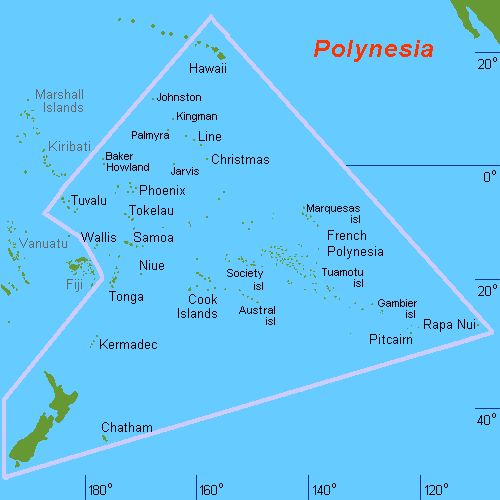
The name Polynesia was introduced in 1756 by French writer Charles de Brosses, who initially used it for all Pacific islands. In 1831, French explorer Jules Dumont d’Urville suggested a more restricted geographical meaning. The expression Polynesian Triangle is therefore also used: its three vertices correspond broadly to Hawaii, New Zealand, and Easter Island, providing a geographical framework for defining Polynesia.
History of Polynesia
The settlement of Polynesia remains partly uncertain because much archaeological evidence has been lost. One major theory, linked to Peter Bellwood, suggests that Austronesian seafarers from Taiwan moved through the Philippines and reached the Tonga–Fiji–Samoa region around 1500 BC, spreading eastward with agriculture and Lapita pottery. Other theories propose a slower migration through Melanesia. Current evidence generally supports a long-term Austronesian expansion from Southeast Asia, with Tonga and Samoa reached by around 1100 BC, the Marquesas by 300 BC, and later settlement of Easter Island, Hawaiʻi and New Zealand. Studies of domestic pigs also support an Asian migration route.
The possibility of South American contact was promoted by Thor Heyerdahl, whose 1947 Kon-Tiki expedition demonstrated that westward Pacific voyages were technically possible. Genetic research has since found evidence of limited prehistoric contact between Polynesians and South Americans, particularly in the southern Marquesas, but an American origin for Polynesian settlement remains highly unlikely. A major 2008 genetic study also found little evidence of significant Polynesian–Melanesian admixture, while the Lapita Expedition demonstrated the feasibility of long-distance migration from the Philippines using traditional-style catamarans and navigation. It covered about 7,400 km (4,000 nautical miles) in six months.
European exploration began with Samuel Wallis (1767), Louis Antoine de Bougainville (1768) and James Cook (1769). Cook’s voyages greatly increased European knowledge of Polynesia, but subsequent traders, settlers and slave traders brought exploitation, introduced diseases and severe population decline. Christian missionaries also sought to replace traditional religious and cultural practices, while European powers and the United States gradually colonised most Polynesian islands. Tonga was the only Polynesian nation never formally colonised.
European expeditions nevertheless produced valuable records of Polynesian languages, customs and societies, including those made by Adelbert von Chamisso during the Rurik expedition. Human settlement also transformed island ecosystems, causing an early wave of animal extinctions, including the moa of New Zealand and the moa-nalo of Hawaiʻi. European colonisation later caused a further wave of extinctions.
Geography of Polynesia
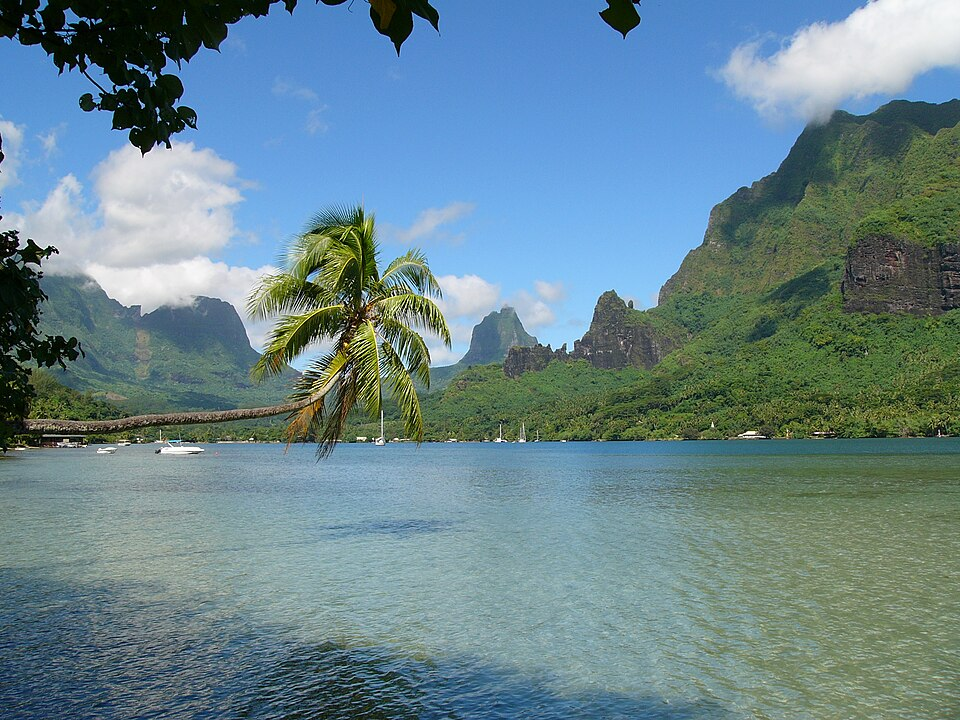
Polynesia is a vast region of the central and southern Pacific Ocean where relatively little land is scattered across a huge area. Its islands cover about 300,000–310,000 km² (117,000–118,000 sq mi), with more than 270,000 km² (103,000 sq mi) belonging to New Zealand. Much of the remaining land is concentrated in the Hawaiian Islands.
Many Polynesian islands, including Hawaii and Samoa, are volcanic and were formed by geological hotspots. By contrast, New Zealand, Norfolk Island, and Ouvéa represent exposed parts of Zealandia, a largely submerged continent. Zealandia sank mostly beneath the ocean around 23 million years ago, while tectonic movements later caused part of it, particularly present-day New Zealand, to rise again.
The Kermadec–Tonga subduction zone north of New Zealand is responsible for significant volcanic activity and the formation of the Kermadec and Tongan islands, while the Alpine Fault crosses New Zealand’s South Island. Zealandia’s continental shelf covers roughly 3.6 million km² (1.4 million sq mi). The oldest rocks associated with Polynesia occur in New Zealand, dating to around 510 million years ago, while the oldest rocks elsewhere in the region are found in the Hawaiian–Emperor seamount chain and are about 80 million years old.
Geographically, Polynesia is usually associated with the Polynesian Triangle, whose three corners are Hawaii, New Zealand, and Easter Island. Within this broad area are major island groups such as Samoa, Tonga, the Cook Islands, Tuvalu, Tokelau, Niue, Wallis and Futuna, and French Polynesia.
Polynesian communities also exist beyond the triangle, including in parts of Papua New Guinea, the Solomon Islands, the Caroline Islands, and Vanuatu. Rotuma, north of Fiji, has particularly strong Polynesian cultural characteristics despite speaking a non-Polynesian language, while parts of the Lau Islands have longstanding cultural and historical connections with Tonga. Ultimately, Polynesia is primarily a cultural and geographical concept within Oceania, alongside Melanesia and Micronesia, rather than a region defined exclusively by strict political or physical boundaries.
Society of Polynesia
Demography
The total population of Polynesia is estimated at around six million people, although only about one million are of Polynesian ancestry. The proportion of indigenous Polynesians varies greatly between islands. Tonga, for example, remains overwhelmingly Polynesian, with around 98% of its population having Polynesian ancestry, whereas in Hawaii they account for only about 6.5%. Most of the non-Polynesian population has Asian origins, particularly Chinese, Japanese, Indian, and Filipino, followed by people of European and American descent. European and American colonisation during the 19th and early 20th centuries, together with migration and the forced movement of enslaved people, greatly contributed to this ethnic diversity.
Because Polynesia covers an enormous oceanic area and its island groups are often separated by thousands of kilometres, its societies never developed a single political or social system. European contact and subsequent colonisation from the late 18th and 19th centuries further increased differences in political, economic, and cultural development. Today, highly developed territories influenced by European institutions and lifestyles coexist with communities where traditional economic and social practices remain important.
Languages
Polynesian languages belong to the Oceanic branch of the Austronesian language family and share many structural features. Their vowel system is generally consistent, with /a, e, i, o, u/ pronounced similarly to the vowels of Italian, Spanish, and German. Consonants are normally followed by a vowel, although their pronunciation varies considerably between island groups. The glottal stop /ʔ/ is commonly represented by an ʻokina or apostrophe.
Differences between Polynesian languages can be illustrated by the evolution of the traditional name for the ancestral homeland. Changes in consonants produced forms such as Havaiʻi in the Society Islands, Hawaiki in New Zealand, ʻAvaiki in the Cook Islands, Hawaiʻi in Hawaii, and Savaiʻi in Samoa. These variations reflect regular historical sound changes from Proto-Polynesian rather than entirely unrelated names.
During the 18th and 19th centuries, a Tahitian-, Māori-, and Hawaiian-based Maritime Polynesian Pidgin functioned as a regional trade language, facilitating communication between European sailors and Polynesian islanders. It was eventually displaced by English, which became the dominant wider means of communication in many parts of the region.
Religions
Traditional Polynesian religion was based on a worldview in which the physical and spiritual worlds were closely interconnected, without a clear separation between earthly life and the afterlife. Despite regional differences, many communities shared an animistic outlook, believing that nature, humans, ancestors, spirits, and gods were connected. Ancestor worship was particularly important, while cultural heroes such as Māui and Tiki were associated with the origins of life, fertility, culture, and fishing.
Religion was closely connected to the social and political hierarchy. Chiefs and nobles, often known as Ariki, claimed descent from gods or prestigious ancestors and were believed to possess greater mana, a form of spiritual power and authority. This helped legitimise their privileged position. Polynesian societies developed diverse pantheons, although many shared creation myths and divine genealogies. Important figures included Hina, Pele, Tāne, Tū, Rongo, and Tangaroa, while ancestral spirits and guardian beings occupied lower levels of the supernatural hierarchy.
The concept of mana was central: this spiritual force was believed to exist in people, animals, plants, objects, and entire landscapes. Individuals could inherit mana through prestigious ancestry or demonstrate it through exceptional achievements. Another important principle was tapu (Hawaiian kapu), referring to things considered sacred and subject to restrictions. Tapu regulated access to places, contact with people or objects, food, and social behaviour, reinforcing both religious beliefs and social hierarchy. Some restrictions also helped protect resources such as fishing grounds and crops.
Religious practices were deeply integrated into everyday life. Rituals and magic were intended to obtain the favour of gods and ancestors and ensure success in activities such as farming, fishing, construction, and warfare. Priests, spirit-mediums, and other religious specialists played important roles in these practices.
From the late 18th century, Christian missionaries profoundly transformed Polynesian religion. Although Christianity eventually became dominant, traditional beliefs were not completely eliminated. Many communities still preserve ancestral traditions, myths, spirits, cultural heroes, mana, and tapu, which remain important elements of Polynesian cultural identity.
Economy of Polynesia
With the exception of New Zealand, many independent Polynesian islands depend heavily on foreign aid and remittances from citizens living abroad. Young people are often encouraged to work overseas and send money back to their families. Tourism provides an additional source of income in places such as Easter Island, while some territories have developed more unusual economic activities, including Tuvalu’s “.tv” internet domain and the Cook Islands’ postage stamp sales.
Hawaii is particularly dependent on tourism, receiving millions of visitors each year. However, this reliance makes its economy vulnerable to external economic changes, encouraging Polynesian islands to diversify their economies and seek greater economic independence rather than depending mainly on tourism and foreign assistance.
Culture of Polynesia
Polynesians developed an exceptional tradition of ocean navigation, despite lacking instruments such as the compass and sextant. Their large double-hulled canoes, ancestors of modern catamarans, were used for long-distance voyages, warfare, transport, and migration, while smaller outrigger canoes served mainly for fishing and coastal travel. Boats were constructed from locally available wood and lashed together with coconut fibre, with construction techniques passed down through specialised families.
Navigators determined their position by combining knowledge of the Sun, Moon, planets, stars, waves, currents, winds, clouds, birds, fish, and floating vegetation. Nearly 300 stars and constellations were reportedly known, and routes were memorised in sections through songs and oral traditions rather than written charts. Navigation skills were taught from childhood through practical experience and mnemonic stick charts, which were used on land but not taken to sea. In 1976, the replica canoe Hōkūleʻa successfully sailed about 4,000 km (2,000 mi) from Hawaii to Tahiti without modern instruments, demonstrating the feasibility of traditional Polynesian navigation.
Traditional Polynesian medicine included specialised knowledge of childbirth, childhood illnesses, injuries, fractures, and medicinal plants. Healers usually specialised in particular areas and combined practical treatments with spiritual and ritual practices, often involving the wider community. Some traditional techniques, including Hawaiian massage, are being revived today, although indigenous medicine was unable to prevent the devastating impact of infectious diseases introduced by Europeans.
Polynesian art was strongly connected with religion, and much of it was destroyed after European contact, particularly by Christian missionaries who targeted temples and sacred objects. Music and dance were central to religious ceremonies, celebrations, and the preservation of oral traditions. Although many traditions were suppressed during colonisation, dances such as Hula, Tahitian and Samoan dances, and Māori traditions have experienced significant revival. Traditional instruments included ritual drums, conch shells, bamboo flutes, panpipes, slit drums, and other percussion instruments, while modern instruments such as the guitar and ukulele later became widespread.
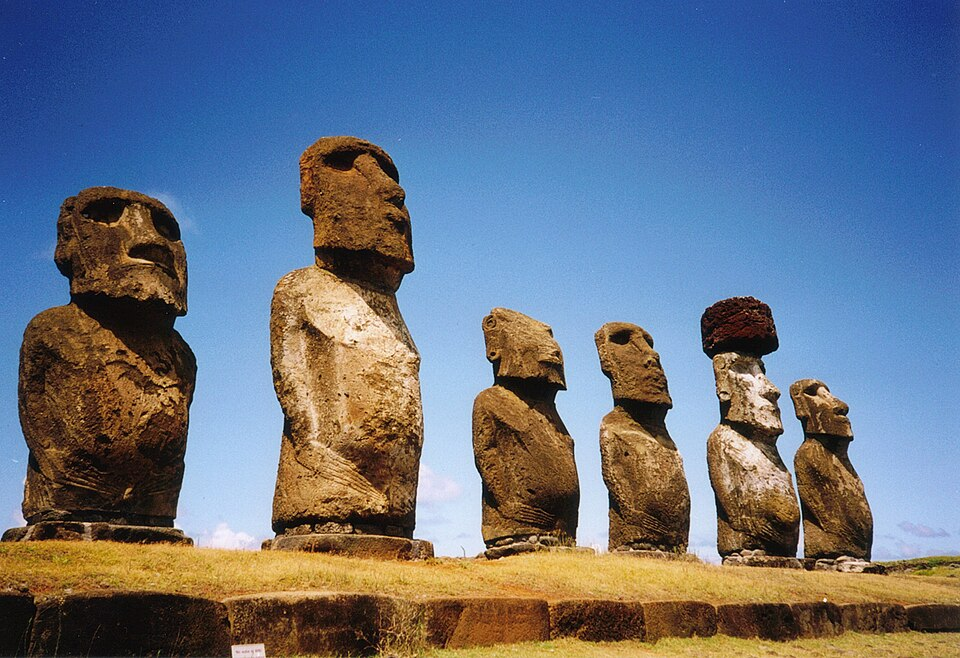
Polynesians also developed sophisticated forms of jewellery, weaving, and textile production. Floral and shell garlands such as lei were associated with ceremonies, while pandanus leaves were woven into mats, baskets, and fans. Tapa and kapa fabrics, made from plants fibres and bark, were often decorated with elaborate patterns. Wood and stone carving and sculpture were equally important, decorating houses, canoes, and temples; the monumental moai of Easter Island are the most famous surviving examples.
Because Polynesian societies had little or no writing system, except for the still-mysterious Rongorongo tradition of Easter Island, oral tradition was essential for preserving history, genealogy, religion, navigation, and practical knowledge. Songs and dances helped people memorise large amounts of information from childhood. Polynesian languages also allowed texts to contain multiple layers of meaning, so a single song could simultaneously function as a historical narrative, a navigational guide, and a record of a group’s religious or genealogical identity.
Cuisine of Polynesia
Polynesian cuisine vary considerably according to climate, geography, and contact with neighbouring cultures. Local traditions were influenced by practices from Micronesia and Melanesia, as well as by later European, Asian, and American cuisines. Polynesian food traditions have also influenced cuisines beyond the Pacific, including Malagasy cuisine.
History
During their expansion across the Pacific, Polynesian settlers introduced numerous cultivated plants to newly inhabited islands. Important crops included taro, breadfruit, sweet potatoes, bananas, and sugar cane, with around 72 plant species identified as human introductions across Polynesian settlement areas. These crops were especially essential on small islands and atolls, where local resources were often insufficient to support growing populations.
Animal husbandry was more limited because pigs and chickens competed with humans for scarce food supplies. The Pacific rat also spread across many islands during the Lapita period, possibly intentionally as a food source, contributing to the decline of numerous small native species. Polynesian settlement also caused the extinction of several birds and other animals. Despite these impacts on island ecosystems, the ocean remained the main source of animal protein. Polynesians developed highly advanced fishing and diving skills, harvesting shellfish, lobsters, and reef animals and locating productive fishing grounds far offshore.
Political division of Polynesia
Politically, the Polynesia comprises countries located entirely or predominantly within it, as well as countries located outside the region that possess territories, dependencies, or constituent regions within it. For the first group, such territories are shown in parentheses and divided between those within and outside the region; for the second, only those located within the region are indicated.
Countries located entirely or predominantly in Polynesia:
- New Zealand 🇳🇿 (Inside Polynesia: Cook Islands 🇨🇰, Niue 🇳🇺, Tokelau 🇹🇰)
- Samoa 🇼🇸
- Tonga 🇹🇴
- Tuvalu 🇹🇻
Countries with territories in Polynesia:
- Australia 🇦🇺 (Inside Polynesia: Norfolk Island 🇳🇫)
- Chile 🇨🇱 (Inside Polynesia: Easter Island 🇨🇱)
- Fiji 🇫🇯 (Inside Polynesia: Rotuma)
- France 🇫🇷 (Inside Polynesia: French Polynesia 🇵🇫, Wallis and Futuna 🇼🇫)
- United Kingdom 🇬🇧 (Inside Polynesia: Pitcairn Islands 🇵🇳)
- United States 🇺🇸 (Inside Polynesia: American Samoa 🇦🇸, Hawaii 🇺🇸)
Traditional recipes of Polynesia
(Only recipes unique to the area or strongly associated with it and rarely found elsewhere are included)
Traditional products of Polynesia
(Only products unique to the area or strongly associated with it and rarely found elsewhere are included)
Recipes commonly prepared in Polynesia
(Only products specific to this territorial level, and not already covered at a broader administrative or geocultural level, are included)
Products commonly consumed in Polynesia
(Only recipes specific to this territorial level, and not already covered at a broader administrative or geocultural level, are included)
Source(s):
https://de.wikipedia.org/wiki/Polynesien
https://en.wikipedia.org/wiki/Polynesia
https://en.wikipedia.org/wiki/Oceanian_cuisine#Polynesia
Photo(s):
1. Hobe / Holger Behr, Public domain, via Wikimedia Commons
2. Rv, CC BY-SA 3.0 http://creativecommons.org/licenses/by-sa/3.0/, via Wikimedia Commons
3. source: Oceania_ISO_3166-1.svg: User:Tintazulderivative work: Cruickshanks, CC BY-SA 3.0 https://creativecommons.org/licenses/by-sa/3.0, via Wikimedia Commons