
Freshwater eels (Anguilla)
Genus of Anguillidae
Food, Animal source foods, Animals (Animalia), Chordates (Chordata), Vertebrates (Vertebrata), Bony fish (Osteichthyes), Ray-finned fish (or Actinopterygians, Actinopterygii), Neotperygii, Teleosts (Teleostei), Eels (Anguilliformes)
Consumption area(s): Earth
Introduction
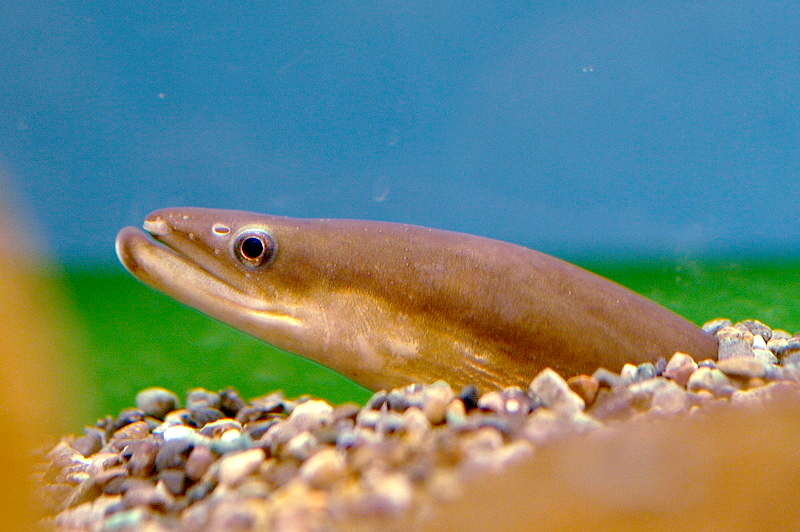
Freshwater eels (Anguilla) are fish characterized by a highly elongated body shape, resembling that of a snake, and by dorsal, caudal, and anal fins that merge into a single uninterrupted fin fold along the body. These fish exhibit a catadromous life cycle, growing and maturing in freshwater habitats before undertaking long migrations to the marine environment for reproduction.
Anguilla have considerable commercial value and are widely consumed in many regions of the world. Although several species are commonly cultured in aquaculture systems, successful captive breeding remains limited, and farming operations largely depend on wild-caught juveniles. Due to significant declines in natural stocks, numerous populations are currently considered threatened, leading conservation organizations such as Seafood Watch to discourage the consumption of Anguilla.
Description of Freshwater eels (Anguilla)
Adult freshwater eels display a markedly elongated, serpentine body plan, with a tubular form and an expanded, pointed head. The dorsal fin typically merges seamlessly with both the caudal and anal fins, producing a continuous fin fringe along the posterior body region. Compared with marine counterparts, they retain relatively developed eyes and pectoral fins, which support navigation and fine-scale movement in rivers and shallow benthic habitats. Their integument retains minute, soft scales embedded within the epidermis, rather than losing them as in many other eel groups, and their jaws and vomer bear bands of small, granular teeth.
A pronounced sexual size dimorphism is present: males prioritize reproductive effort over somatic growth and therefore remain smaller, while females typically attain larger body sizes. Adult coloration varies from brown to olive or yellowish tones, often with mottled patterns that provide effective camouflage against riverbeds and lake substrates, reducing detection by predators in clear or shallow waters. Throughout their life history, these eels undergo significant transformations, particularly during transitions between freshwater and marine environments.
Locomotion relies on axial undulation rather than paired limbs, as these fish lack most paired appendages aside from reduced pectoral fins. This snake-like movement confers high maneuverability, especially useful in structurally complex habitats such as reef systems, riverbeds, and dense underwater environments. Several species also exhibit burrowing behavior, using either head-first or tail-first techniques to penetrate sediment, a strategy linked both to foraging efficiency and predator avoidance.
Anguilla exhibit significant reliance on cutaneous respiration, which contributes roughly 15% of oxygen uptake under normal aquatic conditions, but can rise to about 50% when individuals are exposed to air due to gas exchange through the external integument. This adaptation is crucial for survival during overland movements between water bodies and also supports survival during burrowing behavior in mud, where aerial gas exchange remains possible.
During periods when aquatic habitats begin to desiccate, these eels commonly burrow into sediment and enter a state of torpor, markedly reducing metabolic activity and body temperature. Because rainfall events are unpredictable, this state enhances energy conservation and improves survival under prolonged environmental stress.
Their swimming performance is enhanced by specialized axial musculature and a characteristic W-shaped myomere structure, enabling highly efficient propulsion and unusual abilities such as reverse swimming. Feeding behavior is mechanically assisted by this locomotor capacity: prey is grasped and then torn apart through rapid rotational movements of the body, compensating for relatively small mouth size.
A form of population-dependent sex modulation has also been observed, where sex ratios shift in response to egg density within the environment. High concentrations of eggs tend to favor increased proportions of males, whereas lower densities produce the opposite trend, indicating a flexible regulatory mechanism rather than complete sex conversion.
The epidermis contains abundant mucous cells, particularly concentrated on dorsal and ventral surfaces. Compared with other fish groups, Anguilla produce relatively large amounts of mucus, which serves multiple functions including enhanced protection during predation events, reduced desiccation risk, and improved efficiency of cutaneous respiration when out of water.
A complex metamorphic transition occurs during the shift from the yellow eel stage to the silver eel stage. During this transformation, the swim bladder is physiologically adjusted for high-pressure deep-sea environments, fat reserves increase substantially—especially in females due to reproductive demands—and the visual system undergoes a spectral shift from red-light sensitivity to enhanced blue-light detection, better suited for deep ocean conditions.
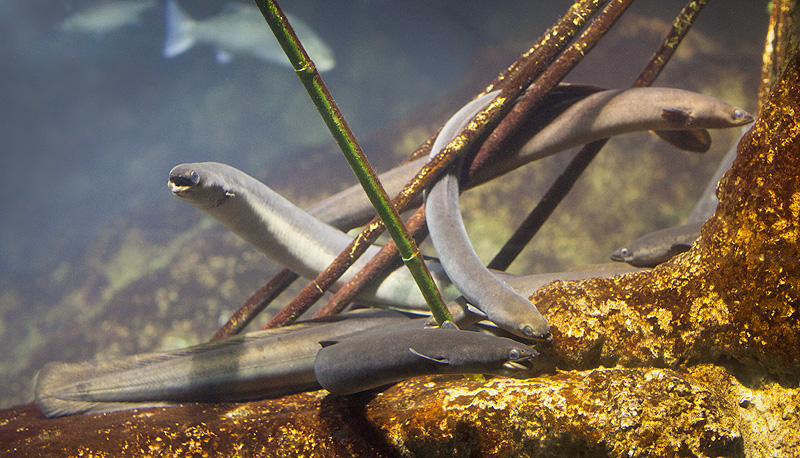
Behavioral observations from captivity suggest a strong intrinsic migratory drive, often expressed as persistent escape attempts and directional swimming toward potential freshwater or marine pathways, reinforcing the interpretation of Anguilla as obligatorily migratory organisms throughout their life cycle.
Sensory
The Anguilla possess a fully developed lateral line system extending along the trunk, a feature that distinguishes them from many related groups. This network detects subtle water displacement, enabling precise perception of the surrounding environment and improving predatory efficiency, particularly in their predominantly nocturnal and opportunistic feeding behavior.
Their olfactory system is highly specialized, with cells in the nasal sacs capable of detecting extremely low concentrations of dissolved chemicals. This heightened acuity supports both nocturnal foraging and long-distance migration, allowing the detection of environmental cues such as land-derived odors, reduced salinity, and lower temperatures to guide directional movement.
In addition, geomagnetic perception plays a central role in orientation and navigation. Because frehwater eels are catadromous and undertake extensive migrations across freshwater and open ocean environments, they rely on the Earth’s magnetic field as a navigational reference. Experimental evidence shows that individuals at different life stages can adjust their movement in response to changes in magnetic field intensity and inclination. This suggests a dependence on geomagnetic cues during migration, potentially complemented by circatidal rhythms in early life stages such as the glass eel phase, although the mechanisms involved remain only partially understood.
Physiology
The cranium of Anguilla includes paired frontal bones, contributing to a reinforced skull architecture that supports mechanical stress during burrowing activities in soft substrates such as mud. This strengthened cranium also facilitates movement through terrestrial obstacles, including narrow spaces beneath rocks and logs in benthic freshwater environments where these fish commonly rest during daylight periods.
Gas exchange is largely associated with ventral lateral gill openings, which account for the majority of respiratory efficiency and are particularly effective in supporting transitions between freshwater and brackish or marine conditions. This respiratory configuration distinguishes freshwater eels from other eel groups that rely primarily on more enclosed or internalized branchial chambers.
Many species display skin variability, allowing coloration to shift in response to environmental conditions. This adaptive pigmentation enhances camouflage, improving concealment from predators and prey across heterogeneous aquatic habitats.
The locomotor system is defined by fused dorsal, anal, and caudal fins, combined with the absence of pelvic fins. The dorsal fin originates around the mid-body region, forming a continuous fin margin that contrasts with more posteriorly restricted fin arrangements in other taxa. Propulsion is generated primarily through anterior-to-posterior axial undulation, producing highly efficient swimming performance that supports both long-distance migration and active predation.
Contrary to earlier assumptions, Anguilla possess a complete pectoral girdle, including both scapula and coracoid elements. This anatomical feature provides additional muscle attachment sites, enhancing control of head movement and improving the force transmission involved in body undulation. It also increases the effectiveness of pectoral fin-driven locomotion, which is particularly relevant during navigation of complex environments and when overcoming terrestrial barriers during short overland movements.
Biology
Freshwater eels occupy a wide range of aquatic environments, including freshwater rivers, estuaries, and marine systems, where they function both as predators and prey. Members of the family Anguilla are predominantly solitary organisms, lacking social communication or coordinated schooling behavior. However, large aggregations of elvers may occur due to synchronized responses to environmental cues rather than social interaction. Their feeding strategy is highly opportunistic, with a broad diet that includes crustaceans, fish, and other available aquatic organisms. Certain species also consume fish eggs, including those of predatory species such as trout.
During early life stages, juveniles typically inhabit sheltered microhabitats such as rock crevices, sediment gaps, or muddy substrates. Anguillids are broadly catadromous, spending most of their adult life in freshwater—primarily rivers—before migrating to the ocean for reproduction. The larval stage, known as leptocephalus, can involve extended migration periods ranging from several months up to nearly a year, with variation between temperate and tropical species in migration duration.
Some species undertake extremely long-distance migrations, with the European eel traveling up to approximately 6000 km during its life cycle. Migration routes are not strictly fixed, and in some cases appear plastic, with ongoing research investigating their variability. In certain populations, a shift has been observed toward a fully marine life cycle, in which individuals no longer return to freshwater environments, a pattern thought to be associated with lower-quality or less productive freshwater habitats.
Reproduction and life cycle
Freshwater eels are classified as semelparous organisms, meaning they reproduce only once in their lifetime, after which they die. Despite this, reproduction is not strictly annual, as individuals may delay migration and spawning until environmental conditions become favorable. In species such as the European eel, sexual maturity can begin around 7 years of age, while extreme longevity has been recorded at up to 85 years in the wild.
Reproductive timing is influenced by multiple environmental factors, including body fat reserves, water quality and temperature, prey abundance, river discharge, and flow conditions. This variability contributes to highly uncertain lifespan estimates, which may range from 50 to 70 years, although long-term demographic data remain limited. Details of fertilization and spawning mechanics are still poorly understood, and developmental timing from egg to larva varies considerably. Some evidence, such as that from studies on the Japanese eel, suggests that breeding cycles may be synchronized with lunar phases, particularly the new moon.
The life cycle of the family is strongly catadromous, with individuals inhabiting freshwater rivers, lakes, or estuaries during growth phases and returning to the ocean for reproduction. Development involves multiple distinct stages, each associated with many shifts. Life begins as eggs, which hatch into planktonic larvae known as leptocephali. These larvae feed on microscopic organic material and are dispersed over long distances by ocean currents. Reproductive output can be extremely high, with species such as the Japanese eel producing between 2 and 10 million eggs. Parental care is generally absent.
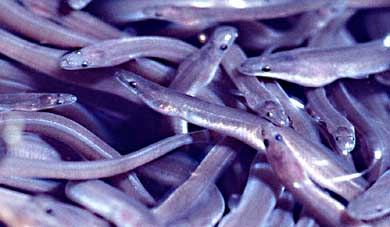
As larvae develop, they transition into the transparent glass eel stage, during which they migrate from the open ocean into estuarine systems. Upon entering freshwater, pigmentation develops and individuals progress through the elver stage and subsequently the yellow eel stage, which represents the primary growth phase in inland habitats. As maturation approaches, eels enter the silver eel stage, characterized by further transformation and preparation for oceanic migration. Adult individuals then return to offshore spawning grounds to complete the reproductive cycle.
Notable discoveries of spawning areas, particularly for the American eel and European eel, have been made in the Sargasso Sea, representing a landmark in research. Additional spawning locations for species such as the Japanese eel and giant mottled eel have more recently been identified in regions of the western North Pacific Ocean.
Uses of Freshwater eels (Anguilla)
Freshwater eels represent a significant group of commercially important food, with eel aquaculture developing into a rapidly expanding industry worldwide. Key species involved in global production include the Australian long-finned eel, short-finned eel, and Japanese eel. Historically, the majority of production has been concentrated in Japan, Korea, and Taiwan, although in recent decades China has become the dominant producer.
Despite their economic value, freshwater eels are subject to strong conservation concerns. Organizations such as Seafood Watch advise against their consumption due to severe and ongoing declines in wild populations. Several species used in products such as unagi have experienced dramatic reductions in abundance over the past fifty years; for example, the European eel has undergone population declines of approximately 80% since the 1960s.
Although a large proportion of eels consumed in markets such as the United States are farm-raised, these systems generally do not involve true closed-cycle breeding. Instead, juveniles are typically harvested from wild stocks and then grown in captivity, maintaining pressure on natural populations. Additional environmental impacts arise from open-net aquaculture systems, which allow the transfer of waste and pathogens into surrounding ecosystems, thereby increasing stress on wild eel habitats.
As obligate carnivores, freshwater eels are often fed with other wild-caught fish, further contributing to the ecological cost and raising concerns about the overall sustainability of current farming practices.
Classification of Freshwater eels (Anguilla)
This genus is divided into species. Among them:
- African longfin eel
- American eel
- Australian short-finned eel
- Celebes longfin eel
- European eel
- Giant mottled eel
- Indian mottled eel
- Indonesian shortfin eel
- Japanese eel
- New Zealand longfin eel
- Pacific shortfinned eel
- Philippine mottled eel
- Speckled longfin eel
- Short-finned eel
Source(s):
https://en.wikipedia.org/wiki/Anguillidae
Photo(s):
1. opencage, CC BY-SA 2.5 https://creativecommons.org/licenses/by-sa/2.5, via Wikimedia Commons
2. Dmitriy Konstantinov, CC BY-SA 3.0 https://creativecommons.org/licenses/by-sa/3.0, via Wikimedia Commons
3. Kils, CC BY-SA 3.0 http://creativecommons.org/licenses/by-sa/3.0/, via Wikimedia Commons