
Eels (Anguilliformes)
Order of teleosts (Teleostei)
Food, Animal source foods, Animals (Animalia), Chordates (Chordata), Vertebrates (Vertebrata), Bony fish (Osteichthyes), Ray-finned fish (or Actinopterygians, Actinopterygii), Neotperygii, Teleosts (Teleostei)
Consumption area(s): Earth
Introduction
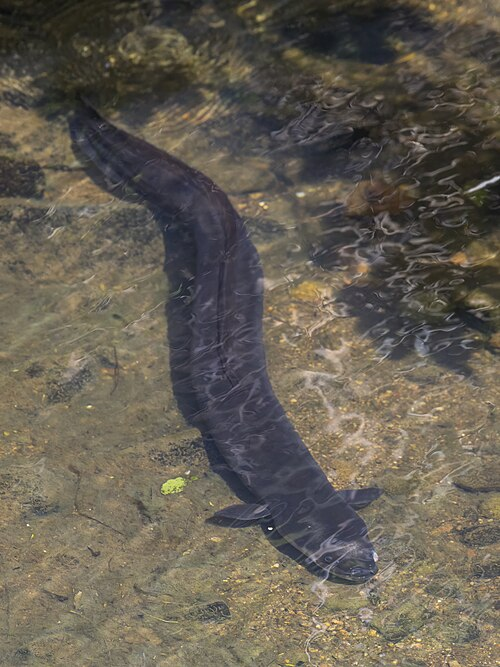
Eels (Anguilliformes) are ray-finned fish that represent a highly diverse lineage, comprising multiple suborders, numerous families and genera, and roughly a thousand described species. Across their life cycle, they undergo a marked transformation, progressing from early larval forms to fully developed adults, and most species occupy a predatory ecological role.
The label “eel” is also applied more broadly to several unrelated fish groups that share a similar elongated body shape, such as electric eels of the genus Electrophorus, swamp eels within the order Synbranchiformes, slime eels belonging to the class Myxini, and deep-sea spiny eels in the family Notacanthidae. Despite their resemblance, these groups are largely the result of convergent evolution, having independently developed eel-like morphologies. The main exception is the deep-sea spiny eels, whose lineage (Notacanthiformes) is closely related to true eels as a sister group rather than an independent adaptation.
In terms of habitat, most true eels are marine organisms, but there are notable deviations from this pattern. Some species, such as those in the genus Anguilla, migrate between freshwater and the sea during their life cycle, while others, like the freshwater moray, remain primarily in inland waters. Additional exceptions include species such as the rice-paddy eel, which reproduces in freshwater environments, and the freshwater snake eel Stictorhinus, further illustrating the ecological flexibility found within this group.
Description of eels (Anguilliformes)
Eels are highly elongated fish whose body length varies dramatically across species, from as little as about 5 cm (2 in) in the one-jawed eel (Monognathus ahlstromi) to nearly 4 m (13 ft) in the slender giant moray. Their body mass also spans a wide range, from roughly 30 g (1 oz) to more than 25 kg (55 lb), with some exceptional species reaching even greater sizes. In terms of morphology, they completely lack pelvic fins, and in many cases the pectoral fins are also absent.
The dorsal, anal, and caudal fins are merged into a continuous fin structure, forming a long ribbon-like fringe that extends along most of the body. Locomotion is achieved through undulatory wave propagation, where muscular waves travel from head to tail to generate thrust, and this mechanism is flexible enough to allow even reverse swimming by inverting wave direction.
Most eel species are primarily nocturnal, occupying shallow marine environments where they hide within sediments such as sand and mud or shelter among rocky crevices. They are often found sharing burrow systems or aggregating in communal shelters. Some species extend their distribution into deeper habitats along continental shelves and slopes, reaching depths of approximately 4,000 m (13,000 ft). True freshwater residency is relatively rare and mainly restricted to members of the genus Anguilla, although even these species migrate back to marine environments to reproduce.
The life cycle of eels is complex and highly specialized. They begin as flattened, transparent larvae known as leptocephali, which drift passively in the ocean’s upper layers while feeding on suspended organic material often referred to as marine snow. As development proceeds, they undergo successive metamorphoses, transitioning into the glass eel stage and then into elvers. While some elvers remain in coastal brackish or marine zones, most migrate into freshwater systems, where they move upstream and often encounter physical barriers such as weirs, dams, and waterfalls that they must overcome.
Uses of eels (Anguilliformes)
Freshwater eels and marine eels hold a significant place in Japanese cuisine, where dishes like unadon and unajū are widely appreciated despite their relatively high cost. In Chinese gastronomy, eel is also highly valued and prepared through a wide spectrum of cooking methods. In markets such as Hong Kong, prices can be extremely elevated, at times reaching around 1000 HKD per kilogram and in exceptional cases even surpassing 5000 HKD.
In India, especially in the northeastern regions, eels are traditionally consumed; in Assam, freshwater varieties known locally as Kusia are commonly cooked in curry-based preparations enriched with herbs. Across the United States and much of Europe, species such as the European eel are part of regional culinary traditions, although populations have declined sharply and the species is now regarded as critically endangered.
In European cuisine, eel appears in several distinctive local forms. In East London, jellied eels were once a staple street food, though their popularity has waned significantly since the mid-20th century. In Spain, the dish known as angulas can be extremely expensive, with prices often reaching about 1000 euros per kilogram.
In New Zealand, the longfin eel remains an important component of traditional Māori diet and cultural food practices. In Italian cuisine, particularly notable are eels from the Valli di Comacchio wetlands along the Adriatic coast, as well as those from Lake Bolsena and the pond systems of Cabras in Sardinia, all considered highly prized. In several European countries, including Germany, the Netherlands, the Czech Republic, Poland, Denmark, and Sweden, smoked eel is regarded as a traditional delicacy and continues to be appreciated in regional culinary cultures.
Classification of eels (Anguilliformes)
This order is divided into families. Among them:
- Anguillidae, with the only edible species belonging to freshwater eels (Anguilla) (european eels)
- Bathymyrinae (conger eels)
- Chlopsidae (false morays)
- Colocongridae (shorttail eels)
- Congridae (conger eels)
- Cyematidae (bobtail eels)
- Derichthyidae (longneck eels)
- Eurypharyngidae (gulper eels)
- Heterenchelyidae (mud eels)
- Heterocongrinae (garden eels)
- Ilyophinae (arrowtooth eels)
- Moringuidae (spaghetti eels)
- Monognathidae (onejaw gulpers)
- Muraenesocidae (pike conger eels)
- Muraenidae (moray eels)
- Muraeninae (morays)
- Myrocongridae (myroconger eels)
- Myrophinae (worm eels)
- Nettastomatidae (duckbill eels)
- Neocyematidae (bobtail eels)
- Nemichthyidae (snipe eels)
- Ophichthidae (snake eels, worm eels)
- Ophichthinae (snake eels)
- Protanguillidae (cave eels)
- Saccopharyngidae (swallower eels)
- Serrivomeridae (sawtooth eels)
- Simenchelyinae (pugnose parasitic eels)
- Synaphobranchidae (cutthroat eels)
- Synaphobranchinae (cutthroat eels)
- Uropterygiinae (tailfin morays)
Source(s):
https://en.wikipedia.org/wiki/Eel
Photo(s):
1. Charles J. Sharp, CC BY-SA 4.0 https://creativecommons.org/licenses/by-sa/4.0, via Wikimedia Commons