
Peninsular Italy (Italian Peninsula)
Introduction
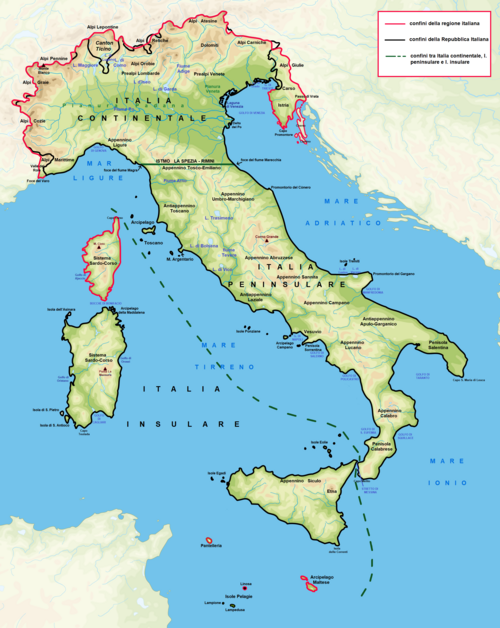
The Peninsular Italy, also called the Italian Peninsula, Italic Peninsula or, less commonly, the Apennine Peninsula, is the part of the European continent that extends into the Mediterranean Sea from northwest to southeast. Politically, the peninsula is almost entirely part of Italy, while also containing the complete territories of the microstates of San Marino and Vatican City. The Italian portion encompasses most of Central and Southern Italy, including Tuscany, Marche, Umbria, Lazio, Abruzzo, Molise, Apulia, Campania, Basilicata, and Calabria, as well as small southern sections of Liguria and Emilia-Romagna.
Geography of the Peninsular Italy
In its strict geographical sense, the Italian Peninsula comprises the territory south of the Magra–Marecchia line, an imaginary boundary near the 44th parallel. It stretches for about 1,000 km from northwest to southeast, is largely crossed by the Apennines, and is bordered by the Tyrrhenian, Ionian, and Adriatic Seas. In southern Italy, it divides into the smaller Salentine and Calabrian peninsulas. Its narrowest point is the Catanzaro Isthmus, only about 35 km wide, while its maximum width reaches approximately 254 km.
The Apennines form the peninsula’s main mountain system, traditionally described as its geographical “backbone.” The range includes the Tuscan-Emilian, Umbrian-Marchean, Abruzzese, Samnite, Campanian, Lucanian, and Calabrian Apennines. The highest summit is Gran Sasso, while the western side also features volcanic and mountainous formations including Mount Vesuvius, the only active volcano on the Italian Peninsula. The landscape varies considerably, with extensive hilly areas in Tuscany, Umbria, and Marche, broad plains in Puglia, and important karst formations in central and southern Italy.
The peninsula’s river systems differ between its two main sides. Because the Apennine watershed lies relatively close to the Adriatic coast, rivers flowing west toward the Tyrrhenian Sea generally have longer courses. The Tiber is the principal river of the peninsula, followed by the Arno and Volturno, while important Adriatic rivers include the Aterno-Pescara, Ofanto, Sangro, Metauro, and Tronto. The Ionian side is characterized by shorter, roughly parallel rivers, including the Basento, Agri, and Bradano.
The peninsula also contains several important lakes, particularly on the Tyrrhenian side. Lake Trasimeno in Umbria is the largest, while Lazio contains major volcanic lakes such as Bolsena, Bracciano, Vico, and Albano. Along the Adriatic coast, Lake Varano and Lake Lesina are distinctive coastal lagoons separated from the sea by sandy barriers.
The coastline is highly varied. The Tyrrhenian side contains numerous bays, promontories, peninsulas, and islands, including the Tuscan Archipelago, the Sorrento Peninsula, and the Gulf of Naples. The Ionian coast includes the Gulf of Taranto, the largest gulf in Italy, together with the rugged coastlines of Calabria and Salento. By contrast, much of the Adriatic coast is relatively low and sandy, extending for hundreds of kilometres, although prominent rocky sections occur around the Gargano and Conero promontories.
Political division of the Peninsular Italy
The following nations fall entirely within the Italian geo-cultural region:
The following nations are not entirely included within the Peninsular Italy:
- Italy 🇮🇹: Tuscany (excluding its northernmost areas), Marche, Umbria, Lazio, Abruzzo, Molise, Apulia, Campania, Basilicata, and Calabria, together with the southern parts of Liguria and Emilia-Romagna.
Traditional recipes of Peninsular Italy
(Only recipes unique to the area or strongly associated with it and rarely found elsewhere are included)
Traditional products of Peninsular Italy
(Only products unique to the area or strongly associated with it and rarely found elsewhere are included)
Recipes commonly prepared in Peninsular Italy
(Only products specific to this territorial level, and not already covered at a broader administrative or geocultural level, are included)
Products commonly consumed in Peninsular Italy
(Only recipes specific to this territorial level, and not already covered at a broader administrative or geocultural level, are included)
Source(s):
https://it.wikipedia.org/wiki/Penisola_italiana
Photo(s):
1. modifica effettuata da Giorgio Eusebio Petetti, immagine originale di MacMoreno, CC BY-SA 4.0 https://creativecommons.org/licenses/by-sa/4.0, via Wikimedia Commons