
Continental Italy
Introduction
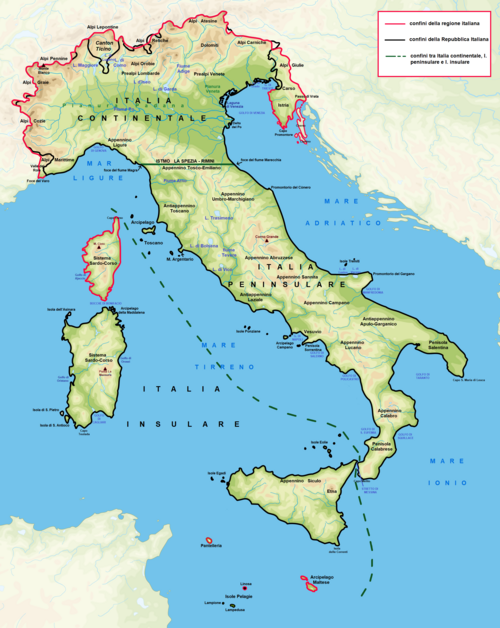
Continental Italy is the northern section of the Italian region, lying between the southern slopes of the Alps and the La Spezia–Rimini isthmus. It faces the Ligurian Sea to the west and the northern Adriatic Sea to the east. Small islands and peninsulas located within this area are nevertheless considered part of Continental Italy, including the islands of the La Spezia Archipelago and those in the Po Delta, as well as the Lignano peninsula.
Geography of Continenatl Italy
Continental Italy is enclosed by the Alps and the Apennines, which form an almost continuous mountain arc between the Ligurian Sea and the northern Adriatic Sea. The arc includes the Ligurian and Tuscan-Emilian Apennines to the south, the Maritime, Cottian and Graian Alps to the west, the Pennine, Lepontine, Rhaetian, Venetian and Carnic Alps to the north, and the Julian Alps to the east.
Inside this mountainous framework lie the Po Valley and the Veneto-Friulian Plain, together forming Italy‘s largest lowland area, covering about 46,000 km² (17,800 sq mi). Mainly created by alluvial deposits from the Po and other rivers, this fertile plain has historically encouraged dense settlement and economic development. Other notable formations include the isolated volcanic Euganean and Berici Hills, while the Karst area of Venezia Giulia is characterized by sinkholes, caves and underground rivers.
The region’s hydrography is dominated by the Po, Italy’s longest river entirely within the country, which flows for about 652 km (405 mi) before reaching the Adriatic through a delta. Other major rivers include the Adige, Piave and Reno, while numerous smaller rivers and resurgence springs occur across the plains. The foothills of the Alps are also home to Italy’s largest lakes, including Lake Garda, Lake Maggiore and Lake Como, which are mainly pre-Alpine lakes of glacial origin.
The coastlines differ considerably between the two seas. Along the Ligurian coast, the Gulf of Genoa divides the shore into the Riviera di Ponente and Riviera di Levante. The western section generally features lower and more sandy shores, while the eastern coast is more rugged, with prominent formations such as Portofino, the Cinque Terre and Portovenere. Several small islands also lie close to the coast.
The northern Adriatic coast is predominantly low and sandy in Emilia-Romagna, while the shores of Veneto and Friuli-Venezia Giulia are distinguished by extensive coastal lagoons, including those of Venice, Caorle and Grado. Farther east, the coast becomes higher and more rocky before continuing into the Istrian Peninsula, whose shoreline is characterized by rocky sections, submerged valleys and elongated coastal inlets. The northernmost Adriatic is marked by the Gulfs of Venice and Trieste.
Political division of the Contintal Italy
The following nations fall entirely within the Italian geo-cultural region:
The following nations are not entirely included within the Italian geo-cultural region:
- Italy 🇮🇹: Tuscany (excluding its southernmost areas), Friuli-Venezia Giulia, Lombardia, Piedmont, Trentino-Alto Adige, Valle D’Aosta, and Veneto, together with the northern parts of Liguria and Emilia-Romagna.
Additionally, several areas outside the mainland also belong to the broader Italian geo-cultural region:
- In Croatia 🇭🇷, regions including Istria and the city of Fiume.
- In France 🇫🇷, territories such as the Roia Valley (including Briga Marittima and Tenda, transferred under the 1947 Treaty of Paris), and several Alpine areas, including Colle del Monginevro, Valle Stretta, and Mont Chaberton near the Montgenevre Pass. Also included are the Mont Cenis area, along with Lake Mont Cenis, and the Mentone Basin extending to Turbìa.
- In Slovenia 🇸🇮, the Julian Alps, Slovenian Gorizia, western parts of Carniola, and the Slovene Littoral.
- In Switzerland 🇨🇭, regions such as the upper Val Divedro in Valais, the Canton of Ticino (excluding the upper valley of Reuss and Val Cadlimo with Piz Blas), and parts of the Canton of Grisons, including the Val Mesolcina, Val Calanca, Val Bregaglia, Val Poschiavo, and Val Monastero (the latter representing Italian-speaking parts of Switzerland).
Traditional recipes of Continental Italy
(Only recipes unique to the area or strongly associated with it and rarely found elsewhere are included)
Traditional products of Continental Italy
(Only products unique to the area or strongly associated with it and rarely found elsewhere are included)
Recipes commonly prepared in Continental Italy
(Only products specific to this territorial level, and not already covered at a broader administrative or geocultural level, are included)
Products commonly consumed in Continental Italy
(Only recipes specific to this territorial level, and not already covered at a broader administrative or geocultural level, are included)
Source(s):
https://it.wikipedia.org/wiki/Italia_continentale
Photo(s):
1. modifica effettuata da Giorgio Eusebio Petetti, immagine originale di MacMoreno, CC BY-SA 4.0 https://creativecommons.org/licenses/by-sa/4.0, via Wikimedia Commons