
Alpine region
Introduction
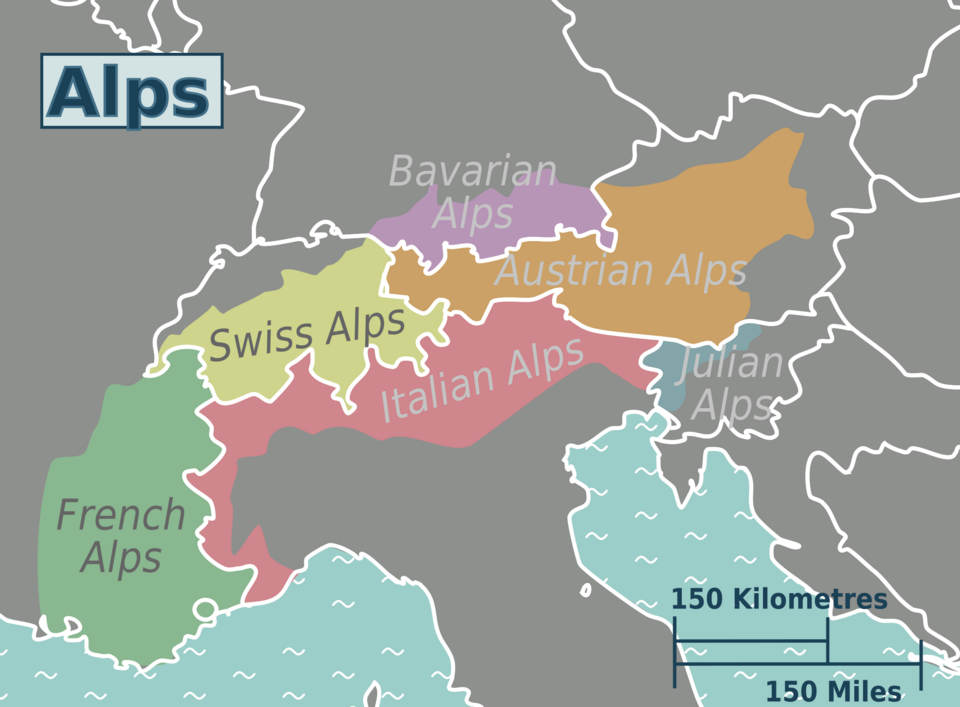
The Alpine Region is centred on the Alps, one of Europe‘s largest and highest mountain systems. The range extends for about 1,200 km (750 mi) from the Mediterranean coast near Nice to the Adriatic coast near Trieste, continuing eastward towards Vienna and the Pannonian Basin. The wider Alpine area encompasses parts of Monaco, France, Switzerland, Italy, Liechtenstein, Germany, Austria and Slovenia. Among its most famous peaks are Mont Blanc and the Matterhorn, while the Alpine Region contains 82 peaks exceeding 4,000 m (13,000 ft).
History of Alpine region
After the Würm glaciation, the retreat of the ice allowed human communities to settle around Alpine lakes and caves. Archaeological evidence includes prehistoric dwellings, standing stones and thousands of rock engravings, especially those of Valcamonica. The discovery of Ötzi, a Neolithic mummy found near the Similaun, provides important evidence of early human activity in the high Alps.
From the 2nd millennium BC, the Alpine region were inhabited by various peoples, including Celts, Raeti, Ligures and Germanic groups. Celtic cultures such as Hallstatt and La Tène left significant archaeological remains, while resources such as salt were extensively exploited. The Romans later incorporated much of the region into their territories and developed roads, settlements and trade routes across the mountain passes. Hannibal’s crossing of the Alps in 218 BC became one of antiquity’s most famous military episodes.
During the Middle Ages, Christianity spread throughout the region and numerous churches, monasteries and castles were built. Alpine passes remained essential for trade, travel and pilgrimage, while powerful dynasties such as the Savoy, Visconti and Habsburgs competed for control. In 1291, several Alpine cantons formed the nucleus of the Swiss Confederation. The Alps also became increasingly important in defining political boundaries.
The Napoleonic Wars transformed the political geography of the region, with Napoleon occupying territories controlled by the Habsburgs and Savoy. Military campaigns were fought across important Alpine passes, including the 1799 campaign of Alexander Suvorov. After Napoleon’s defeat, several Alpine states strengthened their fortifications to protect strategic routes.
For centuries, the highest peaks were regarded as dangerous and mysterious places, but from the 16th century naturalists increasingly explored them for scientific purposes. Conrad Gessner, Horace-Bénédict de Saussure and Placidus a Spescha studied Alpine geology, glaciers and landscapes. Saussure also participated in the third ascent of Mont Blanc in 1787.
The Alpine region became a major source of inspiration for Romantic artists and writers such as Rousseau, Goethe, Turner, Wordsworth and Byron. In 1816, Byron, Percy Bysshe Shelley and Mary Shelley visited the Lake Geneva region, inspiring works including Mont Blanc, The Prisoner of Chillon and Frankenstein. During the 19th century, scientific research developed alongside tourism and mountaineering. The Golden Age of Alpinism saw numerous important ascents, including Edward Whymper’s first ascent of the Matterhorn, while the later Silver Age focused increasingly on technical climbing, particularly in the Dolomites.
During World War II, the Alps served as both strategic territory and a hiding place for Nazi leaders, stolen artworks and military installations. After 1945, some Alpine routes were used by Nazi and fascist fugitives escaping Europe through the so-called ratlines. The mountains have also remained routes for irregular migration, although their difficult terrain and severe weather can make clandestine crossings extremely dangerous.
Geography of Alpine region
The Alpine Region forms a broad crescent across western Europe, extending for about 800 km (500 mi) from the Mediterranean towards the Adriatic and the area around Vienna, with an average peak elevation of roughly 2.5 km (1.6 mi). The mountains cover parts of Austria, Italy, France, Switzerland, Germany, Slovenia, Liechtenstein and Monaco, with Austria, Italy and France containing the largest shares. The range is generally divided into the Western and Eastern Alps, with the Western Alps containing the highest peaks. Mont Blanc, at 4,810 m (15,781 ft), is the highest point, followed by Monte Rosa at 4,634 m (15,203 ft).
The Alps contain numerous mountain passes that have connected northern and Southern Europe for thousands of years. These routes were used for trade, migration, warfare and pilgrimage, initially as footpaths and later by roads and railways. Important passes include the Brenner, Great St Bernard, Mont Cenis, Saint Gotthard, Simplon and Stelvio. Modern tunnels have made trans-Alpine transport easier, including the 57.1 km (35.5 mi) Gotthard Base Tunnel, opened in 2016. The Col de l’Iseran, at 2,770 m (9,088 ft), is the highest major paved pass.
The Alps contain 82 officially recognised peaks above 4,000 m (13,123 ft). Besides Mont Blanc and Monte Rosa, notable summits include the Matterhorn, Weisshorn, Dom, Grand Combin, Jungfrau and Piz Bernina. Most of the major peaks were climbed during the 19th century, when mountaineering developed rapidly. The first ascent of the Matterhorn in 1865 is traditionally regarded as one of the defining achievements of the Golden Age of Alpinism.
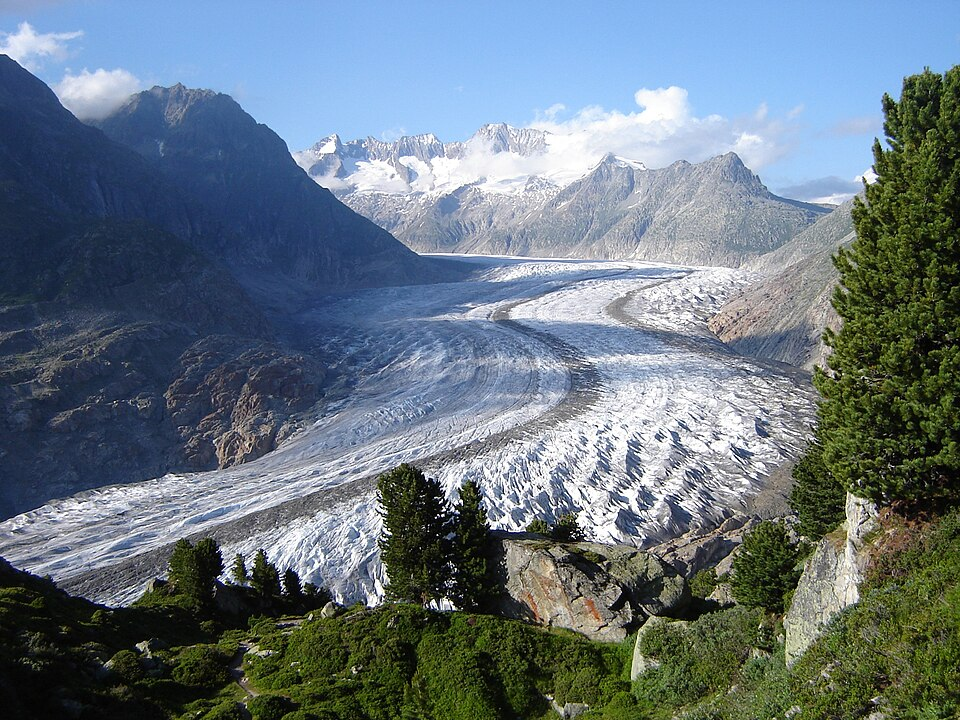
The mountains are also an essential source of water for Europe. Rivers such as the Rhine, Rhône, Ticino, Po and Inn originate in the Alpine region and eventually flow towards several different seas. Alpine water supports drinking supplies, agriculture and hydroelectric power, while numerous lakes—including Lake Geneva and Lake Garda—are important geographical and tourist features. The retreat of glaciers and increasingly variable snowfall associated with climate change may significantly affect future water availability.
The Alpine Region has exceptionally rich plant life, with around 13,000 recorded plant species. Vegetation changes with altitude, progressing from deciduous and coniferous forests to dwarf shrubs and finally alpine meadows above the tree line. Characteristic species include gentians, edelweiss, alpine roses and dwarf pines. Some flowering plants survive at more than 4,000 m (13,000 ft) by adapting to cold, strong winds and limited soil. Traditional land use, deforestation, ski development and changing agricultural practices have all influenced Alpine vegetation.
The Alps are home to around 30,000 animal species, many specially adapted to high-altitude environments. Important mammals include the Alpine ibex, chamois, marmot and brown bear, while golden eagles, bearded vultures and alpine choughs are among the characteristic birds. Reptiles, amphibians and fish can survive close to the snow line, while numerous butterflies, moths, beetles and other invertebrates inhabit the alpine environment. These species often occupy highly specialised habitats shaped by altitude, temperature and seasonal snow cover.
Climate
The Alpine Region illustrates how a temperate lowland climate changes progressively with increasing elevation. As altitude rises, temperatures fall because of the adiabatic lapse rate, producing conditions that can resemble those of polar environments. Mountain ranges also influence European weather by forcing moist air upward, where it cools and releases precipitation. The Alps therefore contribute to a broad wet–dry climatic contrast, with generally wetter conditions to the north and drier areas to the south. Local variations are considerable, and some valleys, including Aosta, Maurienne, Valais, and northern Tyrol, are relatively dry.
Precipitation generally increases with elevation, reaching around 2,600–3,600 mm (100–140 in) per year in the Alpine Region. At 1,000–3,000 m (3,300–9,800 ft), snowfall normally begins in November and persists until April or May, while the permanent snow line lies roughly between 2,400 and 3,000 m (7,900–9,800 ft). Snowmelt causes river and stream levels to reach their highest point in June and July, while areas receiving heavy precipitation can also experience flooding from rapid melting and runoff. The foehn wind, a warm and often dry downslope wind, is another characteristic Alpine weather phenomenon.
The region can be divided into several altitudinal climatic and ecological zones. The colline zone occupies the lowest elevations, roughly 500–1,000 m (1,600–3,300 ft), followed by the montane zone at about 800–1,700 m (2,600–5,600 ft) and the sub-Alpine zone from approximately 1,600–2,400 m (5,200–7,900 ft). Above these lies the Alpine zone, extending from the tree line to the permanent snow line, while the highest glaciated areas form the glacial zone.
Society of Alpine region
Demography
The Alpine Region has a population of around 14.2 million people, spread across an area of approximately 190,717 km² (73,636 sq mi), giving an average population density of about 74.6 inhabitants per km² (2013 data).
The largest cities within the Alpine arc include Grenoble, with 157,424 inhabitants, Innsbruck, with 122,458, Trento, with 117,185, Bolzano, with 106,441 and Lugano, with 68,677 inhabitants, rising to around 150,000 in its wider urban area. Turin, with 892,649 inhabitants, lies on the plain immediately at the foot of the Alps and is also described in Italy as the “Capital of the Alps.” Grenoble and Innsbruck likewise use the designation “Capital of the Alps”, reflecting their strong geographical and historical connections with the Alpine Region.
Languages
The Alpine Region is predominantly French-, German-, and Italian-speaking, with a significant Slovenian-speaking population as well. Its complex relief and the isolation of many valleys have helped preserve numerous linguistic minorities that have disappeared or become less widespread elsewhere. For example, Occitan has survived for centuries in the Po, Maira, and Varaita valleys, while Franco-Provençal (Arpitan) remains traditionally associated with the Aosta Valley.
The Alps are also home to several distinctive Rhaeto-Romance languages, including Friulian, Romansh, and Dolomite Ladin, although Friulian is also spoken outside the Alpine area. Some Germanic varieties are particularly associated with Alpine communities, notably Walser, Cimbrian, and Mòcheno. In the southern Alpine valleys, several Gallo-Italic languages are widespread, including Ligurian, Piedmontese, Lombard, and Venetian, often maintaining a stronger presence than in the neighboring Po Valley.
Religions
The Alpine Region is predominantly Roman Catholic, although Protestant communities are historically significant, particularly in several Swiss cantons. Ticino, by contrast, has traditionally had a Catholic majority. Religious diversity in the Alps was also shaped by the region’s geographical isolation: its valleys provided refuge for the Waldensian community, a Christian movement that originated in Lyon but was forced to leave the city because of religious persecution and subsequently established communities in parts of the Alpine valleys.
Economy of Alpine region
The economy of the Alpine Region is based largely on tourism, which attracts more than 120 million visitors each year and is especially important for mountain communities. Winter sports, particularly downhill skiing, are a major component, although summer tourism remains significant. Major resorts such as Oberstdorf, Saalbach, Davos, Chamonix, and Cortina d’Ampezzo can each receive more than one million visitors annually.
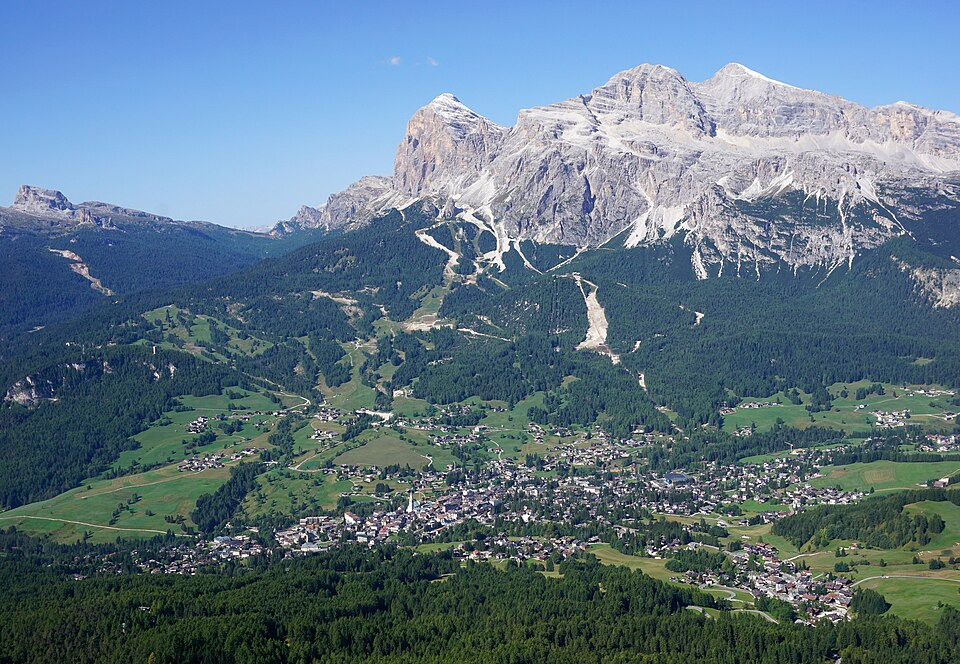
Alpine tourism developed during the early 19th century, when foreign visitors began travelling to the mountains for their landscapes and spa resorts. During the Belle Époque, large hotels were constructed and new railways enabled tourists to reach increasingly high elevations. Winter sports subsequently became more established, with figure skating and skiing gaining popularity and the first ski lifts appearing in the early 20th century.
After World War II, the construction of ski lifts and the expansion of resorts greatly increased access to winter tourism. From the mid-20th century onward, downhill skiing became increasingly popular, while new purpose-built ski resorts were developed, particularly in France. From the late 20th century, however, the rapid expansion of tourism and improved international accessibility raised concerns about traditional Alpine culture and sustainable development. Since around 2015, climate change has contributed to a decline in some high-altitude ski resorts and the total length of ski pistes, increasing reliance on artificial snowmaking.
Culture of Alpine region
Farming has been practiced throughout the Alpine Region for centuries, although its economic importance declined during the 20th century as tourism became increasingly important. The steep and rocky terrain limits available farmland, so grazing and pastoralism have traditionally played a major role. In summer, cattle are moved to high-altitude pastures near the snow line, where herders remain in small stone huts or wooden barns. Their return to the valleys in September is celebrated through traditions such as the Almabtrieb, when cattle are decorated with flowers and large bells and farmers wear traditional clothing.
Traditional Alpine architecture developed to withstand cold winters and heavy snowfall. In high-altitude villages, houses were often built according to medieval designs, with kitchens separated from heated living areas and bedrooms positioned on upper floors to benefit from rising heat. The Swiss chalet, which originated in the Bernese Oberland, is typically built of solid wood and has a sloping roof designed to manage snow. In different parts of the region, roofs may be made from schist, gneiss, slate, or wooden shingles, particularly in forested areas.
The Alpine Region also has a rich and diverse folk culture, especially in the German-speaking areas of Austria, Bavaria, South Tyrol, Liechtenstein, and Switzerland, as well as in Slovenia. Local cultural associations help preserve traditional customs, including folk costumes, music, dance, crafts, and seasonal celebrations. Traditional clothing such as lederhosen for men and dirndls for women is still worn during many festivals and weddings.
Alpine festivals vary between countries and communities and may include Alphorn music, traditional dances, wrestling, archery, and other local sports. Some celebrations preserve customs with pre-Christian origins, including the lighting of fires on Walpurgis Night and Saint John’s Eve. Other important occasions include Volksfeste, wine and harvest festivals, and Fastnacht celebrations before Lent, providing opportunities for local communities to maintain and display their traditional culture.
Cuisine of Alpine region
For centuries, Alpine cuisine has reflected the isolated rural lifestyle of mountain villages and alpine huts, despite considerable differences between regions. Traditional staples include milk and dairy products, cereals, and preserved meats, particularly those dried or smoked. The region’s great geographical extent, varied climates, and historically limited infrastructure have also allowed the cuisines of the surrounding countries to shape local traditions. For instance, sweet chestnuts are widely used in the French and Italian parts of the Alpine Region but are less important in Bavaria and Austria, while sauerkraut, common in Bavarian cuisine, is much less characteristic of southern areas such as Tyrol and South Tyrol.
The survival of these culinary traditions is supported not only by geographical isolation but also by organizations dedicated to protecting regional food heritage. In Switzerland, the Culinary Heritage of Switzerland, established in 2004, created an online encyclopedia documenting more than 400 traditional food products with support from national and cantonal authorities. Similarly, the Slow Food movement, founded in Piedmont, promotes the preservation of local culinary traditions and the diversity of regional food cultures throughout the Alpine Region.
Common products
Milk and dairy products have been fundamental to Alpine cuisine for centuries, reflecting the importance of cattle farming in mountain communities. Traditional dual-purpose cattle breeds, such as Simmental and Tyrol Grey cattle, were already valued for their milk production in Roman times, with writers such as Pliny the Elder and Strabo mentioning Alpine cattle and cheeses. Today, the region is renowned for a wide variety of cheeses, including Emmentaler, Allgäuer Bergkäse, and Tomme de Savoie, as well as numerous soft and hard cheeses made from goat’s milk.
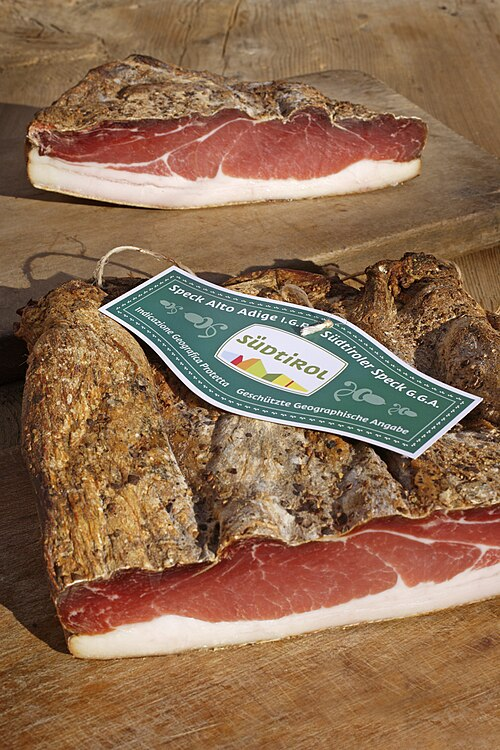
Bacon, sausages, and preserved meats developed partly because Alpine communities needed to preserve meat through the long winter months. Traditional products include Tyrolean Speck, South Tyrolean Speck, Bündnerfleisch, and Valais dried meat, several of which have protected geographical status. Other preserved meats, such as Kaminwurze, remain firmly established in the traditional cuisine of the Alpine Region.
Common dishes
The physically demanding work of mountain farmers and shepherds has traditionally required energy-rich food, making carbohydrate-based dishes and side dishes particularly important in Alpine cuisine. Common cereals include rye, barley, and wheat, used in foods such as bread, semolina dishes, Kaiserschmarrn, and barley soup. Buckwheat, valued for being hardy and easy to cultivate in difficult environments, also became an important Alpine crop. Regional specialities include Pizzoccheri and Sciatt in Valtellina, while Žganci is a traditional buckwheat dish in Slovenia. After maize was introduced to Europe, it became increasingly important and is now mainly consumed as polenta and similar maize-based dishes.
The Alpine Region also has a strong tradition of baked goods, particularly breads that can be stored for long periods, such as South Tyrolean Schüttelbrot and Vinschgauer. During winter, dried fruit is often incorporated into breads, including Kletzenbrot in Austria and South Tyrol and Swiss Birnbrot and Schlorzifladen. In poorer mountain communities, dried fruit was historically added to bread dough to make limited supplies of expensive flour last longer.
Other traditional Alpine dishes include Älplermagronen, Buchteln, Germknödel, Kartoffelpaunzen, Kaspressknödel, Maluns, Schlutz- and Schlipfkrapfen, and Spätzle, reflecting the considerable culinary diversity found across the region.
Common beverages
The southern Alpine regions benefit from relatively favourable climatic conditions for viticulture, and several areas have developed long-established wine traditions. South Tyrol, for example, has cultivated grapes since pre-Roman times, while Valais in Switzerland is another major Alpine wine-producing area. Wines from the French and Austrian Alpine regions have likewise gained international recognition.
Other characteristic products include Swiss Chèvre, Zirbenlikör, an Austrian liqueur made from pine cones, and Enzianschnaps, a spirit distilled from gentian roots. In Paznaun, Tyrol, traditional knowledge concerning the harvesting, processing, and use of gentian roots was recognised by UNESCO as intangible cultural heritage in 2013.
Political divisions of Alpine region
The following nations fall entirely within the Alpine region:
- Liechtenstein 🇱🇮
- Monaco 🇲🇨
The following nations are not entirely included within the Alpine region:
- Austria 🇦🇹, most of the country, particularly the western, central and southern mountainous areas.
- Switzerland 🇨🇭, much of the central and southern part of the country.
- Germany 🇩🇪, the extreme south of Bavaria.
- France 🇫🇷, the southeast, particularly the Alpine areas of Auvergne-Rhône-Alpes and Provence-Alpes-Côte d’Azur.
- Italy 🇮🇹, the northern part of the country along the Alpine arc, including parts of Piedmont, Aosta Valley, Lombardy, Trentino-Alto Adige/South Tyrol, Veneto, and Friuli-Venezia Giulia.
- Slovenia 🇸🇮, mainly the northwestern and northern areas.
Traditional recipes of Alpine region
(Only recipes unique to the area or strongly associated with it and rarely found elsewhere are included)
Traditional products of Alpine region
(Only products unique to the area or strongly associated with it and rarely found elsewhere are included)
Recipes commonly prepared in Alpine region
(Only products specific to this territorial level, and not already covered at a broader administrative or geocultural level, are included)
Products commonly consumed in Alpine region
(Only recipes specific to this territorial level, and not already covered at a broader administrative or geocultural level, are included)
Source(s):
https://en.wikipedia.org/wiki/Alps
https://it.wikipedia.org/wiki/Alpi
Photo(s):
1. Drat70, CC BY-SA 4.0 https://creativecommons.org/licenses/by-sa/4.0, via Wikimedia Commons
2. Jo Simon on Flickr, CC BY 2.0 https://creativecommons.org/licenses/by/2.0, via Wikimedia Commons
3. kallerna, CC BY-SA 4.0 https://creativecommons.org/licenses/by-sa/4.0, via Wikimedia Commons
4. Fotograf Frieder Blickle, CC BY-SA 4.0 https://creativecommons.org/licenses/by-sa/4.0, via Wikimedia Commons