
Western Europe
Introduction
Western Europe is the western part of Europe, but its boundaries can change depending on the historical, cultural, or geographical framework being used. The term has therefore been interpreted in different ways over time. During the Cold War (1945–1991), Western Europe was generally associated with the Western Bloc, led by the United States and NATO, in opposition to the Soviet-led Eastern Bloc and the Warsaw Pact. The Iron Curtain divided the continent for almost five decades, separating countries with different political and economic systems.
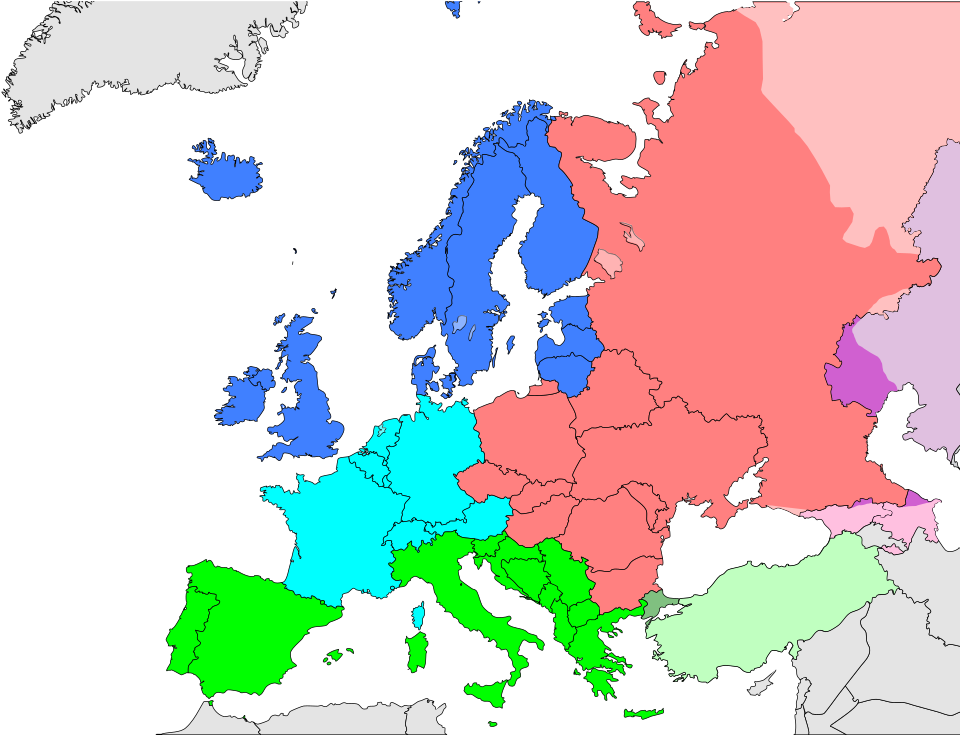
In this website, however, Europe is divided according to the UN geoscheme, which follows a mainly geographical rather than Cold War-based classification. Under this system, Western Europe is a relatively small region, comprising only a limited number of countries located roughly between Spain and the Czech Republic, with both countries excluded from the region.
Political division of Western Europe
The UN geoscheme identifies the following countries as belonging to the region. Any autonomous regions, dependencies, overseas territories, or other constituent territories are shown in parentheses after the country’s name, divided between those within and outside the region.
- Austria 🇦🇹
- Belgium 🇧🇪
- France 🇫🇷 (Outside Western Europe: Clipperton Island 🇫🇷, Corse, French Guiana 🇬🇫, French Polynesia 🇵🇫, French Southern and Antarctic Lands 🇹🇫, Guadeloupe 🇬🇵, Martinique 🇲🇶, Mayotte 🇾🇹, New Caledonia 🇳🇨, Saint Barthélemy 🇧🇱, Saint Martin 🇲🇫, Saint Pierre and Miquelon 🇵🇲, Wallis and Futuna 🇼🇫)
- Germany 🇩🇪
- Liechtenstein 🇱🇮
- Luxembourg 🇱🇺
- Monaco 🇲🇨
- Netherlands 🇳🇱 (Outside Western Europe: Aruba 🇦🇼, Bonaire 🇧🇶, Curaçao 🇨🇼, Saba 🇧🇶, Sint Eustatius 🇧🇶, Sint Maarten 🇸🇽)
- Switzerland 🇨🇭
Geo-cultural divisions of Western Europe
Although not all of these subregions fall entirely within the geographical boundaries of Western Europe, the region can be geoculturally divided into the following areas:
- Alpine region
- Benelux region
- French region (no separate pages are created for this region, as it essentially corresponds to Metropolitan France plus Monaco)
- Germanic region (no separate pages are created for this region, as it essentially corresponds to Germany)
Traditional recipes of Western Europe
(Only recipes unique to the area or strongly associated with it and rarely found elsewhere are included)
Traditional products of Western Europe
(Only products unique to the area or strongly associated with it and rarely found elsewhere are included)
Recipes commonly prepared in Western Europe
(Only products specific to this territorial level, and not already covered at a broader administrative or geocultural level, are included)
Products commonly consumed in Western Europe
(Only recipes specific to this territorial level, and not already covered at a broader administrative or geocultural level, are included)
Source(s):
https://en.wikipedia.org/wiki/Western_Europe
Photo(s):
1. Kolja21, CC BY 3.0 https://creativecommons.org/licenses/by/3.0, via Wikimedia Commons