
White mustard
Species of Sinapis
Food, Plant source foods, Plants (Plantae), Flowering plats (angiospermae), Mesangiosperms, Eudicots, Core eudicots, Superrosids, Rosids, Malvids (Eurosids II), Brassicales (Cruciales), Brassicaceae (Cruciferae), Sinapis
Species name: Sinapis alba
Consumption area(s): Earth
Note: For better understanding, please read the article on flowering plants (angiospermae) first. If you come across unfamiliar words, you can click on any highlighted term to open the glossary with definitions of key botanical terms.
Introduction
White mustard is a plant species within the genus Sinapis and a member of the Brassicaceae family. Valued as an aromatic plant, it provides one of the essential ingredients for traditional mustard condiments. The term white mustard refers to its pale seeds, while it is also known as yellow mustard, reflecting the bright yellow flowers it produces.
Description of the plant
White mustard grows as an annual herbaceous plant, typically reaching 30–60 cm in height, though it can occasionally grow from 15 to 220 cm. The upper parts of the plant are usually hairy, with hairs often pointing backward, while hairless stems are rare. The stems are angular and primarily branched in the upper portion.
The leaves are arranged alternately along the stem and consist of a petiole and leaf blade. Lower and middle leaves are generally petiolate, with blades ranging from 5 to 14 cm long and 2 to 6 cm wide, rarely up to 20 cm long or 8 cm wide. Their shape is highly variable, including oblong, ovate, lanceolate, or pinnatifid, with irregularly toothed or wavy margins. Each leaf may have two to three lobed segments on either side of the central vein and a prominent terminal lobe. Upper leaves are smaller, 2–4.5 cm long, mostly ovate, with shallowly toothed margins and sometimes almost entire.
Flowering occurs from June to July, sometimes extending to October in Switzerland. The terminal inflorescence begins corymb-like and elongates into a raceme as the axis stretches during fruit maturation, containing numerous flowers but no bracts. The pedicels are 5–7 mm long, generally rigid and hairy, and at least as long as the sepals.
The hermaphroditic flowers are tetramerous and radially symmetrical, about 10 mm in diameter. The four sepals, green or yellow, are narrowly elliptical, typically 4–7 mm long and 1–1.8 mm wide, spreading horizontally when open. The four yellow petals are 8–12 mm long and 4–6 mm wide. There are two pairs of nectar glands, and the flower contains four to six stamens with slender filaments (3–8 mm) and anthers (1.2–1.5 mm). The superior ovary consists of two fused carpels.
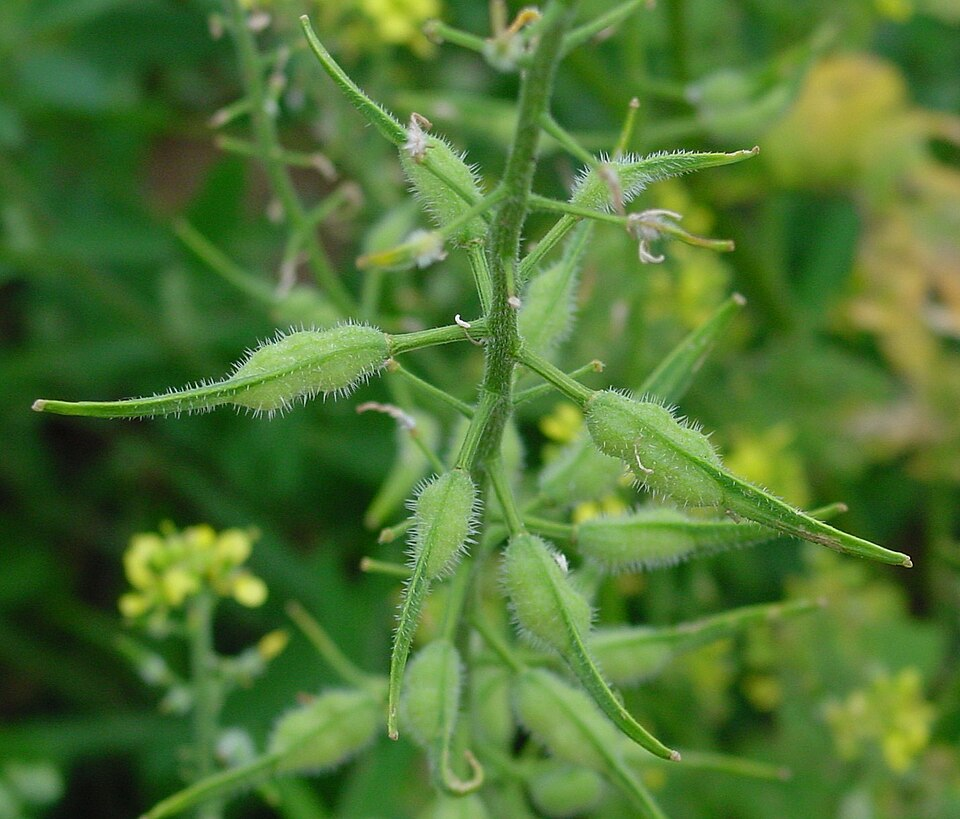
Fruits develop as silique scattered along the fruiting stem, which can reach up to 30 cm in length. The sturdy stem supporting the pods is usually 6–12 mm thick, angular, and slightly thickened at the tip. The siliques are 2–4.2 cm long, 3–5.5 mm in diameter, and contain 4–8 seeds. The upper portion of the silique forms a flattened beak 10–25 mm long, roughly the same length as the rest of the pod, often sickle-shaped. The overall silique shape is a reliable identifying feature of this species.
Description of the edible parts (seeds)
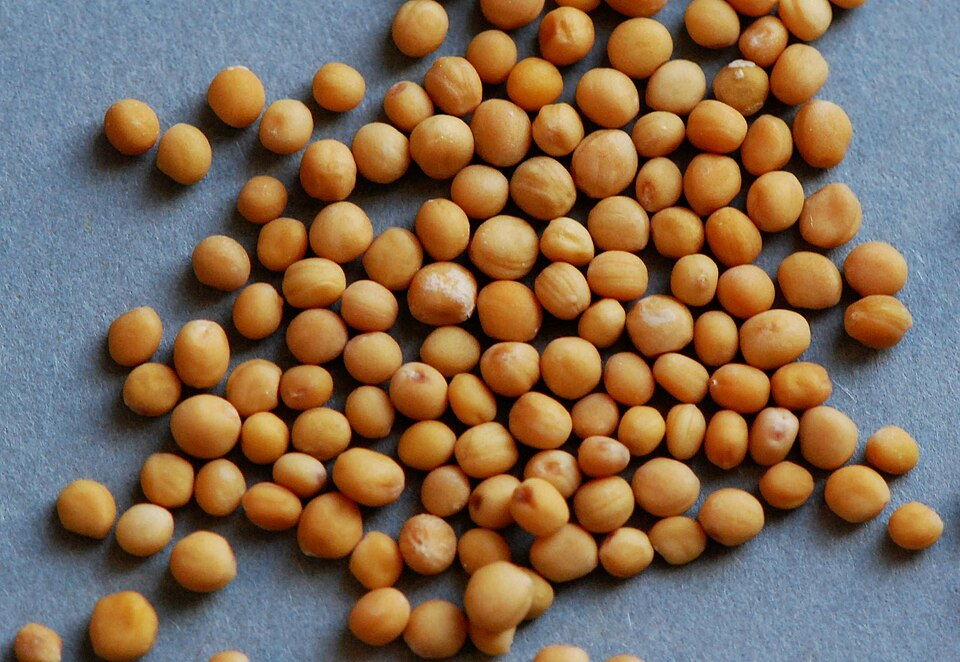
The seeds are typically pale yellow, light brown, gray, or reddish-brown in color and are nearly spherical in shape. They usually measure 2–3 mm in diameter (occasionally from 1.7 to 3.5 mm). The seed coat is finely reticulated, giving it a delicate textured surface.
Uses of white mustard
White mustard seeds can be used whole for pickling or toasted to add flavor to various dishes. When ground and combined with other ingredients, they form a paste or the more familiar table mustard. In some recipes, turmeric is added to enhance the yellow color of the condiment. The seeds are rich in sinalbin, a substance responsible for their pungent taste. In white mustard, sinalbin is broken down by enzymes such as myrosinase, producing ‘white principles’. Compared to black mustard seeds, white mustard contains fewer volatile oils, resulting in a milder flavor.
In Greece, the leaves are consumed during winter, before flowering, and are locally known as vrouves (βρούβα) or lapsana (λαψάνα). In California’s wine regions (Napa and Sonoma Counties), the flowering season of white mustard (February–March) is celebrated with an annual Mustard Festival.
Nutritional facts table of the seeds
Since nutritional values can vary slightly depending on the cultivar, the figures provided below represent general averages.
| Nutrients | Per 100 g |
| Calories (kcal) | 448 |
| Total fat (g) | 28.3 |
| ———Saturated fat (g) | 1.89 |
| Cholesterol (mg) | 0 |
| Sodium (mg) | 0 |
| Total carbohydrates (g) | 30.9 |
| ———Dietary fiber (g) | 20.9 |
| ———Total sugar (g) | 10 |
| Protein (g) | 28 |
Recipes that use this product as an ingredient:

Photo(s):
1. Leo Michels, Public domain, via Wikimedia Commons
2. Pancrat, CC BY-SA 3.0 https://creativecommons.org/licenses/by-sa/3.0, via Wikimedia Commons