
Sinapis
Genus of Brassicaceae (Cruciferae)
Food, Plant source foods, Plants (Plantae), Flowering plats (angiospermae), Mesangiosperms, Eudicots, Core eudicots, Superrosids, Rosids, Malvids (Eurosids II), Brassicales (Cruciales), Brassicaceae (Cruciferae)
Consumption area(s): We were unable to find reliable data on the distribution of this product, but it is presumably consumed mainly in Europe.
Note: For better understanding, please read the article on flowering plants (angiospermae) first. If you come across unfamiliar words, you can click on any highlighted term to open the glossary with definitions of key botanical terms.
Introduction
Sinapis constitute a small group of plants within the Brassicaceae family. Among them, white mustard stands out as a highly significant cultivated species, widely valued for its agricultural and economic importance.
Description of Sinapis
Species of the genus Sinapis are mostly annual herbaceous plants, only rarely perennial, typically reaching heights of about 30–80 cm. The above-ground parts may be hairless or covered with simple trichomes, while the upright stem is often branched toward the upper portion.
The leaves, arranged alternately in a spiral pattern along the stem, may be petiolate or sessile and either simple or compound. Lower leaves are generally petiolate and strongly lobed or pinnate, whereas upper leaves possess short or barely visible petioles and are less dissected, with only shallow lobing. The leaf margins are usually irregularly and coarsely toothed.
Flowers develop in a terminal inflorescence that begins corymb-like and gradually elongates into a raceme as the axis extends during fruit maturation. The bisexual flowers, typical of the Brassicaceae, display a cruciform arrangement with four free green sepals and four yellow, spreading petals. The androecium consists of six fertile stamens with oblong anthers, while two fused carpels form a superior ovary containing several ovules. A short style ends in a stigma with two lobe, and four separate nectary glands are present.
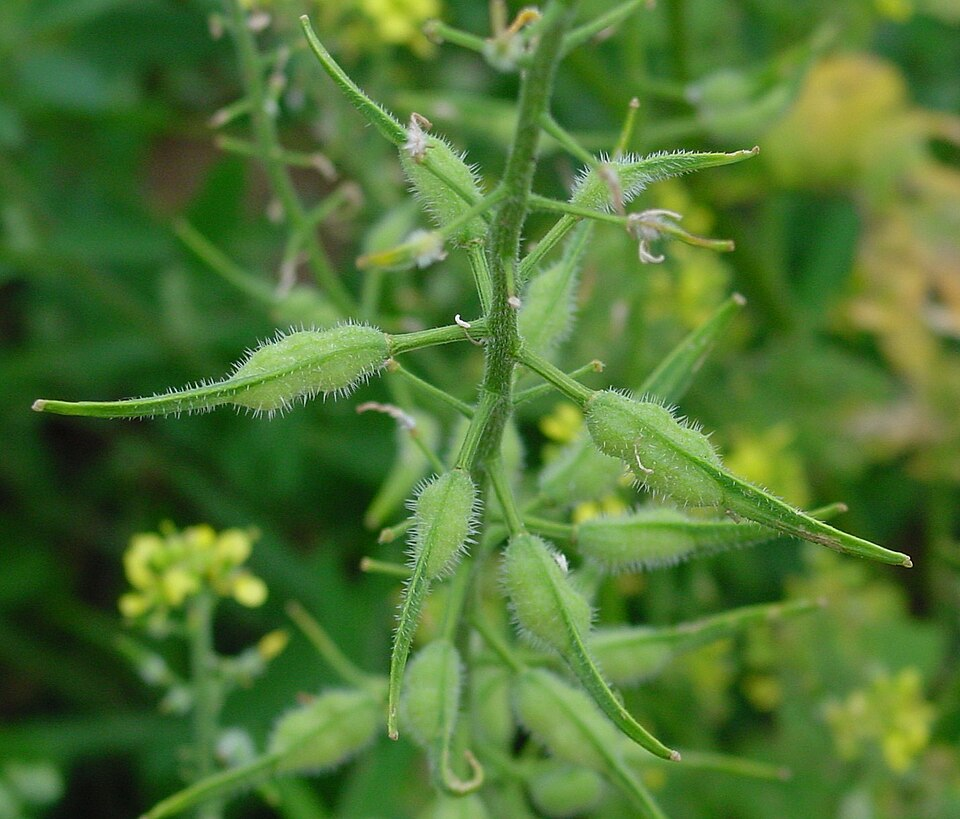
The inflorescence is generally loosely structured, and the fruit stalks may be slender or thickened. The fruits are elongated silique that vary in forms, often slightly quadrangular in cross-section, and split open into two valves at maturity. A distinctive trait of this genus is the extended, seedless beak at the tip of the silique. The valves show several raised longitudinal ribs, while the membranous septum and rounded replum are fully developed. Each fruit locule typically contains two to five seeds arranged in a single row, with the terminal segment often empty or sparsely seeded.
The seeds are usually rounded and somewhat stout, occasionally slightly flattened, and have a finely reticulate surface. Inside, the cotyledons are folded lengthwise. Notably, mustard seeds possess an exceptionally long viability, remaining capable of germination for several decades.
Classification of Sinapis
This genus is further divided into species. Among them are:
- White mustard
- Wild mustard
Photo(s):
1. Leo Michels, Public domain, via Wikimedia Commons