
Penne
Foods, Culinary bases, Flour-based foods, Shaped unleavened doughs, Italian pasta
Consumption area(s): Italy 🇮🇹, San Marino 🇸🇲, Vatican City 🇻🇦
Introduction
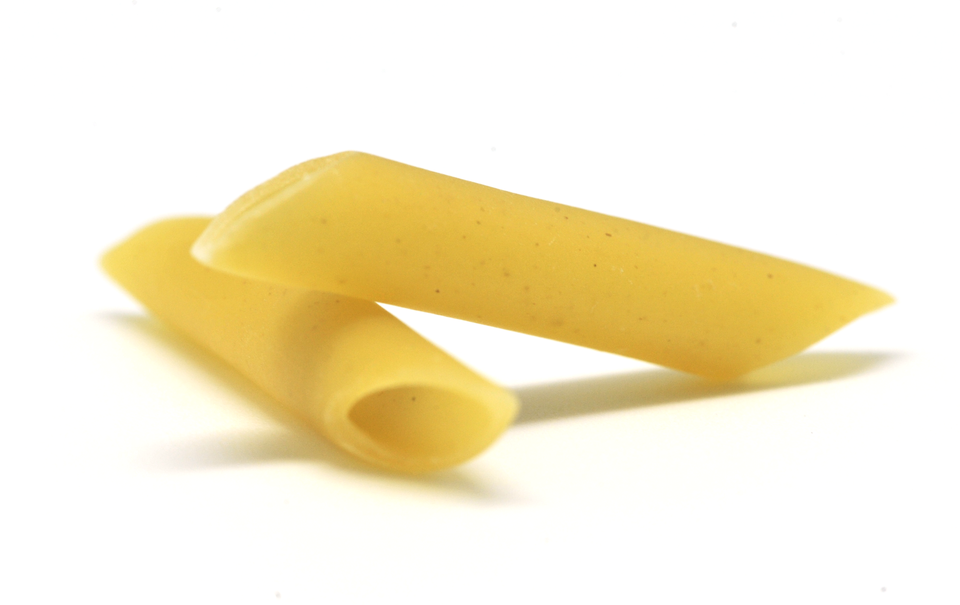
Penne are a widely recognized type of short pasta, distinguished by their hollow, cylindrical body and diagonally cut ends. Their shape gives them a particularly effective structure for carrying sauces, as the seasoning can collect both inside the tube and on the outer surface. The name penne derives from their resemblance to the pointed nibs of writing pens, reflecting the distinctive appearance of the newly developed pasta shape.
Description of penne
Penne are traditionally produced in two main varieties: penne lisce (smooth penne), with a smooth exterior, and penne rigate, marked by longitudinal ridges that increase the pasta’s ability to retain sauce. A larger version is known as pennoni, while mezze penne are shorter versions of the standard format.
Their hollow structure makes penne particularly versatile in cooking, allowing sauces to penetrate the central cavity. The ridged version provides an even stronger grip for thicker or more substantial sauces. They are generally served al dente and paired with a broad range of preparations, from simple tomato-based sauces to more elaborate recipes. Among the best-known combinations is penne all’arrabbiata, traditionally associated with Lazio, in which the pasta is dressed with a spicy tomato sauce. Another particularly famous preparation is penne alla vodka, made with tomato, cream and vodka, which became especially fashionable during the 1980s and later experienced renewed popularity in the United States.
History of penne
Penne have the unusual distinction of having a well-documented date and place of origin. Their development can be traced to 1865, when Giovanni Battista Capurro, a pasta maker from San Martino d’Albaro, then an independent locality and now part of Genoa, patented a machine capable of cutting pasta diagonally.
The invention was significant because it allowed fresh pasta to be cut at an angle without being crushed, making it possible to obtain the characteristic penne shape in different lengths. The original production included shorter pieces of approximately 3 cm, corresponding to mezze penne, and longer pieces reaching around 5 cm, corresponding to standard penne.
Production methods for penne
Although the production process is broadly similar across the different types of penne, each variety may have specific characteristics related to its shape and surface. For this reason, the production method is described separately on the individual pages dedicated to each penne subtype.
Classification of penne
Penne can be classified according to their length and the texture of their surface. We can found:
- Mezze penne (half penne)
- Penne lisce (smooth penne)
- Penne rigate (ridged penne)
- Pennoni
Nutritional facts table
Please note that nutritional values may vary slightly depending on the producer or the exact ingredients used.
| Nutrients | Per 100 g dry weight | Per 100 g fresh weight |
| Calories (kcal) | 359 | 240 |
| Total fat (g) | 2 | 1 |
| ———Saturated fat (g) | 0.5 | 0.2 |
| Cholesterol (mg) | 0 | 0 |
| Sodium (mg) | 0.5 | 0.67 |
| Total carbohydrates (g) | 70.9 | 48 |
| ———Dietary fiber (g) | 3 | 2.6 |
| ———Total sugar (g) | 3.5 | 0.4 |
| Protein (g) | 12.8 | 8.7 |
Photo(s):
1. Popo le Chien, CC0, via Wikimedia Commons