
Passata di pomdoro 🇮🇹 🇸🇲 🇻🇦
Food, Plant source foods, Plants (Plantae), Flowering plats (angiospermae), Mesangiosperms, Eudicots, Core eudicots, Superastierds, Asterids, Lamiids, Solanales, Solanaceae, Solanum, Tomato
Consumption area(s): Italy 🇮🇹, San Marino 🇸🇲, Vatican City 🇻🇦
Introduction
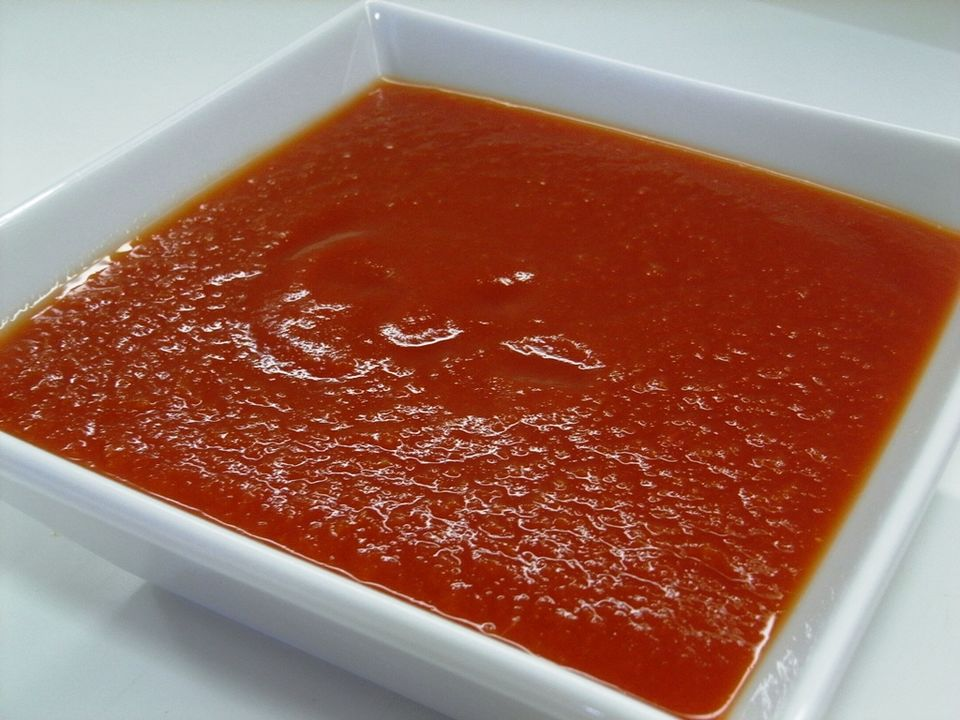
Passata di pomodoro (Tomato pureé) is a dense liquid created by straining tomatoes. It’s often mistaken for tomato sauce, but the two are different. Sauce is produced by cooking this product and incorporating additional ingredients such as onion, garlic, extra virgin olive oil, herbs, or spices. In some recipes, the passata itself may already contain elements like basil, olive oil, or salt, though these can also be added later during the preparation of dishes.
Compared to passata, tomato pulp is not strained or cooked; it is simply peeled and pulped, resulting in larger, chunkier pieces. Tomato paste is prepared in a manner similar to passata, but the final product is much thicker due to a higher degree of water evaporation, giving it a denser and more concentrated texture.
Production methods for passata di pomodoro
Homemade passata di pomdoro
Passata di pomodoro
Іngredients
- 2.5 kg
ripe tomato (4.4 lb) - 10
(sweet) basil leaves (optional, not always used) - 1/2 tbsp
table salt
Іnstructions
- Inspect all tomatoes carefully, discard any damaged ones, wash them thoroughly, remove the stems, cut them lengthwise, and press out the seeded core.
- Collect the cleaned tomato pulp in one bowl and the extracted juice in another, then transfer the pulp to a large pot.
- Cook the tomatoes over low heat for about 30 minutes, stir occasionally, and salt them once fully softened.
- Pass the cooked tomatoes through a food mill in small batches, using a medium-fine disc, and gather the tomato passata in a clean container.
- The passata can be eaten immediately or canned to preserve it for up to about one year, if proper hygienic and heat-processing steps are followed as described below.
Canning the tomato passata
- Prepare jars and lids by properly sanitizing them before use. Three primary methods can be employed:Boiling sterilization (most reliable method): check integrity of jars and lids, then wash both thoroughly in hot water without detergent. Fully submerge jars and lids in a pot of water, bring to a rolling boil and maintain for about 30 minutes (≈ 100°C / 212°F). Allow to cool in the water or remove with sterilized tongs and place on a clean cloth.Oven sterilization (fan-assisted): wash jars and lids in hot water without detergent. Place jars (without lids) on a tray and heat at 170°C (≈ 338°F) for about 20 minutes. Lids and seals, also washed without detergent, should be placed in the switched-off oven for about 10 minutes. Handle all items with heat protection and let cool on a clean cloth.Dishwasher sterilization: place jars and lids suitable for high temperatures in the dishwasher, washed without detergent, with no other items. Run a high-temperature cycle (≥70°C / 158°F). At the end of the cycle, place jars and lids upside down on a clean cloth to air-dry completely.
- Fill the sanitized jars with the hot passata, ensuring you leave about 1–1.5 cm (½ inch) of headspace at the top. If desired, add a small amount of previously washed basil leaves before sealing the jars.
- Seal the jars firmly, submerge them in hot water, bring to a boil, and process them according to size: 30 minutes for 250 g jars (about 8.8 oz), 35 minutes for 500 g (about 17.6 oz), 40 minutes for 1 kg (about 2.2 lb).
- Remove the jars with care, allow them to cool completely, and verify vacuum sealing before storing.
Notes:
Industrial passata di pomdoro
The processing of passata largely follows the same path as tomato paste, with a few key differences: there is no stage of concentration, and the blanching is performed more slowly at lower temperatures to preserve the natural texture and flavor. After crushing the tomatoes, they undergo blanching, which helps the skin separate from the pulp.
The mixture then moves through the refining stage, where it first passes through a pulper that removes skins and seeds using a combination of a screw mechanism and centrifugal force, and is subsequently passed through a finer refiner to achieve a smooth consistency. The passata is then pasteurized to ensure safety and extend shelf life, before being finally packaged for distribution.
Nutritional facts table
| Nutrients | Per 100 g |
| Calories (kcal) | 31 |
| Total fat (g) | 0.1 |
| ———Saturated fat (g) | 0 |
| Cholesterol (mg) | 0 |
| Sodium (mg) | 200 |
| Total carbohydrates (g) | 5.1 |
| ———Dietary fiber (g) | 1.6 |
| ———Total sugar (g) | 4.5 |
| Protein (g) | 1.5 |
Recipes that use this product as an ingredient:

Source(s):
https://it.wikipedia.org/wiki/Passata_di_pomodoro
Photo(s):
1. Javier Lastras da Spagna/Spagna, CC BY 2.0, via Wikimedia Commons