
Basil
Spieces of Ocimum
Food, Plant source foods, Plants (Plantae), Flowering plats (angiospermae), Mesangiosperms, Eudicots, Core eudicots, Superastierds, Asterids, Lamiids (Euasterids I), Lamiales, Lamiaceae, Nepetoideae, Ocimum
Species name: Ocimum basilicum
Consumption area(s): Earth
Note: For better understanding, please read the article on flowering plants (angiospermae) first. If you come across unfamiliar words, you can click on any highlighted term to open the glossary with definitions of key botanical terms.
Introduction
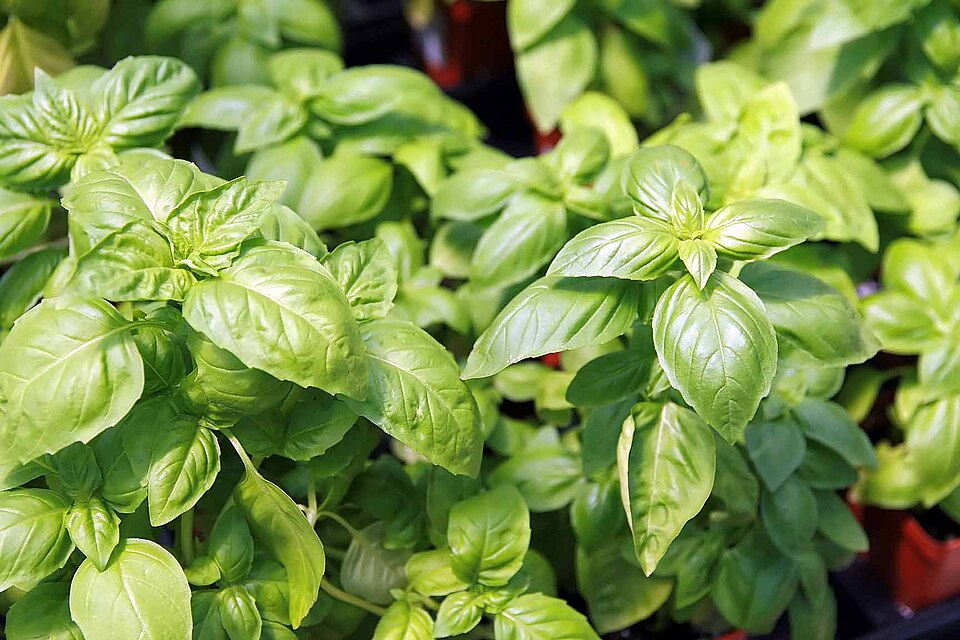
Basil, commonly known as great basil, is a fragrant herb from the mint family. This delicate plant is used in countless culinary traditions, and in most Western dishes the name “basil” usually refers to the familiar sweet or Genovese cultivar. It originated in tropical areas stretching from Central Africa to Southeast Asia, and while it is grown as an annual in cooler regions, it can survive a bit longer as a short-lived perennial or biennial in warmer, Mediterranean-like climates.
Description of the plant
Basil is generally cultivated as an annual herb, though certain forms may persist for more than one season. In most cultivars, the plant rises anywhere from 30 to 150 centimetres, displaying a notable variability in stature. The foliage consists of glossy, ovate leaves whose margins may appear smooth or lightly toothed. They often curve subtly upward and occur in opposite pairs along the plant’s square stems. Their coloration spans from bright green to deep purple, depending on the specific variety.
At the top of the main stem, a central inflorescence produces clusters of small white flowers. Unlike the typical structure observed in other Lamiaceae, basil’s four stamens and pistil rest on the lower lip of the corolla rather than being hidden beneath the upper portion. Once the flowers are insect-pollinated, the corolla soon detaches, and within the bilabiate calyx four rounded achenes begin to mature.
Description of the edible parts (leavev and seeds)
Leaves
Basil is most often used fresh, since its aroma fades rapidly when heated, so it is usually added at the end of cooking. The leaves can be stored briefly in the refrigerator in sealed bags, or preserved longer by freezing them after a quick blanching. Its taste carries a note reminiscent of licorice.
In Mediterranean cooking, well-known types include Sweet (Genovese), Purple Ruffles, Mammoth, Cinnamon, Lemon, Globe, and African Blue. Basil is essential for pesto, where it is blended with olive oil, and it also appears in many sauces and soups, sometimes even helping to thicken them. The herb is often infused into cream or milk to flavor desserts such as ice cream or truffles, and it is also used to make aromatic oils or vinegars.
The variety known as lemon basil has a pronounced citrus scent and taste because of its citral content. It is widely enjoyed in Indonesia, where it is eaten fresh alongside meat or fish.
Seeds
When placed in water, the seeds of certain basil varieties turn gel-like, a texture that makes them popular in various Asian beverages and desserts, including Indian faluda, Iranian sharbat-e-rihan, and the drink known as hột é. In Kashmir, people traditionally end the Ramadan fast with babre beole, a sweet, cooling sharbat prepared with these seeds.
Production methods for basil
Basil grows best in warm, dry, and sunny conditions and is highly sensitive to cold. It thrives in well-drained, organic soils where roots receive plenty of oxygen, and stronger light can increase its height, biomass, and dry matter. Although native to warmer regions, it is widely cultivated in the Mediterranean, temperate, and subtropical zones.
In cooler climates, seeds are often started indoors and transplanted after frost risk passes, or sown directly once the weather warms. Basil can also grow indoors under bright or artificial lighting, which can enhance growth, flowering, and essential oil production, while UV-B exposure boosts certain volatile compounds.
When a stem flowers, it stops producing leaves, becomes woody, and yields fewer aromatic oils. Gardeners often pinch flower stem to encourage leaf growth, while selective harvesting of leaves promotes branching. If allowed to flower, basil forms small black seeds that can be saved for the next season, and some plants may even regrow the following year.
Basil is propagated from seeds or cuttings, with seeds germinating best at high temperatures and benefiting from a 12-hour soak to improve vigor. Cuttings, taken from healthy tips of the stems, often produce an earlier harvest and higher yields, and exposure to blue light accelerates root formation, shortening the overall growing period.
History of basil ad food
Basil has long been tied more to superstition than to food traditions, appearing in the beliefs of communities throughout Asia, the Middle East, and the Mediterranean. References to its culinary use do not appear until the late 1700s, and reports from 19th-century travelers describe different Ocimum species growing across Africa, Persia, and tropical Asia, whether wild or cultivated.
Among the Egyptians and Greeks, the plant carried strong associations with death and the afterlife, even serving in embalming. In contrast, Chinese and Arab cultures valued its medicinal effects, while Crusaders relied on basil to mask foul odors and ward off insects on their ships.
To the Greeks and Romans, basil held darker meanings, linked to evil, misfortune, and hatred. Writers such as Pliny the Elder claimed it could induce lethargy or madness, and Chrysippus warned of harm to the stomach and liver. The Romans even associated it with the mythical basilisk, believing the herb could act as a protective antidote. Folklore from parts of Africa adds that it shields against scorpions.
During the Middle Ages, basil found use in treating wounds and was included in vulnerary waters applied to the skin. Some naturalists, including Nicholas Culpeper, regarded it as poisonous, and legends suggested it might even attract scorpions when placed beneath a pot. Medieval manuscript imagery portrayed it as a sign of hatred or Satan, while Jewish folklore attributed to it a capacity to give strength during fasting.
Classification of basil
The basil is classified into cultivars and hybrids. Below are some of the main examples:
Cultivar
- Anise basil
- Cinnamon basil
- Dark opal basil
- Greek basil
- Globe basil
- Lettuce leaf basil
- Napolitano basil
- Purple basil
- Rubin basil
- Sweet basil (Genovese basil)
- Thai basil
Hybrids
- African blue basil
- Lemon basil
- Spice basil
Nutritional facts table of leaves
Please note that nutritional values may vary slightly depending on the specific cultivar or hybrid, but they differ mainly between fresh and dried products.
| Nutrients | Fresh leaves (100 g) | Dried leaves (100 g) |
| Calories (kcal) | 23 | 233 |
| Total fat (g) | 0.5 | 4.1 |
| ———Saturated fat (g) | 0 | 2.2 |
| Cholesterol (mg) | 0 | 0 |
| Sodium (mg) | 4 | 76 |
| Total carbohydrates (g) | 3 | 47.8 |
| ———Dietary fiber (g) | 2 | 37.7 |
| ———Total sugar (g) | 0 | 1.7 |
| Protein (g) | 3 | 23 |
Nutritional facts table of seeds
Please note that nutritional values may vary slightly depending on the specific cultivar or hybrid
| Nutrients | Per 100 g |
| Calories (kcal) | 391 |
| Total fat (g) | 16.86 |
| ———Saturated fat (g) | 1.73 |
| Cholesterol (mg) | 0 |
| Sodium (mg) | 19 |
| Total carbohydrates (g) | 53.28 |
| ———Dietary fiber (g) | 29 |
| ———Total sugar (g) | 0.43 |
| Protein (g) | 15.25 |
Source(s):
https://en.wikipedia.org/wiki/Basil
https://it.wikipedia.org/wiki/Ocimum_basilicum
Photo(s):
1. Photo by David J. Stang, CC BY-SA 4.0 https://creativecommons.org/licenses/by-sa/4.0, via Wikimedia Commons