
White-clawed crayfish
or Atlantic stream crayfish
Species of Austropotamobiu
Food, Animal source foods, Animals (Animalia), Arthropods (Arthropoda), Crustaceans (Crustacea), Decapods (Decapoda), Pleocyemata, Astacidea, Astacidae, Austropotamobius
Species name: Austropotamobius pallipes
Consumption area(s): Andorra 🇦🇩, Austria 🇦🇹, Bosnia and Herzegovina 🇧🇦, Croatia 🇭🇷, France 🇫🇷, Ireland 🇮🇪, Italy 🇮🇹, Liechtenstein 🇱🇮, Monaco 🇲🇨, Portugal 🇵🇹, Russia 🇷🇺, San Marino 🇸🇲, Slovenia 🇸🇮, Spain 🇪🇸, Switzerland 🇨🇭, United Kingdom 🇬🇧, Vatican City 🇻🇦
Introduction
White-clawed crayfish is a European freshwater crayfish currently listed as endangered. Its common names include the white-clawed crayfish and Atlantic stream crayfish.
This species is generally absent from acidic waters and prefers moderately flowing streams. It coexists with various freshwater invertebrates, including caddisflies, mayflies, and mollusks, while trout and the three-spined stickleback share the same habitat. Shelter is provided by tree roots and rocks along the stream banks, whereas juvenile crayfish find refuge in vegetation such as watercress and mats of grass extending from the banks.
Description of White-clawed crayfish
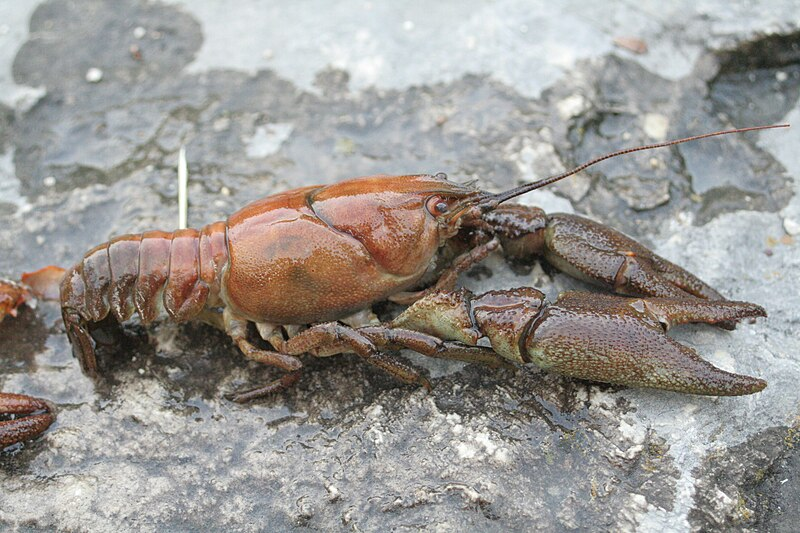
In many European countries, this species is commonly called the “white-clawed crayfish” due to the distinctive pale coloration of its legs and ventral side, which contrasts with the darker body, ranging from reddish-brown to dark green, sometimes with yellowish tones. The crayfish is stout with a robust carapace, reaching up to 11–12 cm in length and 90 g in weight. Males are generally larger than females.
It inhabits well-oxygenated streams and rivers, favoring gravel or sandy beds with banks that offer sheltered hiding spots, often provided by fallen tree branches or leaf litter. Being a cold-blooded organism, it thrives in cool waters with an optimum around 15 °C, tolerating temperatures only up to 23 °C. This species is predominantly nocturnal.
Its diet is omnivorous, including algae, aquatic plants, worms, mollusks, and insect larvae. It exhibits strong territorial and mating aggression, with captured individuals sometimes showing partially or fully damaged limbs or claws.
Reproduction mainly occurs in autumn. The female carries approximately 100 fertilized eggs on her abdomen for 5–6 months, continuously ventilating and cleaning them. The eggs hatch in spring, but the juveniles remain attached to the mother’s body for a period before becoming independent.
Nutritional facts table of White-clawed crayfish
As specific nutritional values for this species are not available, the general values for freshwater crayfish.
| Nutrients | Per 100 g |
| Calories (kcal) | 81 |
| Total fat (g) | 1.2 |
| ———Saturated fat (g) | 0.18 |
| Cholesterol (mg) | 133 |
| Sodium (mg) | 94 |
| Total carbohydrates (g) | 0 |
| ———Dietary fiber (g) | 0 |
| ———Total sugar (g) | 0 |
| Protein (g) | 17 |
Recipes that use this product as an ingredient:

Source(s):
https://en.wikipedia.org/wiki/Austropotamobius_pallipes
https://it.wikipedia.org/wiki/Austropotamobius_pallipes
Photo(s):
1. David Gerke, CC BY-SA 3.0 https://creativecommons.org/licenses/by-sa/3.0, via Wikimedia Commons