
Penne lisce (smooth penne) 🇮🇹 🇸🇲 🇻🇦
Foods, Culinary bases, Flour-based foods, Shaped unleavened doughs, Italian pasta, Penne
Consumption area(s): Italy 🇮🇹, San Marino 🇸🇲, Vatican City 🇻🇦
Introduction
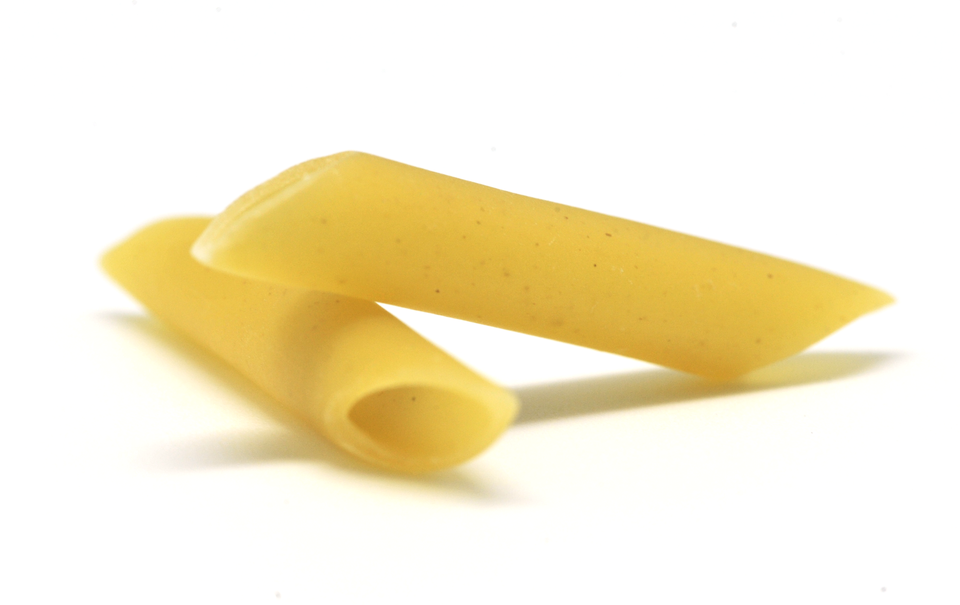
Penne lisce (smooth penne), are a variety of penne distinguished by their smooth, untextured outer surface. Like other penne, they have a hollow cylindrical shape with ends cut diagonally, but lack the longitudinal ridges characteristic of penne rigate. Their relatively compact shape allows them to hold sauce inside the central cavity while maintaining a clean and firm texture when properly cooked.
Production methods for penne lisce
Penne lisce are typically sold as dry pasta, ready to cook straight from the package. However, it’s also possible to make them from scratch at home, as shown in the recipe below.
Penne lisce (smooth penne)
Іngredients
- 500 g
semola (4 cups) (outside Italy, it is perfectly acceptable to use a standarddurum wheat semolina) * - 250 ml
water (1 cup)
Іnstructions
- Place the semola on a clean work surface and gradually add the water, mixing it in slowly while kneading continuously. You can also use a stand mixer fitted with a dough hook.
- Knead until you obtain a smooth, uniform dough.
- Shape the dough into a ball, wrap it tightly in plastic wrap, and let it rest at room temperature for about 30 minutes.
- Roll out the dough using a pasta machine or a rolling pin until you get a smooth, thin sheet about 2 millimeters (0.08 inches) thick.
- Cut the sheet into squares of equal size, each side measuring approximately 2 centimeters (0.8 inches).
- Place each square over a smooth pasta board or work surface, then position the shaping stick diagonally across the dough. Roll the dough around the stick to form the characteristic hollow, cylindrical shape with diagonally cut ends of penne lisce. Gently remove the pasta from the stick and continue until all the dough has been used.
- Alternatively, cut the dough into strips and feed them into a pasta extruder fitted with a smooth penne die. Extrude the dough and cut it into pieces of approximately 5 centimeters (2 inches) in length.
- Then, using a knife, trim both ends diagonally to obtain the characteristic slanted edges of penne lisce. Continue until all the dough has been used.
- Arrange the finished penne lisce on a tray, keeping the pieces well separated, and leave them in a cool, dry place until ready to cook.
Notes:
Nutritional facts table
Please note that nutritional values may vary slightly depending on the producer or the exact ingredients used.
| Nutrients | Per 100 g dry weight | Per 100 g fresh weight |
| Calories (kcal) | 359 | 240 |
| Total fat (g) | 2 | 1 |
| ———Saturated fat (g) | 0.5 | 0.2 |
| Cholesterol (mg) | 0 | 0 |
| Sodium (mg) | 0.5 | 0.67 |
| Total carbohydrates (g) | 70.9 | 48 |
| ———Dietary fiber (g) | 3 | 2.6 |
| ———Total sugar (g) | 3.5 | 0.4 |
| Protein (g) | 12.8 | 8.7 |
Recipes that use this product as an ingredient:

Photo(s):
1. Popo le Chien, CC0, via Wikimedia Commons