
Neopterygii
Subclass of ray-finned fish (or Actinopterygians, Actinopterygii)
Food, Animal source foods, Animals (Animalia), Chordates (Chordata), Vertebrates (Vertebrata), Bony fish (Osteichthyes), Ray-finned fish (or Actinopterygians, Actinopterygii)
Consumption area(s): Earth
Introduction
Neopterygii represents a major lineage within the Ray-finned fish (Actinopterygii). This group is divided into two principal branches, Holostei and Teleostei, with teleosts accounting for the overwhelming majority of modern fish species and more than half of all living vertebrates.
Present-day holosteans are restricted to freshwater habitats, whereas teleosts have successfully colonized a wide range of ecosystems, occurring in both marine and freshwater environments. Their remarkable evolutionary success has resulted in an extraordinary level of biodiversity across the globe. The diversity of teleosts continues to expand as scientific research progresses. Every year, numerous previously unknown species are identified and formally described, highlighting the vast and still incompletely explored richness of this group.
Description of Neopterygii
During the early stages of their evolutionary history, Neopterygii achieved considerable success thanks to significant improvements in locomotion. Compared with their ancestral ray-finned fish, they developed a lighter skeleton and reduced scale mass, features that enhanced agility and swimming efficiency. Their jaws also became stronger and more effective, allowing them to exploit food resources more successfully.
Although the transition from earlier actinopterygians involved relatively few anatomical changes, some innovations had profound evolutionary consequences. One of the most important was the increased control of the dorsal and anal fins, which greatly enhanced swimming performance and maneuverability.
Additional modifications of the skull enabled the development of a wide variety of feeding strategies. These adaptations allowed neopterygians to exploit previously inaccessible resources and occupy a broad range of ecosystems. Together, these evolutionary advancements contributed to the extraordinary diversification of the group, making Neopterygii the most dominant assemblage of fish and, consequently, the largest vertebrate lineage in terms of species diversity.
Classification of Neopterygii
This subclass is divided into the following infraclasses:
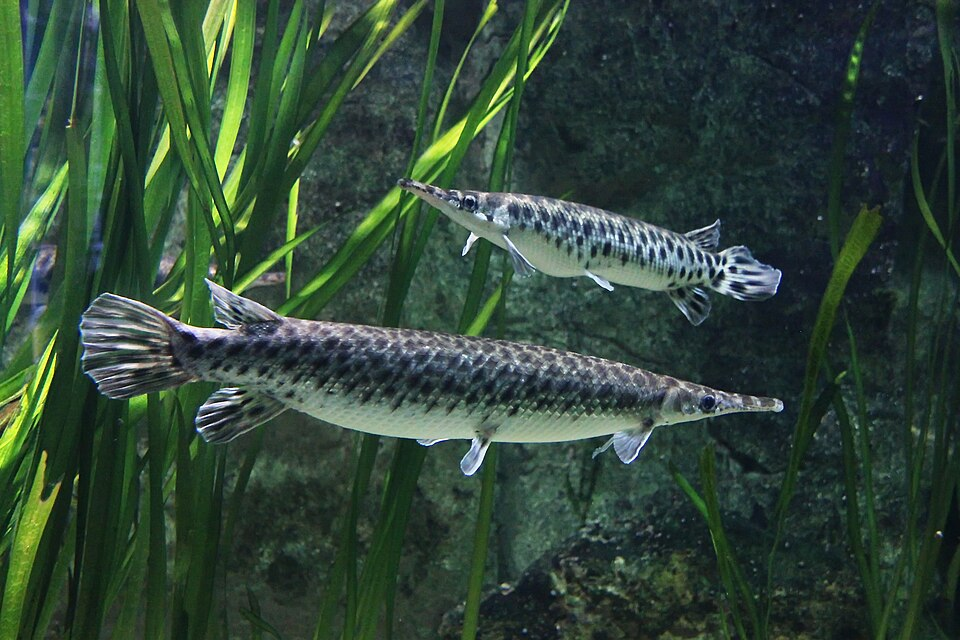
- Holostei (bowfins, gars)
- Teleosts (Teleostei) (cods, eels, salmons, sardines, trouts, tuna)
Source(s):
https://en.wikipedia.org/wiki/Neopterygii
Photo(s):
1. Usien, CC BY 3.0 https://creativecommons.org/licenses/by/3.0, via Wikimedia Commons