
Ray-finned fish (or Actinopterygians, Actinopterygii)
Class of bony fish (Osteichthyes)
Food, Animal source foods, Animals (Animalia), Chordates (Chordata), Vertebrates (Vertebrata), Bony fish (Osteichthyes)
Consumption area(s): Earth
Introduction
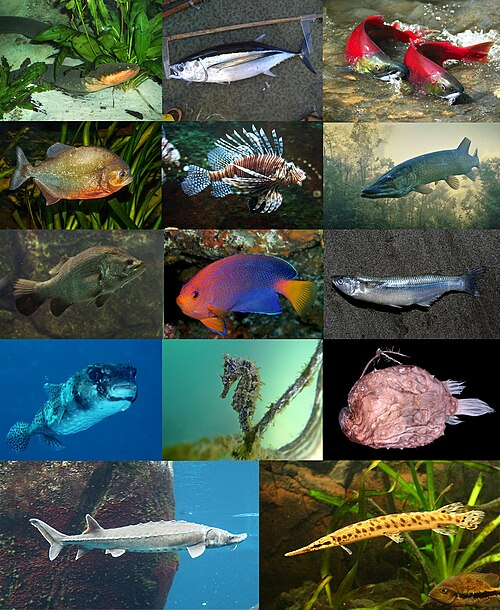
Ray-finned fish (or Actinopterygians, Actinopterygii) represent a major class of bony fishes. These animals include an overwhelming majority of living fish diversity and account for almost 99% of more than 30,000 known fish species. Ray-finned fishes are distributed globally, occupying freshwater systems, brackish zones, and fully marine environments. They can be found from deep oceanic regions to underground waters and even in high-altitude mountain streams.
Their ecological range is matched by a striking diversity in body size. Size variation within the group is extreme: at the lower end, species such as Paedocypris measure only about 8 mm (0.3 in), while at the upper extreme, organisms like the giant sunfish can reach approximately 2,700 kg (6,000 lb), and the giant oarfish may extend to around 8 m (26 ft), with some reports suggesting up to 11 m (36 ft).
A defining anatomical feature of this lineage is the structure of their fins. Unlike the fleshy fins of their lobe-finned relatives, ray-finned fishes possess lightweight, fan-like fins supported by fine bony rods known as lepidotrichia. This arrangement allows the fins to flex and reshape rapidly, optimizing movement efficiency. These fins behave much like adjustable fans, capable of altering shape, angle, and surface area in response to swimming demands. This flexibility enhances propulsion efficiency, producing a superior thrust-to-weight performance compared with both lobe-finned fish and cartilaginous fish.
At the structural level, the fin rays are connected directly to internal skeletal support elements called radials, which serve as the articulation points linking the fins to the deeper endoskeletal framework, including structures such as the pelvic and pectoral girdles.
Description of Ray-finned fishes (or Actinopterygians, Actinopterygii)
Ray-finned fish display a wide array of morphological and physiological adaptations that vary significantly across lineages. A central anatomical innovation is the swim bladder, a gas-filled organ primarily involved in buoyancy control, although its structure and function differ markedly among groups.
In most ray-finned fish, the swim bladder originates as a dorsal outgrowth above the foregut. This contrasts with the condition seen in bichirs, where it develops ventrally in a manner comparable to the lungs of lobe-finned fish, preserving a more ancestral configuration. In early-diverging forms, this organ retained a respiratory role, a function still observed in Holostei such as bowfins and gars. In certain specialized species like the arapaima, the swim bladder has been secondarily modified to facilitate air-breathing, while in other evolutionary lines it has been entirely lost.
Another major physiological distinction concerns the urogenital system. In teleosts, excretory and reproductive system are completely separated, whereas in Chondrostei they share common ducts, and intermediate configurations with partial separation occur in groups such as Cladistia and Holostei.
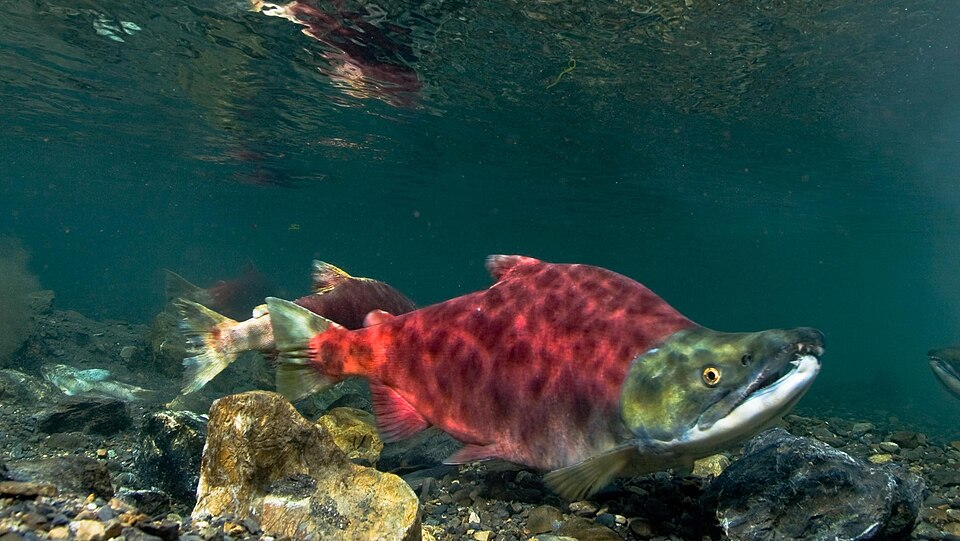
The integument also shows broad diversity. Ray-finned fish exhibit multiple scale types, but all teleosts possess thin, flexible leptoid scales, characterized by fan-like outer ridges and a fibrous internal structure. These scales lack the heavily enamel– or dentine-like layers typical of more primitive forms and are notably lighter and more transparent. Unlike ganoid scales, new leptoid scales grow by incremental concentric layering as the organism increases in size.
Reproductive strategies in ray-finned fish are predominantly characterized by separate sexes and external fertilization, where females release eggs into the environment and males fertilize them externally. Development typically includes a free-swimming larval stage. However, reproductive diversity is considerable, and sequential hermaphroditism is relatively common. The most frequent pattern is protogyny, in which individuals begin life as females and later transition to males in response to environmental or social triggers, while protandry (male-to-female transition) is comparatively rare.
Parental care varies widely across species. Most oviparous teleosts do not exhibit parental care, leaving eggs unattended after spawning. Nevertheless, a significant minority of families display viviparity, ovoviviparity, or varying degrees of egg care provided by one or both parents. Among living species, viviparity remains relatively uncommon, occurring in a small fraction of teleosts, with male parental care being more prevalent than female care.
Some exceptional reproductive systems include cases of self-fertilization, as seen in the mangrove rivulus, an simultaneous hermaphrodite capable of producing both gametes and performing internal fertilization. Its reproductive flexibility is linked to its ecological adaptation to extended periods outside water in mangrove habitats. Occasionally, males emerge at lower temperatures (below 19 °C / 66 °F) and can fertilize eggs produced by hermaphroditic individuals, thereby maintaining genetic material diversity within an otherwise highly inbred population.
Classification of Ray-finned fishes (or Actinopterygians, Actinopterygii)
This class is divided into the following subclasses:
- Chondrostei (paddlefish, sturgeons)
- Neopterygii (bowfins, carps, cods, eels, gars, pikes, salmons)
Source(s):
https://en.wikipedia.org/wiki/Actinopterygii
Photo(s):
1. MathKnight, CC BY-SA 4.0 https://creativecommons.org/licenses/by-sa/4.0, via Wikimedia Commons
2. Milton Love, Marine Science Institute, University of California, Santa Barbara, CA 93106, Public domain, via Wikimedia Commons