
Refined corn oil (refined maize oil)
Food, Plant source foods, Vegetable oils and derivatives, Corn oil
Consumption area(s) (countries that consumed more than 0.5 kg per person annually in 2023):
Argentina 🇦🇷, Azerbaijan 🇦🇿, Bahrain 🇧🇭, Belgium 🇧🇪, Bulgaria 🇧🇬, Canada 🇨🇦, China 🇨🇳, Croatia 🇭🇷, Estonia 🇪🇪, France 🇫🇷, Germany 🇩🇪, Greece 🇬🇷, Honduras 🇭🇳, Hungary 🇭🇺, Israel 🇮🇱, Italy 🇮🇹, Jordan 🇯🇴, Kuwait 🇰🇼, Libya 🇱🇾, Monaco 🇲🇨, Mozambique 🇲🇿, North Korea 🇰🇵, Oman 🇴🇲, Palestine 🇵🇸, Paraguay 🇵🇾, Qatar 🇶🇦, San Marino 🇸🇲, Saudi Arabia 🇸🇦, Serbia 🇷🇸, Slovenia 🇸🇮, South Africa 🇿🇦, Suoth Korea 🇰🇷, Spain 🇪🇸, Saint Lucia 🇱🇨, Tanzania 🇹🇿, Tunisia 🇹🇳, United Arab Emirates 🇦🇪, United Kingdom 🇬🇧, United States of America 🇺🇸, Uruguay 🇺🇾, Vatican City 🇻🇦, Venezuela 🇻🇪, Zimbabwe 🇿🇼
Chemical/physical properties:
- Saponifiable fraction: ~99%
- Saturated fatty acids: ~2-12%, including 8.0–19% palmitic acid, 0.5–4% stearic acid, and trace amounts of behenic acid (<0.5%), arachidic acid (<0.5%), plus minor contributions from other saturated fatty acids
- Unsaturated fatty acids: ~83-97%, including 19.5–50% oleic acid, 34–62% linoleic acid, and 0.1–2% linolenic acid, with minor contributions from gadoleic acid (<0.5%), plus trace amounts of other unsaturated fatty acids
- Unsaponifiable fraction: ~1%
Chemical/physical properties:
- Smoke point: 232°
- Density: 0.92 kg/l a 15 °C
Introduction
Refined corn oil is a corn oil obtained after a series of industrial refining processes designed to improve its stability, neutrality, and suitability for large-scale food production. During refining, impurities, free fatty acids, pigments, and volatile compounds are removed, resulting in an oil that is typically colorless, odorless, and almost completely neutral in flavor. These characteristics make it particularly useful in processed foods and culinary applications where the oil should not alter the original taste of the product.
Description of refined corn oil
One of the most important technological properties of refined corn oil is its relatively high smoke point, close to 200 °C, which allows it to withstand high cooking temperatures with reduced oxidative degradation. For this reason, it is extensively employed in deep-frying, industrial food preparation, and other heat-intensive cooking methods.
The refining process also improves the oil’s oxidative stability. Manufacturers frequently enrich refined corn oil with tocopherols or vitamin E, natural antioxidants that help delay rancidity and prolong shelf life. In many commercial products, beta-carotene is additionally incorporated to provide the characteristic yellow appearance commonly associated with edible vegetable oils.
From a nutritional perspective, refined corn oil remains rich in polyunsaturated fatty acids, especially linoleic acid, and contains relatively low levels of saturated fats. However, the refining process may reduce part of the naturally occurring micronutrient content originally present in less processed oils.
Nutritional facts table
Please note that nutritional values can vary slightly depending on corn types
| Nutrients | Per 100 g |
| Calories (kcal) | 828 |
| Total fat (g) | 99.9 |
| ———Saturated fat (g) | 12,9 |
| Cholesterol (mg) | 0 |
| Sodium (mg) | 0 |
| Total carbohydrates (g) | 0 |
| ———Dietary fiber (g) | 0 |
| ———Total sugar (g) | 0 |
| Protein (g) | 0 |
Recipes that use this product as an ingredient:

Photo(s):
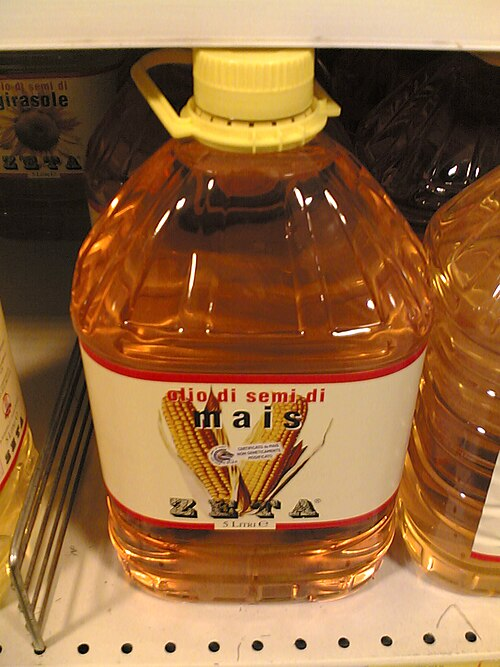
1. Basilicofresco, CC BY-SA 3.0 https://creativecommons.org/licenses/by-sa/3.0, via Wikimedia Commons