
Amphibians (Amphibia)
Class of vertebrates
Food, Animal source foods, Animals (Animalia), Chordates (Chordata), Vertebrates (Vertebrata)
Consumption area(s): Earth
Introduction
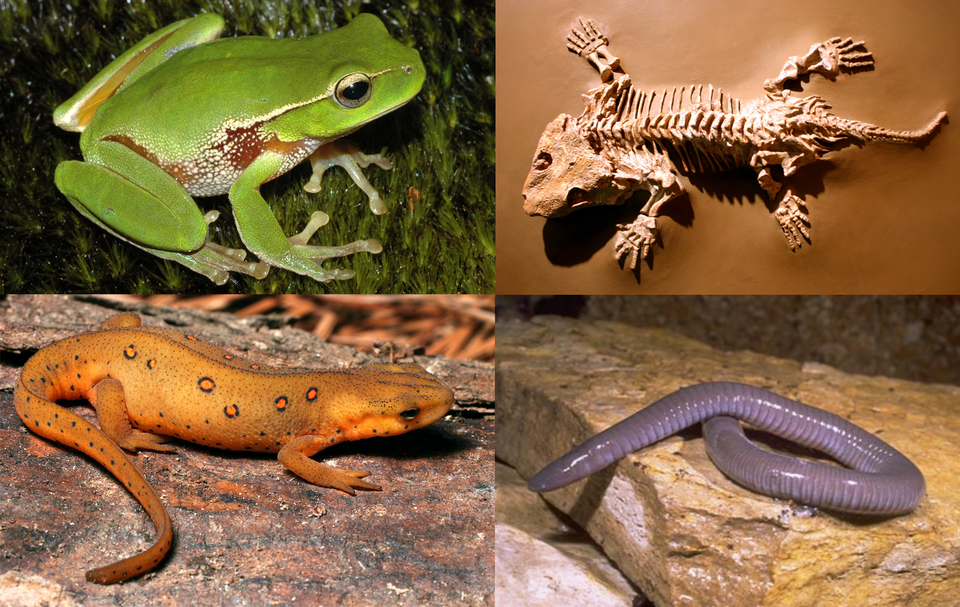
Amphibians (Amphibia) are vertebrate organisms classified within the phylum Chordata. They represent the earliest vertebrates to successfully adapt to life on land as tetrapods, and historically they experienced a wide radiation and diversification. Despite this, most species still maintain a strong dependence on aquatic environments. The term “amphibian” reflects their dual life strategy: their life cycle typically includes an aquatic phase, and in many species, the larval stage differs markedly in form from the adult stage. This transformation occurs through metamorphosis, a process that reshapes their structure and function as they mature.
Description of amphibians (Amphibia)
Amphibians are tetrapods whose ears has adapted to detect airborne sounds. In this transition, the stapes became thinner than in more primitive relatives and connects to a surface membrane known as the eardrum, clearly visible in frogs. Within the inner ear, they also possess a specialized sensory structure called the papilla amphibiorum. Their skin is highly vascularized and rich in glands, including mucus-secreting and, in some species, glands that also release toxic compounds. often linked to bright warning colors. The mouth contains small teeth used to grip prey, which is swallowed whole.
The skin is periodically shed and frequently consumed by the animal itself. In adults, it remains moist and plays a dual role: offering protection and assisting in respiration. Because it allows significant water loss, amphibians are typically restricted to humid environments. Their limbs, four in total, are relatively simple but well suited for jumping, especially in anurans, whose compact body, elongated rear region, and absence of a tail enhance their leaping ability.
Their lungs are structurally simple and not highly efficient, so much of the gas exchange occurs through the skin (cutaneous respiration), which must stay moist. In some groups like salamanders, lungs are elongated and simple, while certain species may entirely lack lungs and rely on external gills. The circulatory system centers on a three-chambered heart with two atria and one ventricle, causing partial mixing of oxygenated and deoxygenated blood. Circulation is therefore double—as blood passes twice through the heart—and incomplete, due to this mixing.
The digestive system ends in a shared chamber called the cloaca, which serves for the elimination of waste, as well as the release of gametes.
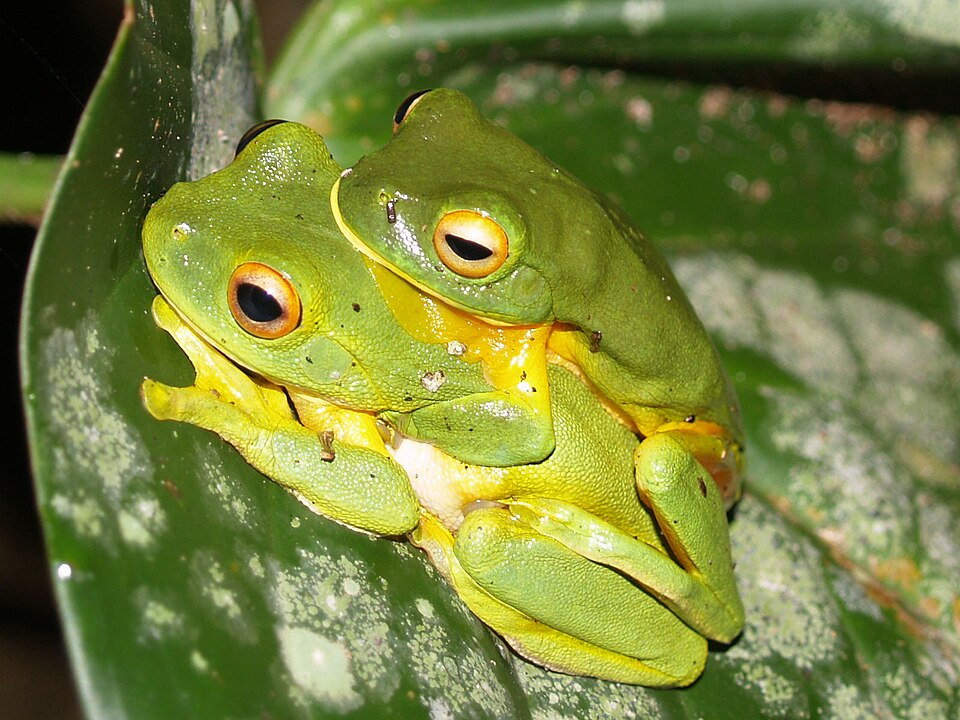
Reproduction in most species remains closely tied to water and is generally sexual. Eggs lack a protective shell and are enclosed in a gelatinous layer, requiring deposition in aquatic environments, where they swell upon contact with water. Fertilization is typically external, with the male clasping the female and releasing sperm as eggs are laid, though more derived species may show internal fertilization.
The embryos develop into aquatic larvae, equipped with a tail, external gills, and a long digestive tract, along with a keratinized mouth structure adapted to diet. Through metamorphosis, gradual transformations occur: limbs develop, lungs form, gills disappear, and in many cases the tail is lost. In some evolutionary lineages, this transformation has been reduced or lost.
Certain species, such as the axolotl, exhibit neoteny, retaining larval traits even in an adult stage. This condition can be reversed experimentally through exposure to an hormone which triggers full development and a shift toward terrestrial life. Many salamanders display forms of neoteny, sometimes influenced by environmental conditions. However, in species like the olm, metamorphosis does not occur even when stimulated hormonally.
Classification of amphibians (Amphibia)
Amphibians are primarily classified into orders. These are:
- Caecilians (Gymnophiona)
- Frogs (Anura)
- Salamanders (Urodela)
Source(s):
https://it.wikipedia.org/wiki/Amphibia
Photo(s):
1. Various; see each photo, CC BY-SA 3.0 http://creativecommons.org/licenses/by-sa/3.0/, via Wikimedia Commons
2. Rainforest_harley, CC BY-SA 2.0 https://creativecommons.org/licenses/by-sa/2.0, via Wikimedia Commons