
Frogs (Anura)
Order of amphibians (Amphibia)
Food, Animal source foods, Animals (Animalia), Chordates (Chordata), Vertebrates (Vertebrata), Amphibians (Amphibia)
Consumption area(s): Earth
Introduction
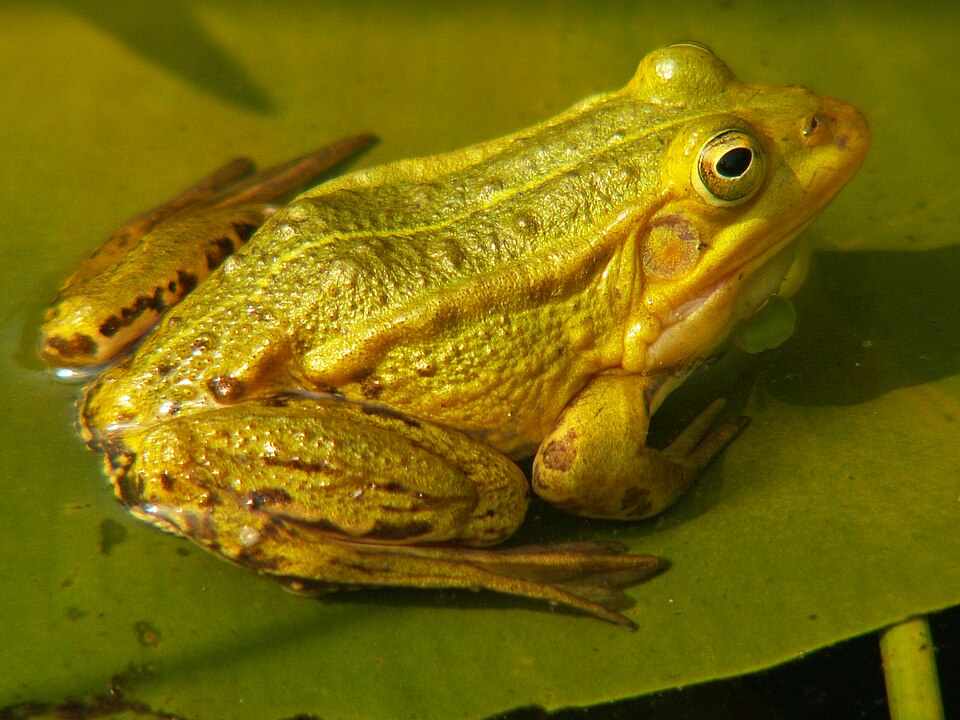
Frogs (Anura) are a highly diverse assemblage of short-bodied, tailless amphibian vertebrates that belong to the order Anura. Most species are at least partially semi-aquatic, relying on both aquatic habitats and terrestrial environments across different stages of their life cycle.
Frogs are found across an exceptionally wide geographical range, from equatorial tropical zones to subarctic climates, demonstrating a remarkable ecological adaptability. However, their highest levels of species richness and diversity are concentrated in tropical rainforests and associated wetland ecosystems, where environmental conditions support complex amphibian life cycles. Collectively, frogs represent approximately 88% of all living amphibian species, making them the dominant group within Amphibia. In broader evolutionary terms, they also rank among the five most species-rich vertebrate orders, highlighting their major role in global vertebrate biodiversity.
Description of frogs (Anura)
Anuran amphibians typically range in body length from about 35 to 75 millimetres, although their size variation is extreme across species. At the lower end, some of the smallest known representatives include Psyllophryne didactyla and Eleutherodactylus iberia, measuring roughly 10 mm and 10.5 mm respectively. In stark contrast, the largest member of the group is Conraua goliath, a giant frog reaching approximately 32 cm in body length, and up to 70–80 cm in total length when the legs are fully extended.
Their anatomy is strongly specialized for jumping locomotion, particularly through the elongation of the hind limbs, which are supported by an additional skeletal element formed by the fusion and extension of the astragalus and calcaneus in the ankle region. The body is generally compact and robust, with a broad skull, relatively small forelimbs, and disproportionately powerful hind limbs. Most species have large protruding eyes and a clearly visible tympanic membrane on each side of the head. The mouth is wide, and many species possess a rapidly projecting adhesive tongue used for prey capture.
The vertebral column is short, usually composed of around eight pre-sacral vertebrae, tightly fused to limit movement mainly to slight lateral and dorso–ventral flexion. The posterior vertebrae are fused into a single structure called the urostyle, functionally analogous to a tailbone. Sexual dimorphism is common: females are often larger, while males may develop more robust hind limbs. Vocal communication is widespread, produced by lung compression and air sac resonance, and reflects their classification as tailless amphibians.
Many tropical species exhibit toxicity or venom production, often accompanied by highly conspicuous coloration, such as combinations of red, yellow, and blue patterns with black markings, which serve as warning signals to predators.
In terms of feeding, all frogs and toads are strict carnivores, consuming only live prey, primarily insects and other aquatic or terrestrial invertebrates. Their vision is highly sensitive to movement, making stationary prey largely ignored. Because they lack the ability to chew, prey is swallowed whole.
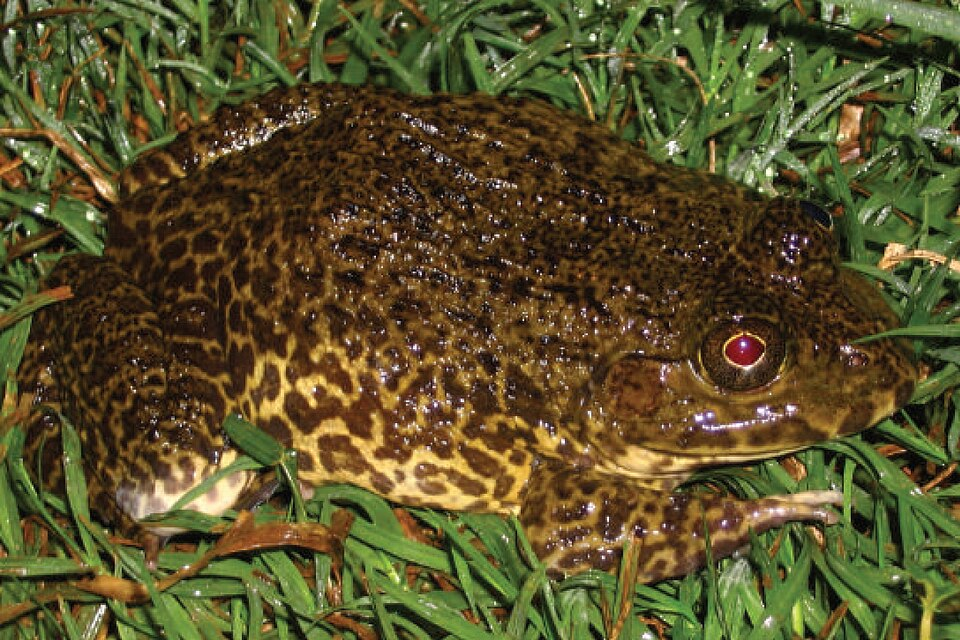
Reproduction typically occurs in aquatic environments, with external fertilization following mating. Females lay large numbers of eggs—often between 100 and 200, though survival rates are low. Eggs hatch into tadpoles, which undergo a developmental period lasting approximately 1.5 to 3 months. During metamorphosis, they develop limbs for jumping, lungs for aerial respiration, lose the tail, and shift from a detritivorous diet to carnivory. Adult males attract females through croaking calls, produced by inflating vocal sacs, and females often select mates based on the strength and intensity of the call.
Communication systems in frogs work like a kind of biological frequency separation, where different species produce calls in different sound ranges to avoid overlap and make it easier to recognize each other. Body size influences acoustic properties: larger frogs tend to produce lower-frequency, deeper, and more spaced calls, while smaller species emit higher-pitched and more rapid signals.
Some species that are less competitive acoustically have evolved alternative signaling strategies. For example, males of Lithobates albilabris generate ground vibrations by pressing parts of their bodies into mud, while females of the Malaysian tree frog produce signals by tapping their hind limbs against vegetation such as reeds.
Classification of frogs (Anora)
Frogs (Anura) are primarily classified into families. These are:
- Ranidae (European edible frog, marsh frog, American bullfrog)
- Dicroglossidae (Indian bullfrog, Chinese edible frog)
- Pyxicephalidae (African bullfrog)
- Leptodactylidae (South American edible frogs)
Source(s):
https://en.wikipedia.org/wiki/Frog
https://it.wikipedia.org/wiki/Anura
Photo(s):
1. Piet Spaans, CC BY-SA 2.5 https://creativecommons.org/licenses/by-sa/2.5, via Wikimedia Commons
2. Arvin Diesmos, National Museum of the Philippines, nationalmuseum.gov.ph, Public domain, via Wikimedia Commons