
Yogurt
Food, Animal source foods, Dairy products
Consumption area(s): Earth
Introduction
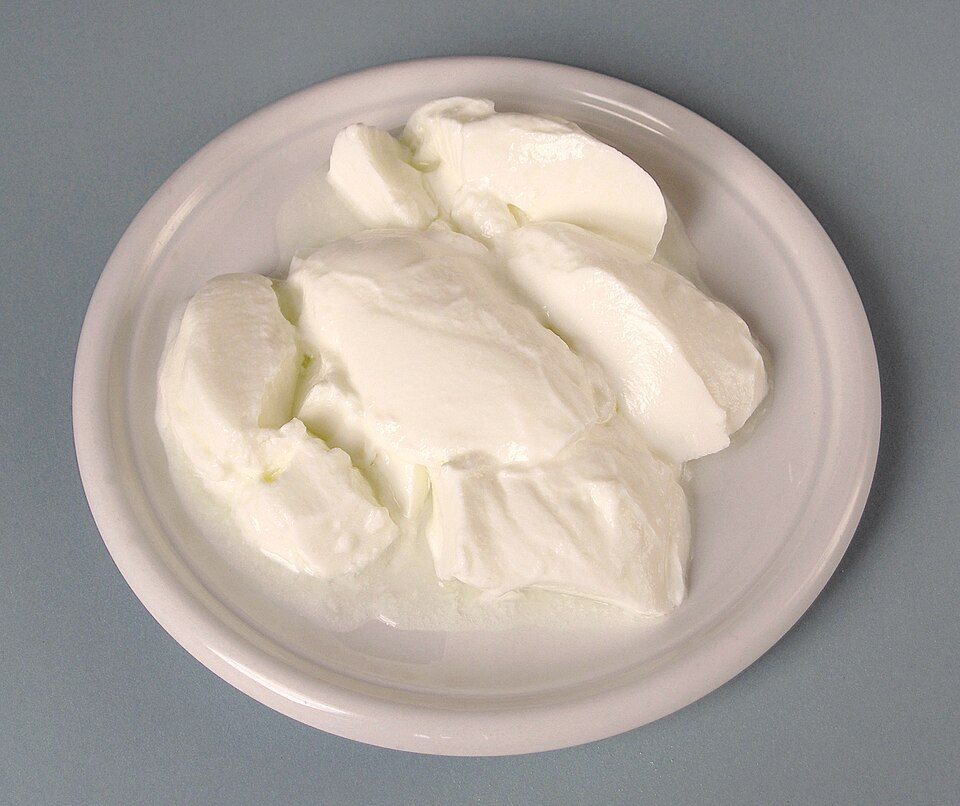
Yogurt is a dairy product obtained through the bacterial fermentation of milk, during which specific microorganisms convert the milk sugars into lactic acid. This acid modifies the protein structure of the milk, giving yogurt its distinctively creamy texture and tangy flavor. Although cow’s milk is the most common base, yogurt can also be made from the milk of goats, sheep, buffalo, camels, or even yaks, each lending the final product its own unique qualities.
The production process relies on lactic acid bacteria such as Lactobacillus delbrueckii subsp. bulgaricus and Streptococcus thermophilus, which drive the fermentation. Sometimes, additional strains like lactobacilli or bifidobacteria are introduced to enhance the yogurt’s health benefits. Certain countries, including China, have established specific standards regulating the minimum bacterial count required for a product to be labeled as yogurt — typically at least one million colony-forming units (CFU) per milliliter.
Throughout fermentation, the temperature must be kept between 30 and 45°C (86–113°F) for a duration of 4 to 12 hours. Longer fermentation results in higher acidity, while excessive heat, although it speeds up the process, may negatively affect the texture, leading to whey separation or a grainier consistency instead of the desired smoothness.
History of yogurt
Genetic analysis of Lactobacillus delbrueckii subsp. bulgaricus suggests that this bacterium may have originated on plant surfaces, with the milk contamination occurring either accidentally or through transfer from milk-producing animals. The origins of yogurt remain uncertain, but it is widely believed that Neolithic peoples of Central Asia and Mesopotamia, around 5000 BCE, accidentally discovered milk fermentation. This discovery likely took place independently in several regions, since fermentation is a natural biological process.
In ancient Greece, a dairy product similar to yogurt, known as oxygala, was consumed with honey, much like modern strained Greek yogurt. The earliest written reference to yogurt appears in the works of Pliny the Elder, who described “barbarian” peoples capable of transforming milk into a thick, tangy substance. Yogurt is also mentioned in medieval Turkish texts, such as the Dīwān Lughāt al-Turk by Mahmud Kashgari and the Kutadgu Bilig by Yusuf Has Hajib, where it was portrayed as a traditional food of the Turkic peoples. The first yogurts were probably spontaneously fermented by naturally occurring bacteria, often prepared in goatskin bags used as containers.
Beyond its nutritional value, yogurt was also employed for its medicinal properties. A notable example is Emperor Akbar of India, who reportedly enjoyed yogurt flavored with mustard and cinnamon. Another famous anecdote involves King Francis I of France, said to have been cured of chronic diarrhea by yogurt sent by Sultan Suleiman the Magnificent, illustrating the product’s therapeutic reputation.
In the 20th century, yogurt production underwent a major transformation thanks to Isaac Carasso, who in 1919 founded the Danone company in Barcelona, named after his son. This marked the beginning of yogurt’s global expansion. In the United States, yogurt gained widespread popularity during the 1950s and 1960s, driven by scientists promoting its health benefits. Companies such as Colombo Yogurt introduced innovations like fruit jam blends, helping yogurt become a beloved and widely consumed food around the world.
Production methods for yogurt
The production process of yogurt begins with the heating of milk to a temperature between 30 and 45°C (86–113°F), a range that ensures beneficial microorganisms remain unharmed. Next, specific bacterial cultures, known as starter cultures, are introduced—most commonly Streptococcus thermophilus and Lactobacillus bulgaricus. These bacteria play a crucial role in initiating milk fermentation, gradually transforming it into the final product. After inoculation, the milk is kept at a constant temperature for 4 to 12 hours, during which the fermentation process becomes fully active.
To produce a thicker and more compact yogurt, milk with a higher solid concentration than regular milk can be used. This yields a denser, creamier texture, which can be further enhanced by adding milk powder. Additionally, yogurt production naturally forms two protective barriers against pathogens — heat and acidity (low pH). However, some bacteria, such as E. coli O157:H7, are capable of surviving in acidic environments, meaning that acidity alone is not sufficient to ensure product safety. For this reason, the initial heating step, known as pasteurization, is essential for eliminating pathogens and denaturing milk proteins.
Once the yogurt reaches its ideal consistency, it may be strained to remove excess whey, resulting in a thicker, richer product that appeals to consumers seeking a creamy, less watery texture.
Classification of yogurt
Yogurt is primarily classified according to the type of milk from which it is made. Thus, one can find:
- Buffalo milk yogurt
- Camel milk yogurt
- Cow milk yogurt
- Goat milk yogurt
- Sheep milk yogurt
- Yak milk yogurt
Recipes that use this product as an ingredient:
Source(s):
https://en.wikipedia.org/wiki/Yogurt
Photo(s):
1. No machine-readable author provided. Rainer Zenz assumed (based on copyright claims)., CC BY-SA 3.0 http://creativecommons.org/licenses/by-sa/3.0/, via Wikimedia Commons