
White sugar (Refined sugar)
Food, Plant source foods, Sugar (Sucrose)
Consumption area(s): Earth
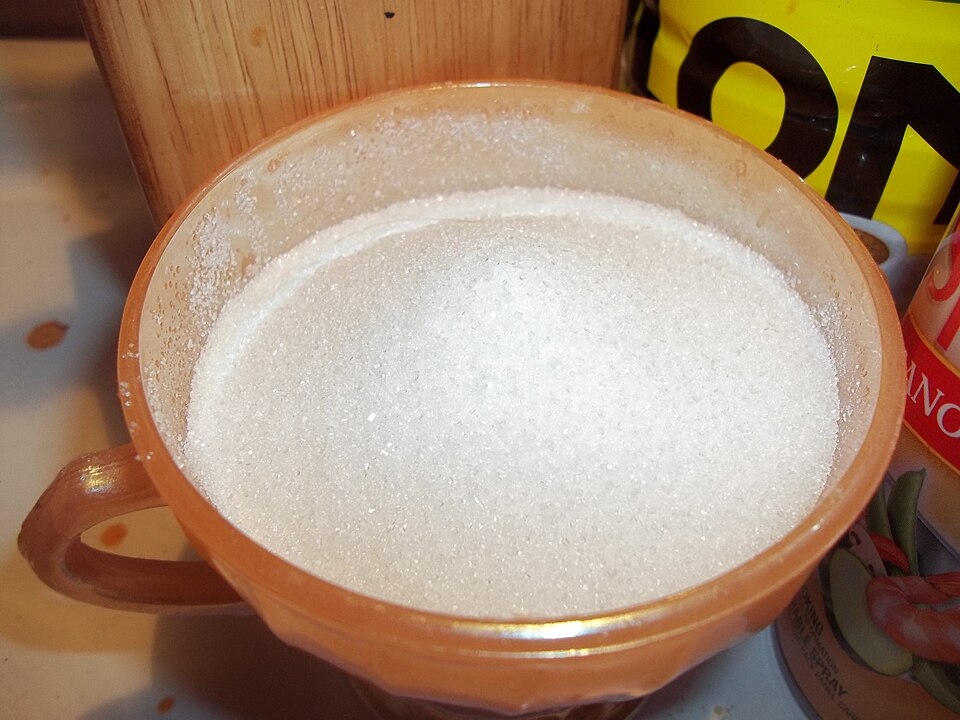
Introduction
White sugar (Refined sugar, is produced from either sugarcane or sugar beet, and undergoes an intensive refining process that gives it its characteristic bright white color. During this treatment, substances such as milk of lime (calcium hydroxide) are used to remove all traces of molasses, resulting in a product composed almost entirely of sucrose, with a purity exceeding 99.7%. From a chemical standpoint, this substance is identical regardless of its plant origin, although advanced methods like carbon-13 analysis can still determine whether it comes from cane or beet.
From a nutritional perspective, refined white sugar is essentially devoid of micronutrients. Unlike less processed sugars, it lacks minerals such as calcium, potassium, iron, and magnesium. While these elements may be present in small amounts in less refined alternatives like cane sugar, their concentrations are generally so minimal that they provide no meaningful nutritional benefit.
History of white sugar (refined sugar)
It is not possible to determine exactly when highly refined white sugar first appeared in history. However, records from Pliny the Elder in the 1st century AD describe a substance used in the East that was “as white as gum.” This statement likely exaggerates its actual appearance, since the refining techniques available at the time were too primitive to achieve such a bright white color. Nevertheless, from that period onward, sugar processing methods gradually advanced, with a particularly rapid improvement after the 17th century.
Over time, new technological innovations transformed production processes. Early purification methods, based mainly on heating and simple filtration, were progressively replaced or enhanced by the use of animal charcoal, which allowed for more effective removal of impurities and produced a clearer, more crystalline product. Additional developments included the application of lime-based compounds and other chemical agents to decolorize the sugar, along with increasingly sophisticated mechanical techniques to obtain highly pure crystals.
Classification of white sugar (refined sugar)
White sugar is classified according to its granule size. It can therefore be found in the following types:
- Coarse white sugar
- Granulated white sugar (table sugar)
- Caster white sugar
- Powdered white sugar
Nutritional facts table
| Nutrients | Per 100 g |
| Calories (kcal) | 400 |
| Total fat (g) | 0 |
| ———Saturated fat (g) | 0 |
| Cholesterol (mg) | 0 |
| Sodium (mg) | 0 |
| Total carbohydrates (g) | 100 |
| ———Dietary fiber (g) | 0 |
| ———Total sugar (g) | 100 |
| Protein (g) | 0 |
Source(s):
https://en.wikipedia.org/wiki/White_sugar
Photo(s):
1. Sparkveela, CC0, via Wikimedia Commons