
Uzzano
Comune in the province of Pistoia
Earth, Europe, Italy, Tuscany, Province of Pistoia
Introducion
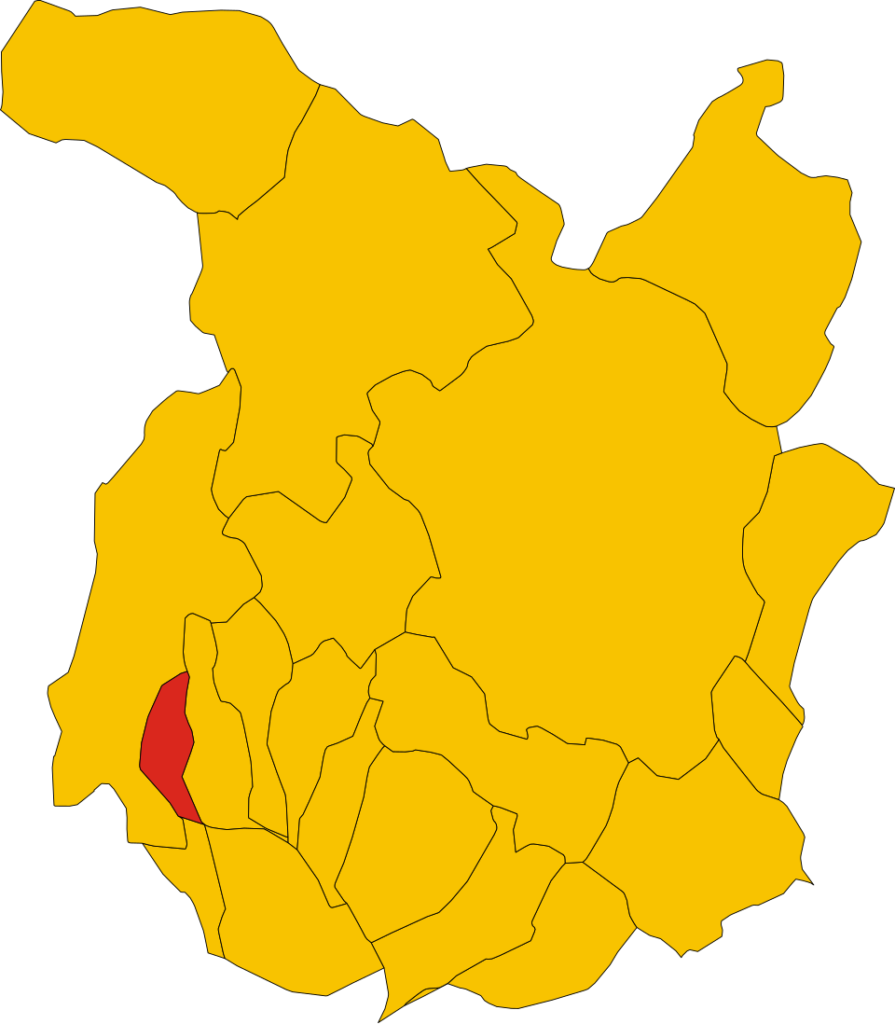
Uzzano is a small comune in the province of Pistoia, in Tuscany, with a population of just under six thousand residents. Its administrative center is not located in a single historic core but in the hamlet of Santa Lucia, reflecting the area’s structure as a scattered settlement rather than a compact town. The historical roots of Uzzano can be traced back to the Lombard period, although the origin of its name points further into the past. Linguistic evidence suggests a connection to a Roman-era estate, likely derived from the personal name Audianus, possibly referring to a former soldier who had been granted land in the area.
| Area (km² / sq mi) | 7.8 |
| Population | 5.659 (2024) |
History of Uzzano
The earliest written records of the village date back to around the year 1000, when it was controlled by the Cunimondinghi, a prominent Lombard-origin noble family from Lucca. By 1202, Uzzano had already developed a degree of municipal autonomy, although it continued to remain within the sphere of influence of Lucca.
During the 14th century, specifically between 1329 and 1339, the settlement was conquered by Florence, marking the beginning of a long period under Florentine control that lasted until the 19th century. At that point, the broader Valdinievole area was reassigned to Lucca within the political framework of the Grand Duchy of Tuscany. Over time, the municipal seat shifted repeatedly: initially located in the historic center, it was first moved to Pescia and ultimately relocated in 1980 to Santa Lucia.
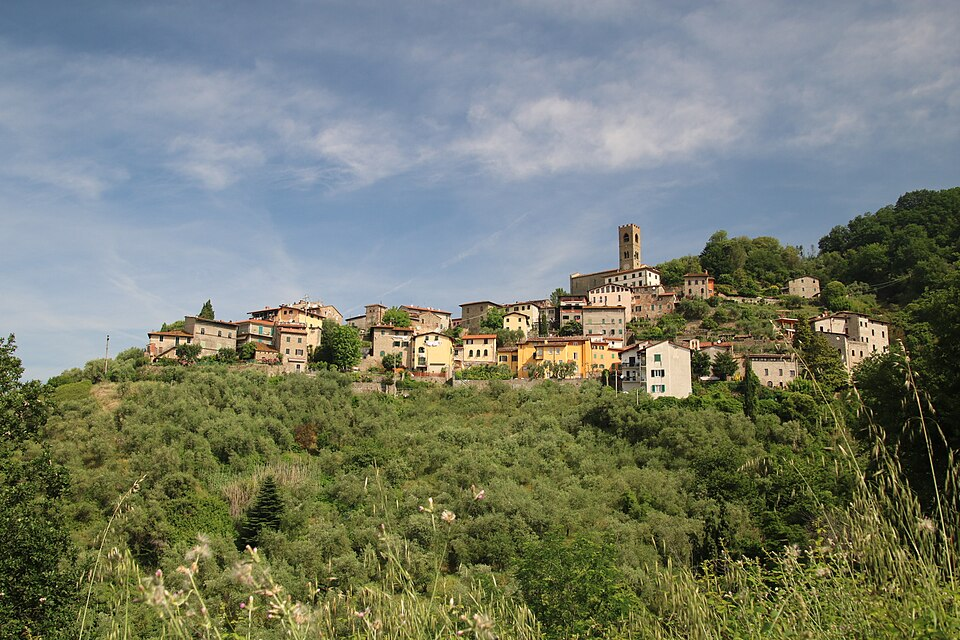
In 1893, Uzzano expanded its territory by incorporating Chiesina Uzzanese and Chiesanuova; however, these areas later separated and became an independent comune in 1963. Later, with the establishment of the province of Pistoia in 1927, Uzzano, along with the other towns of the Valdinievole, was officially included within its administrative boundaries.
Points of interest and culture in Uzzano
Despite its limited size, Uzzano preserves a remarkably rich historical and artistic heritage, largely concentrated in the village of Uzzano Castello. Among the religious buildings, the most prominent is the Church of Saints Jacopo and Martino, dating back to the 12th–13th centuries, which houses significant artworks, including a sculpture attributed to Giovanni della Robbia and several Florentine-style frescoes. In the hamlet of Torricchio, the Church of the Immacolata Concezione stands alongside a former Capuchin convent, now managed by the Secular Franciscan Order.
The area also features smaller places of worship and numerous oratories, such as those dedicated to the Madonna del Canale, Sant’Antonio da Padova, and Santa Maria dei Dolori. Another historically relevant complex, now largely in ruins, is the Hospital of San Luca e Ercolano, founded by Sant’Allucio and once connected to the ancient route linking Florence and Lucca.
In terms of civil architecture, the Palazzo del Capitano stands out, currently housing the municipal archives and preserving a 15th-century fresco. Noteworthy as well are the public fountain in Piazza Umberto I and the modern town hall. The surrounding territory is dotted with elegant historic villas, including Villa Fanny, Villa del Castellaccio—where Giacomo Puccini once stayed—Villa del Vescovo, Villa Il Riposo, Villa di Quarrata, Villa Petri, and Villa di Campugliano, all reflecting the long-standing presence of aristocratic and cultured families.
Until the Second World War, the local economy was predominantly based on agriculture, with olive groves and vineyards covering the hills, while the plains were used for cereal cultivation and vegetable farming. The area was especially known for producing high-quality olive oil and the renowned Bianco di Valdinievole wine.
From the 1960s onward, following its classification as an economically disadvantaged area, Uzzano experienced a phase of industrial development, with the establishment of textile, metalworking, and food-processing industries. In earlier periods, brickworks were also active, particularly in Santa Lucia, where clay extraction had been practiced since the Middle Ages.
Source(s):
https://it.wikipedia.org/wiki/Uzzano
Photo(s):
1. Vonvikken, Public domain, via Wikimedia Commons
2. Mongolo1984, CC BY-SA 4.0 https://creativecommons.org/licenses/by-sa/4.0, via Wikimedia Commons