
Thymus
Genus of Nepetoideae
Food, Plant source foods, Plants (Plantae), Flowering plats (angiospermae), Mesangiosperms, Eudicots, Core eudicots, Superastierds, Asterids, Lamiids (Euasterids I), Lamiales, Lamiaceae, Nepetoideae
Consumption area(s): Europe, North Africa, and Turkey
Note: For better understanding, please read the article on flowering plants (angiospermae) first. If you come across unfamiliar words, you can click on any highlighted term to open the glossary with definitions of key botanical terms.
Introduction
The genus Thymus comprises roughly 350 species of strongly aromatic plants belonging to the Lamiaceae. Members of this genus are typically perennial herbs or small shrubs, often characterized a notable production of essential oils, which give them their distinctive fragrance. The natural range of Thymus is centered in the Mediterranean region, where these plants are native to large parts of Europe, North Africa, and Turkey.
Several species within this genus are widely cultivated for both culinary and ornamental purposes. In everyday language they are generally referred to as thyme, a name derived from the most widely known species, Thymus vulgaris, commonly called common thyme, which is especially valued as a kitchen herb for its intense aroma and flavor.
Description of Thymus
Plants of the genus Thymus are generally small aromatic perennials that may grow as shrub, or occasionally herbaceous plants, rarely exceeding about 50 cm in height. The most frequent life form is the fruticose chamaephyte, a perennial woody plant with a branched shrub-like habit and renewal buds located above the ground. Some species are suffruticose chamaephytes, characterized by a woody base and herbaceous upper parts that die back each year, while the renewal buds remain 2–30 cm above the soil.
The tissues contain numerous essential-oil glands, responsible for the plants’ strong fragrance, which appear on the leaves as small punctuations arranged in a cross-like pattern. From a reproductive standpoint, many members of the genus exhibit a gynodioecious system, with populations containing both hermaphroditic and female individuals.
The root system is typically fibrous, sometimes producing additional roots from the stem nodes. The stem itself is often woody and may grow upright or creeping along the ground, with certain forms developing long prostrate shoots capable of rooting at the nodes. Its internal structure gives the stem a quadrangular cross-section, a feature typical of the Lamiaceae, caused by supporting collenchyma tissue located at the four angles.
The leaves are generally small, with a short petiole, and arranged opposite each other along the stem. Each pair is oriented at a right angle relative to the next pair, forming a decussate pattern. Leaf shapes vary from ovate to lanceolate, with entire margins that may sometimes roll slightly downward. Their color ranges from deep green to grey or silvery, and in many species the surface is covered with trichomes, giving the foliage a soft, hairy appearance.
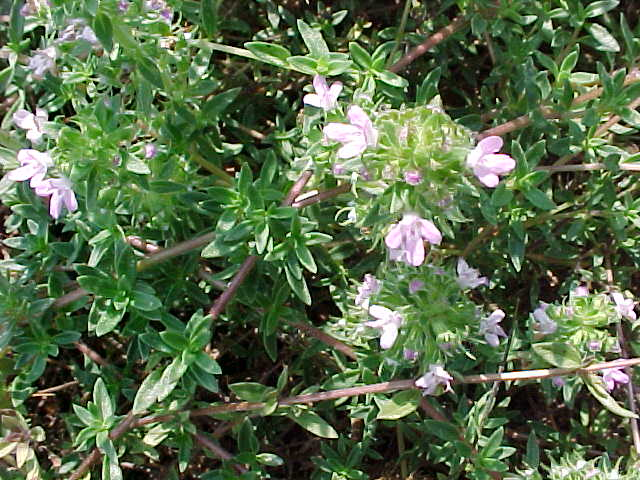
The inflorescences appear as spike-like clusters positioned near the top of the branches. They consist of groups of flowers arranged in verticillasters, circular whorls that may appear rounded or elongated. At the base of these clusters are bracts shaped similarly to the leaves.
The flowers are typically hermaphroditic and display bilateral symmetry. The calyx, formed by fused sepals, is two-lipped and may appear bell-shaped or tubular, with several longitudinal veins visible on its surface. It ends in five pointed teeth and often remains attached even after the fruit develops. The corolla, composed of fused petals, is also bilabiate: the upper lip curves upward, while the lower lip is divided into three lobes. Flower coloration varies widely, including white, cream, pink, violet, or purple tones.
Inside the flower, the androecium consists of four stamens arranged in a didynamous configuration, with two longer and two shorter filaments that often extend slightly beyond the corolla tube. The anthers contain the pollen grains, which may display three or six colpi. The gynoecium includes a superior ovary formed by two fused carpels, internally divided into four chambers, each containing an ovule. A slender style emerges from the base of the ovary and ends in a bifid stigma. At the base of the ovary lies a nectary disc that produces nectar to attract pollinators.
The fruit develops as a schizocarp that separates into four small nutlets, with a smooth and hairless surface. These plants are mainly pollinated by insects, especially bees, as well as flies and occasionally butterflies. After maturation, the seeds may initially be dispersed by wind, while further movement on the ground often occurs through ants.
Classification of Thymus
This genus is further divided into numerous species. Among the best known are:
- Caraway thyme
- Common thyme
- Thymus × citriodorus (lemon tyme, lime thyme and orange thyme)
- Wild thyme
Photo(s):
1. Name lips at en.wikipedia, Public domain, via Wikimedia Commons