
Sweet basil (Genovese basil)
Food, Plant source foods, Plants (Plantae), Flowering plats (angiospermae), Mesangiosperms, Eudicots, Core eudicots, Superastierds, Asterids, Lamiids (Euasterids I), Lamiales, Lamiaceae, Nepetoideae, Ocimum, Basil
Species name: Ocimum basilicum
Consumption area(s): Albania 🇦🇱, Andorra 🇦🇩, Bosnia and Herzegovina 🇧🇦, Croatia 🇭🇷, Cyprus 🇨🇾, France 🇫🇷, Greece 🇬🇷, Italy 🇮🇹, Malta 🇲🇹, Monaco 🇲🇨, Montenegro 🇲🇪, San Marino 🇸🇲, Slovenia 🇸🇮, Spain 🇪🇸, Turkey 🇹🇷, Vatican City 🇻🇦
Introduction
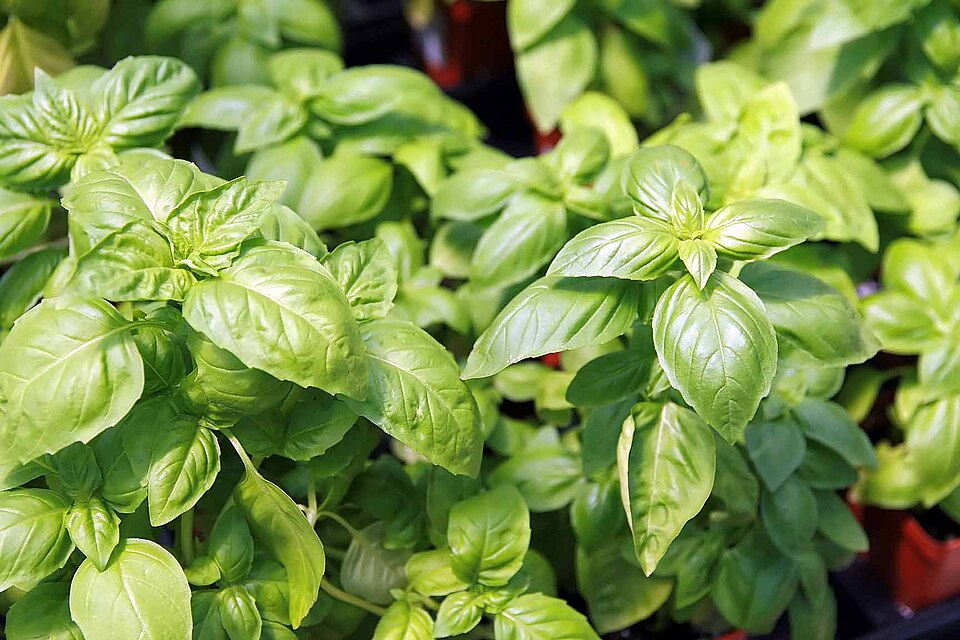
Sweet basil (orGenovese basil) is a cultivar ofbasil belonging to the Lamiaceae, widely appreciated for its aromatic leaves, sweet–clove scent, and its essential role in Mediterranean cuisine. Although the species originated in tropical Asia, it has been cultivated across the Mediterranean region for centuries, becoming one of the most recognizable and widely used herbs in cooking.
Description of sweet basil
Sweet basil is typically a tender annual plant, growing up to 60–75 cm in height. It has an upright, bushy growth habit with large, glossy green leaves that release a distinctive aroma when crushed, often described as containing notes of clove, lemon, and licorice. The plant thrives in full sun, warm temperatures, and well-drained soil, and it branches readily, allowing for continuous harvesting throughout the growing season. In culinary contexts, sweet basil is used primarily fresh, as drying significantly reduces its characteristic fragrance and flavor. It is commonly added to soups, tomato sauces, salads, bruschetta, and numerous traditional dishes.
The seeds are small and black with a mild, nutty flavor, commonly used in Indian cuisine. They can also be soaked in water and added to smoothies, such as faloodas, or to yogurt.
A specific, geographically limited variant of this cultivar—grown in designated areas of Liguria, especially around Genoa—is officially recognized in the European Union as Genovese basil PDO (Basilico Genovese DOP). This certification ensures that only basil produced in those controlled zones may be marketed under the PDO denomination, reflecting its traditional cultivation methods and regional significance.
Classification of sweet basil
A notable regional cultivar of sweet basil is recognized for its distinctive aroma and traditional use:
- Genovese Basil PDO (Basilico Genovese DOP)
Nutritional facts table of the leaves
| Nutrients | Fresh leaves (100 g) | Dried leaves (100 g) |
| Calories (kcal) | 23 | 233 |
| Total fat (g) | 0.5 | 4.1 |
| ———Saturated fat (g) | 0 | 2.2 |
| Cholesterol (mg) | 0 | 0 |
| Sodium (mg) | 4 | 76 |
| Total carbohydrates (g) | 3 | 47.8 |
| ———Dietary fiber (g) | 2 | 37.7 |
| ———Total sugar (g) | 0 | 1.7 |
| Protein (g) | 3 | 23 |
Nutritional facts table of seeds
| Nutrients | Per 100 g |
| Calories (kcal) | 391 |
| Total fat (g) | 16.86 |
| ———Saturated fat (g) | 1.73 |
| Cholesterol (mg) | 0 |
| Sodium (mg) | 19 |
| Total carbohydrates (g) | 53.28 |
| ———Dietary fiber (g) | 29 |
| ———Total sugar (g) | 0.43 |
| Protein (g) | 15.25 |
Recipes that use this product as an ingredient:
Photo(s):
1. Photo by David J. Stang, CC BY-SA 4.0 https://creativecommons.org/licenses/by-sa/4.0, via Wikimedia Commons