
Sparkling water
Foods, Other items, Water, Carbonated water
Consumption area(s): Earth
Introduction
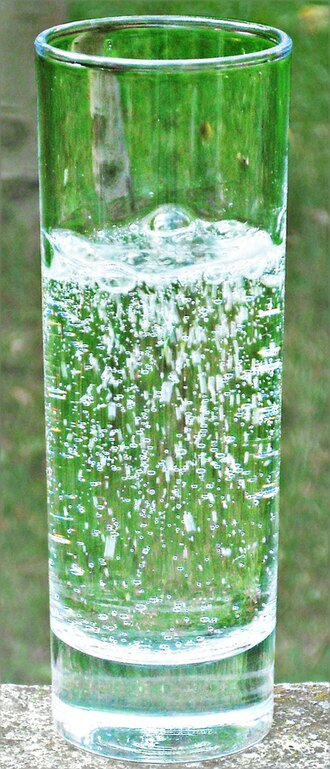
Sparkling water refers to carbonated water that contains dissolved carbon dioxide (CO₂), which produces a distinctive effervescent texture due to the formation of small gas bubbles. This carbonation can originate naturally, when water passes through geological formations rich in CO₂, or be introduced artificially during industrial processing. In contrast, club soda is always artificially carbonated water that typically includes added mineral salts (such as sodium bicarbonate or potassium salts) to modify taste and reduce the perceived acidity of the dissolved carbon dioxide.
Natural forms of sparkling mineral water emerge from underground sources where water is enriched with dissolved gases during its passage through rock layers. In contrast, most commercially available versions are produced by injecting pressurized carbon dioxide into purified water, replicating the natural effervescence. These products are widely distributed in glass bottles, plastic bottles, and cans, and may also be generated on demand in bars, restaurants, or domestic settings using compact carbonation devices or CO₂ cartridges.
History of sparkling water
Early developments in sparkling water began with experiments on dissolving carbon dioxide (historically called “fixed air”) into water. In the 18th century, scientists such as William Brownrigg, Gabriel François Venel, Dr. Macbride, and later Joseph Priestley investigated methods of artificially carbonating water, often using CO₂ obtained from chemical reactions or natural sources. Priestley in particular discovered that water infused with this gas acquired a pleasant, refreshing taste, marking an important step toward modern sparkling beverages.
Building on these discoveries, inventors such as Henry Cavendish and later J. J. Schweppe developed practical devices capable of producing carbonated water more efficiently. By the late 18th century, companies began manufacturing artificial mineral water on a larger scale, making sparkling water commercially available. The development of industrial systems allowed carbonated water to be produced consistently and in greater volumes.
Modern sparkling water is created by injecting pressurized carbon dioxide into water, a process that increases gas solubility under pressure. When the container is opened, the pressure drops and the dissolved gas escapes, forming the characteristic bubbles and effervescence.
Production methods for sparkling water
For a detailed overview of the different production methods, refer to the “Production methods for carbonated water” section in the main article on carbonated water.
Uses of sparkling water
Plain sparkling water or sparkling mineral water is often consumed as a substitute for soft drinks or alcoholic beverages, offering a non-sweet and more neutral-tasting alternative. Many producers also create unsweetened sparkling water products that are lightly flavored with aromatic compounds, such as essential oils, to enhance sensory appeal without adding sugar or calories.
In addition to beverage consumption, sparkling water is increasingly used in culinary applications, particularly in Western cooking. It can replace plain water in deep-frying batters, helping to produce a lighter and airier structure similar to tempura-style coatings. According to food scientists, the carbon dioxide bubbles incorporated into the batter create internal gas pockets that expand during cooking, contributing to a lighter texture and a perception of reduced density compared to traditional frying mixtures.
Nutritional facts table
| Nutrients | Per 100 g |
| Calories (kcal) | 0 |
| Total fat (g) | 0 |
| ———Saturated fat (g) | 0 |
| Cholesterol (mg) | 0 |
| Sodium (mg) | 0 |
| Total carbohydrates (g) | 0 |
| ———Dietary fiber (g) | 0 |
| ———Total sugar (g) | 0 |
| Protein (g) | 0 |
Recipes that use this product as an ingredient:

Photo(s):
1. Égoïté, CC BY-SA 3.0 https://creativecommons.org/licenses/by-sa/3.0, via Wikimedia Commons