
Sourdough starter 🌍
Food, Other items, Leavining agents
Consumption area(s): Since reliable data on the consumption of this food are not available, we assume it to have an almost global presence, with higher usage peaks in Europe and North America.
Introduction
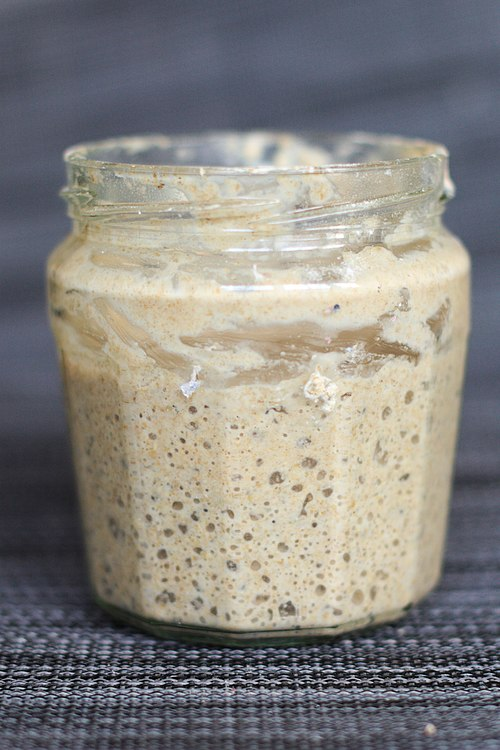
Sourdough starter, also known as natural leaven or wild yeast dough, is a mixture of flour and water that undergoes spontaneous fermentation thanks to the presence of microorganisms. These include lactic acid bacteria and yeasts, which originate from the environment, the raw ingredients, and even the hands of the baker. Through their metabolic activity, a native microbial community develops, in which lactobacilli are the dominant species.
Description of sourdough starter
Sourdough starter—also known as natural leaven—is a microbiologically complex environment where numerous microorganisms coexist in a delicate balance. To keep it active, it must undergo regular feedings (or refreshments) with fresh flour and water, which provide nutrients for the bacteria and allow them to maintain their metabolic activity. The internal balance of the starter changes depending on variables such as storage conditions, feeding frequency, temperature, and the ingredients used.
Sourdough starter is often confused with simply a piece of dough taken from a previous batch and reused to ferment a new one—it still contains all the original ingredients. This practice is common in Southern Italy, where the term crìscito (or crescente) may refer either to a regularly refreshed sourdough or to a saved piece of dough from a prior baking.
The introduction of industrial baker’s yeast (Saccharomyces cerevisiae) has led to some blending of methods, with doughs that may contain both types of fermenting agents. When lactic acid bacteria dominate—as in true sourdough—the process produces lactic acid and acetic acid, while fermentation driven by Saccharomyces cerevisiae is primarily alcoholic. In breadmaking, the gas released during these processes causes the dough to rise, improving its structure, aroma, and shelf life.
From a practical perspective, using sourdough is more complex than using baker’s yeast, as it requires longer fermentation times and greater care. However, it offers numerous advantages: it enhances protein digestibility through partial breakdown, provides better structure and workability, and positively influences the color, aroma, and flavor of the final product. Bread made with sourdough is generally more digestible and has a longer shelf life than bread made with baker’s yeast, thanks to its natural acidity, which slows down spoilage and microbial growth.
History of sourdough starter
Naturally leavened bread has been documented as early as 3700 B.C. in Switzerland, though it is believed that the sourdough starter technique originated thousands of years earlier, developing within the first agricultural communities of the Fertile Crescent and ancient Egypt. For centuries, breadmaking relied exclusively on this natural fermentation process, while baker’s yeast became widespread only recently, less than 150 years ago.
Up until the European Middle Ages, sourdough starter remained essential for bread production. Later, baker’s yeast, derived from beer fermentation, began to spread widely, leading to a gradual decline of natural fermentation. The turning point came in 1871, with the industrial production of yeast specifically designed for breadmaking.
During the 20th century, the use of sourdough starter declined even further, as baker’s yeast—faster and more predictable—became the standard. However, in pursuit of a richer flavor, some bakers began extending fermentation times, allowing the development of lactic acid bacteria even in yeast-based doughs. From the 2010s onward, sourdough has experienced a revival, both among artisan bakers and within the food industry, often being used alongside baker’s yeast to combine tradition, flavor, and efficiency.
Recipe
Sourdough starter
Іngredients
- 1 cup
flour (usuallysoft wheat flour is used, though this may vary depending on local traditions, which can affect the final result. In general, a refined flour with a protein content of 10–12% is preferred) (120 g) - 4 tbsp lukewarm
water (60 g) - 1 tbs
honey ,malt ,sugar ,yogurt , or fruits, but also selected microorganisms from laboratories or already mature starters may be used (optional, as they facilitate the fermentation process)
For each feeding, you need to add an amount of flour equal to the total weight of the dough and half that weight in water, so the quantities may vary.
Іnstructions
- Mix the water, flour, and, if used, the optional starter until you obtain a smooth, homogeneous dough, then shape it into a ball. Use a very sharp knife to make a deep cross on the top of the ball. Place the dough ball into a tall glass jar and cover it with perforated plastic wrap. Let the dough rest for 48 hours at a stable room temperature, preferably near fruit.
- After this period, the first feeding is required. Remove the dough from the jar, discard any dried surface, and weigh it. Add an amount of flour equal to the weight of the dough and half that weight in water, then knead again to form a ball. Repeat the previous steps: score the dough, place it back into the glass jar, and cover it with plastic wrap for another 48 hours.
- Repeat this feeding process four more times. As a general rule, when the dough becomes too large, remove a portion of it before feeding. Until the starter is mature, this portion should be discarded, but once mature, it can be used as sourdough starter.
- Continue the feeding process for another 15 cycles, reducing the resting time to 24 hours instead of 48.
- The sourdough starter is ready when it triples in size within 4 hours after feeding. If this does not occur on the expected days, continue to feed the dough daily until it reaches the desired activity.
- Once mature, store it in the fridge in the glass jar, covered with perforated plastic wrap, and feed it every 5–7 days (for the first months, 5 days is recommended). Always allow it to rest outside the fridge for 1 hour before and 1 hour after each feeding. Storing the sourdough starter at room temperature is not recommended, as it would require daily feedings.
Nutritional facts table
Please note that nutritional values may vary slightly depending on the ingredients used.
| Nutrients | Per 100 g |
| Calories (kcal) | 289 |
| Total fat (g) | 1.8 |
| ———Saturated fat (g) | 0.5 |
| Cholesterol (mg) | 0 |
| Sodium (mg) | 1.5 |
| Total carbohydrates (g) | 56 |
| ———Dietary fiber (g) | 2.4 |
| ———Total sugar (g) | 2.6 |
| Protein (g) | 12 |
Recipes that use this product as an ingredient:
Source(s):
https://it.wikipedia.org/wiki/Lievito_naturale
https://en.wikipedia.org/wiki/Sourdough
Photo(s):
1. Jeuwre, CC BY-SA 4.0 https://creativecommons.org/licenses/by-sa/4.0, via Wikimedia Commons