
Reale
Food, Animal source foods, Animals (Animalia), Chordates (Chordata), Vertebrates (Vertebrata), Mammals (Mammalia), Therians (Theria), Placentals (Placentalia), Artiodactyls (Artiodactyla), Ruminants (Ruminantia), Bovids (Bovidae), Bovines (Bovinae), Bovini, Bos, Cattle
Species name: Bos Taurus
Consumption area(s): Italy 🇮🇹, Monaco 🇲🇨, San Marino 🇸🇲, Vatican City 🇻🇦. However, it should be noted that similar cuts may also be consumed in other countries.
Anatomy of reale
This cut is located in the anterior region of the ribcage, situated between the neck and the belly area. Anatomically, this cut includes the muscles surrounding the first five thoracic vertebrae. This cut is mainly composed of two distinct muscles: the intercostal and the latissimus dorsi.
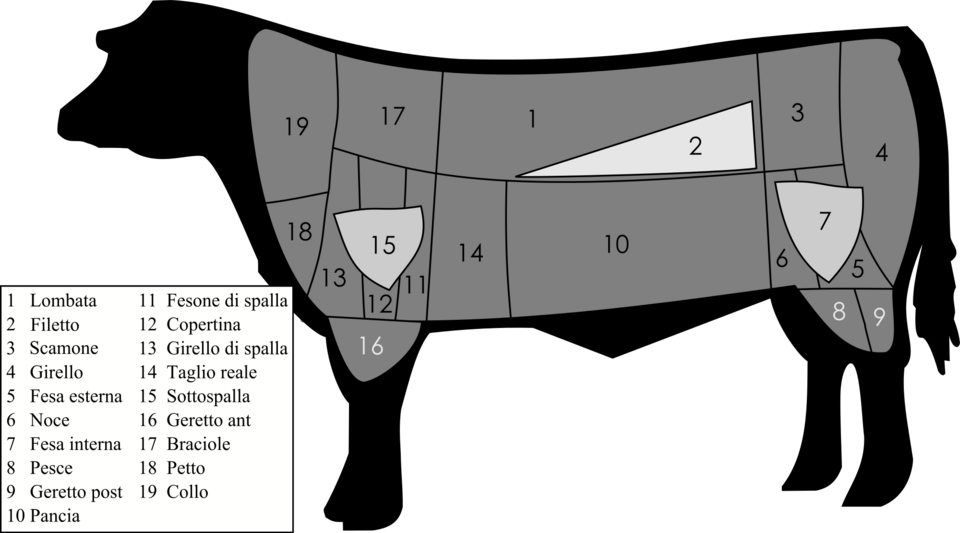
In the image, it corresponds to anterior part of number 19.
Similar cuts aroud the Earth
- United States, Canada: Chuck (only the postero-superior part)
- United Kingdom, Ireland, Australia, South Africa, New Zealand: Chuck and blade
- Brazil: Acém (only the antero-superior part)
- France, Monaco: Basses côtes
- Germany: Rinderhals, Kamm, or Nacken (only the posterior part)
- Russia: Шея (Sheya) (only the posterior part)
- Turkey: Gerdan (only the postero-superior part)
- Portugal: Coberta do acém or acém comprido (only the antero-superior part)
- Netherlands: Neck (only the posterior part)
- Finland: Etuselkä
- Poland: Karkówka (only the posterior part)
- Croatia: Vratina (only the posterior part)
Uses of reale
The reale cut is considered one of the less prized cuts, which is why it is sometimes left attached to other portions, rather than being sold separately. Its structure, composed of tough muscle, makes it less tender, justifying its classification among second-tier cuts.
It can be cooked whole with the bone, ideal for a traditional boiled meat dish, particularly appreciated in the cold season. Alternatively, if the ribs are removed, the latissimus dorsi can be obtained and used as cut meat. When slicing, care is required: the fibers tend to separate easily, so it is preferable to keep the slices thick. Due to its broad and thin shape, this cut is also suitable for stuffing or for preparing stews and ground meat.
Nutritional facts table
It should be noted that nutritional values may slightly vary depending on the animal.
| Nutrients | Per 100 g |
| Calories (kcal) | 145 |
| Total fat (g) | 7 |
| ———Saturated fat (g) | 2.2 |
| Cholesterol (mg) | 65 |
| Sodium (mg) | 60 |
| Total carbohydrates (g) | 0 |
| ———Dietary fiber (g) | 0 |
| ———Total sugar (g) | 0 |
| Protein (g) | 20.5 |
Recipes that use this product as an ingredient:
Source(s):
https://piratasuino.it/wp-content/uploads/2024/04/QUADERNO-1-I-TAGLI-DEL-BOVINO.pdf
Photo(s):
1. Yzmo, Giglio83, CC BY-SA 3.0 https://creativecommons.org/licenses/by-sa/3.0, via Wikimedia Commons