
Punta di petto/Gros bout de poitrine/Maçã do peito
Food, Animal source foods, Animals (Animalia), Chordates (Chordata), Vertebrates (Vertebrata), Mammals (Mammalia), Therians (Theria), Placentals (Placentalia), Artiodactyls (Artiodactyla), Ruminants (Ruminantia), Bovids (Bovidae), Bovines (Bovinae), Bovini, Bos, Cattle
Species name: Bos Taurus
Consumption area(s): Although the precise anatomy of this cut may vary from country to country, making it difficult to attribute a clear distribution, France 🇫🇷, Italy 🇮🇹, Monaco 🇲🇨, Portugal 🇵🇹, San Marino 🇸🇲 and Vatican City 🇻🇦 extract an anatomical cut that is fairly similar among them. We therefore estimate the distribution of the punta di petto within this geographical area. It should also be noted that the Anglo-Saxon brisket, although similar, has a different anatomical structure.
Local name(s)
- Italy, San Marino, Vatican City: Bruschetto (Palermo), Fiocco (Treviso), Forcella (Florence), Petto (Belluno, Macerata, Padua, Perugia, Trento, Venice), Petto grosso (Rome, Vatican City), Polpa di petto (Foggia), Punta di petto (Bari, Bologna, Florence, Genoa, L’Aquila, Mantua, Messina, Milan, Naples, Parma, Potenza, Rovigo, Turin, Verona, Vicenza), Punta di pettu (Reggio Calabria), Zoia (Treviso)
- France, Monaco: Gros bout de poitrine
- Portugal: Maçã do peito
Anatomy of punta di petto/gros bout de poitrine/maçã do peito
This cut is located in the anterior part of the animal, near the shoulder, the forelimb, and reale. This anatomical portion consists of two distinct muscle groups: the deep pectorals and the superficial pectorals.
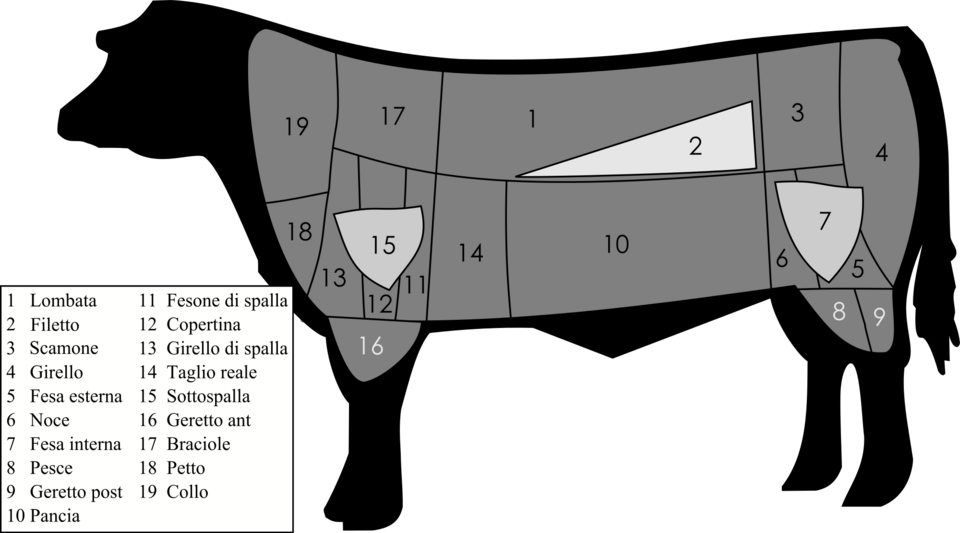
In the imagine, the punta di petto corresponds to number 18.
Similar cuts aroud the Earth
- United States, Canada: Brisket
- United Kingdom, Ireland, Australia, South Africa, New Zealand: Brisket
- Brazil: Peito
- Argentina: Pecho
- Germany: Rinderbrust
- Russia: Челышко (Chelyshko), грудинка (Grudinka)
- Turkey: Döş (the most anterior part)
- Netherlands: Brisket
- Finland: Rinta
- Poland: Mosto
- Croatia: Ribra
Uses of punta di petto/gros bout de poitrine/maçã do peito
The punta di petto is a cut of meat obtained from the lower thoracic region of cattle. The muscles that compose it include the superficial pectorals and the deep pectorals. Since cattle lack clavicles, these muscles support approximately 60% of the body weight when the animal is standing or moving. Consequently, the meat is rich in connective tissue, making proper cooking necessary to tenderize it.
The punta di petto can be prepared in various ways, such as roasting, boiling, or braising, often basting during cooking to prevent drying out. Being naturally fibrous and tough due to its high collagen content, the meat becomes tender when the collagen gelatinizes with heat. The fat cap, which often remains attached, helps to keep the meat moist during the long cooking times required to break down the connective tissue. The essential element for this transformation is water, which allows the collagen to convert into gelatin, giving the meat a soft and juicy texture.
Nutritional facts table
It should be noted that nutritional values may slightly vary depending on the animal.
| Nutrients | Per 100 g |
| Calories (kcal) | 157 |
| Total fat (g) | 7 |
| ———Saturated fat (g) | 2.6 |
| Cholesterol (mg) | 70 |
| Sodium (mg) | 60 |
| Total carbohydrates (g) | 0 |
| ———Dietary fiber (g) | 0 |
| ———Total sugar (g) | 0 |
| Protein (g) | 21 |
Recipes that use this product as an ingredient:
Source(s):
https://piratasuino.it/wp-content/uploads/2024/04/QUADERNO-1-I-TAGLI-DEL-BOVINO.pdf
Photo(s):
1. Yzmo, Giglio83, CC BY-SA 3.0 https://creativecommons.org/licenses/by-sa/3.0, via Wikimedia Commons