
Prosciutto Toscano DOP (Tuscan Prosciutto PDO)
Food, Animal source foods, Preserved animal source products, Preserved pork products
Consumption area(s): Tuscany
Introduction
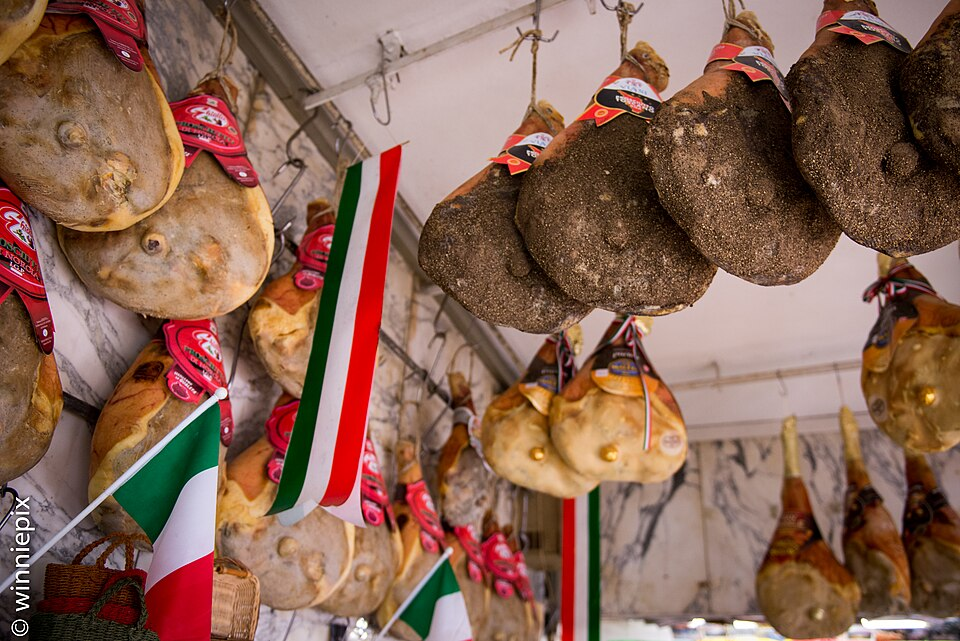
Prosciutto Toscano DOP (Toscan Prosciutto PDO) refers to a traditional prosciutto obtained exclusively from fresh pork legs that comply with the official production specification. The designation guarantees both geographical origin and strict adherence to defined breeding, processing, and maturation standards, which preserve the product’s traditional identity and quality.
Description of Prosciutto Toscano DOP
Prosciutto Toscano PDO is a whole prosciutto with a balanced flavour, firm texture, and moderate salinity. It is produced from the hind limb of heavy pigs raised according to strict genetic and nutritional standards, typically derived from or related to Large White and Landrace breeds. The finished product has a rounded shape with a slight arch due to trimming, leaving a muscular border that does not exceed 8 cm beyond the femur head. When sliced, the meat ranges from bright red to light red, with limited intramuscular fat. The external fat layer is white, compact, and firmly adherent, with slight pinkish veining.
The aroma is delicate but distinctive, developed through traditional salting and long maturation. The taste is mild, well-balanced, and pleasantly savory, reflecting both the raw material and the controlled aging process. Key chemical parameters such as salt content, moisture level, and proteolysis index are strictly regulated to ensure consistent quality and texture development.
Production method for Prosciutto Toscano DOP
The production of Prosciutto Toscano PDO follows a structured and regulated sequence from animal selection to final aging. Only pork legs from heavy pigs (minimum 160 kg and at least nine months old) raised in approved Lombardia, Emilia Romagna, Marche, Umbria, Lazio, Tuscany under controlled breeding and feeding systems are used. After slaughter, the legs are chilled for at least 24 hours at -2°C to +2°C to stabilize the meat.
The legs are then trimmed using a precise cut that shapes the ham and removes the foot, skin, and internal fat with a V-shaped incision. Each trimmed leg must weigh at least 11.8 kg. A tamper-proof metal seal is applied to guarantee traceability and indicate the start of processing. Dry salting must begin within 120 hours of slaughter using salt, black pepper, and natural herbs, without any additives or preservatives. During this phase, the meat is kept at 0°C–3°C.
After salting, the hams undergo a resting period to allow dehydration, followed by washing with lukewarm water free from disinfectants. They are then transferred to controlled rooms for drying under regulated temperature and humidity conditions. The final preparation stage involves the application of sugna, a protective coating made of lard, wheat or rice flour, salt, pepper, and natural herbs, applied to the exposed lean surface. Maturation takes place in ventilated rooms at 12°C–25°C, with natural airflow, humidity, and exposure to environmental conditions. The minimum aging period is 10 months for lighter hams (7.5–8.5 kg) and 12 months for heavier ones (>8.5 kg).
At the end of maturation, an official fire-brand mark is applied under supervision, certifying PDO compliance. Hams intended for slicing and packaging require additional aging and must retain the original stamped rind. All slicing operations must occur exclusively within the designated production area under official control.
Nutritional facts table
Please note that nutritional values may vary slightly depending on the individual product.
| Nutrients | Per 100 g |
| Calories (kcal) | 278 |
| Total fat (g) | 17.3 |
| ———Saturated fat (g) | 6.5 |
| Cholesterol (mg) | 95 |
| Sodium (mg) | 2200 |
| Total carbohydrates (g) | 0.1 |
| ———Dietary fiber (g) | 0 |
| ———Total sugar (g) | 0 |
| Protein (g) | 30.4 |
Source(s):
https://it.wikipedia.org/wiki/Prosciutto_toscano
https://www.prosciuttotoscano.com/wp-content/uploads/2019/01/disciplinare-consorzioprosciutto.pdf
Photo(s):
1. Winniepix from UK, CC BY 2.0 https://creativecommons.org/licenses/by/2.0, via Wikimedia Commons