
Oryza
Genus of rice (Oryzeae)
Food, Plant source foods, Plants (Plantae), Flowering plats (angiospermae), Mesangiosperms, Monocots, Poales, Grasses (or Poaceae, cereals), Ehrhartoideae (Oryzoideae), Rice (Oryzeae)
Consumption area(s): Earth
Note: For better understanding, please read the article on flowering plants (angiospermae) first. If you come across unfamiliar words, you can click on any highlighted term to open the glossary with definitions of key botanical terms.
Introduction
Oryza is a genus of monocotyledonous flowering plants within the Poaceae family, specifically classified under the Oryzeae subfamily. The genus comprises roughly twenty species, including the two main cultivated rice species, Oryza sativa (Asian rice, the common rice) and Oryza glaberrima (African rice), both of which are major food crops of global significance. Oryza sativa alone accounts for about 20% of total cereal consumption worldwide, highlighting its critical role in human nutrition.
Description of Oryza
Plants in this genus typically grow as tall grasses in wet environments, reaching heights of 1–2 meters. The genus includes both annual and perennial species. The stems, or culms, are generally erect or ascending, while the leaves, mostly cauline, feature a linear blade of moderate width.
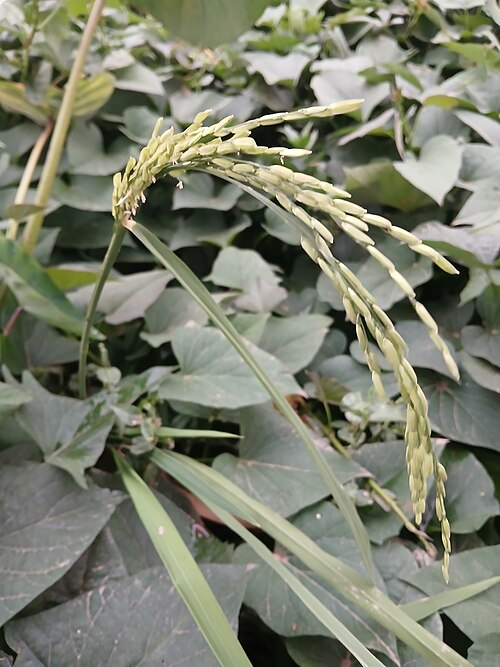
The inflorescence is a branched panicle with spikelets borne on short peduncles and strongly compressed laterally. In wild species, the spikelets break apart at maturity beneath the sterile lemmas, whereas in cultivated varieties, human selection has made them persistent.
Each spikelet contains three flowers, of which only the upper one is fertile. The sterile flowers are reduced to two narrow lemmas at the base of the fertile flower. The fertile lemma is sometimes covered with fine spines, rarely smooth, with five prominent veins and an apex that may be straight-edged. The palea resembles the lemma but is narrower, with three veins and an apex ending in a tip. Fertile flowers possess six stamens.
The fruit is a caryopsis of variable shape, with an embryo extending about 25% of its length and a linear hilum that spans the full length of the caryopsis.
Classification of Oryza
- African rice
- Asian rice (common rice)
- Australian rice
- Barth’s rice
Photo(s):
1. Friday musa, CC BY-SA 4.0 https://creativecommons.org/licenses/by-sa/4.0, via Wikimedia Commons