
Leeks
Cultivar of Allium ampeloprasum
Food, Plant source foods, Plants (Plantae), Flowering plats (angiospermae), Mesangiosperms, Monocots, Asparagales, Amaryllidaceae, Allium, Allium ampeloprasum
Cultivar name: Allium ampeloprasum var. porrum
Consumption area(s): Europe
Note: For better understanding, please read the article on flowering plants (angiospermae) first. If you come across unfamiliar words, you can click on any highlighted term to open the glossary with definitions of key botanical terms.
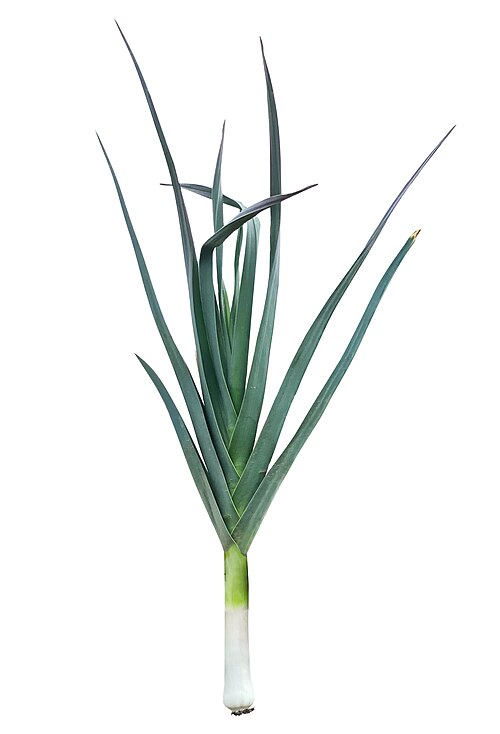
Introduction
Leeks are biennial plants derived from Allium ampeloprasum. Rather than forming a true stem, the portion consumed consists of tightly layered leaf sheaths, which together create a cylindrical structure often informally described as a stalk.
History of leeks as food
In the Hebrew Bible, the term חציר is interpreted by several scholars as referring to the leek, described as plentiful in Egypt. Archaeological discoveries in ancient Egypt, including preserved plant remains as well as decorative reliefs and illustrations, confirm that leeks formed part of the local diet as early as the second millennium BCE. Written sources further indicate that the crop was cultivated in Mesopotamia from the early second millennium BCE onward.
In ancient Rome, leeks—known as porrum—were commonly consumed and often considered more refined than both garlic and onions. The first-century cookbook Apicius preserves several culinary preparations centered on leeks. The vegetable was especially favored by the emperor Nero, who reportedly ate it regularly in soups or seasoned with oil, convinced it enhanced the quality of his voice. Because of this habit, he acquired the nickname “Porrophagus,” meaning “leek eater.”
Production methods for leeks
Leeks thrive in friable, well-aerated soil that allows excess water to drain efficiently. They are suitable for cultivation in the same geographic zones that support onion production. While direct sowing in open ground is possible, growers usually start them in densely planted nursery beds and later relocate the young plants. Transplanting is typically carried out after about twelve weeks, once the seedlings reach roughly the diameter of a pencil.
For optimal development, leeks prefer temperatures close to 20 °C (68 °F). Compared with many other cultivated members of the Allium genus, they demonstrate stronger cold resistance, enabling continuous production throughout much of Europe. After planting, the crop can remain in the field for a prolonged period, allowing for a harvest window that may extend up to six months.
Uses of leeks
Leeks are characterized by a delicate, onion-like flavor. When uncooked, their texture is crisp and compact. The parts most commonly eaten include the white base of the leaves (just above the roots), the pale green section, and, less frequently, the dark green leaves. The tougher dark green tops are often discarded because of their fibrous consistency, although they are well suited for sautéing or, more typically, for enriching stocks and broths. In some culinary traditions, several leaves are bound together with herbs to create a bouquet garni.
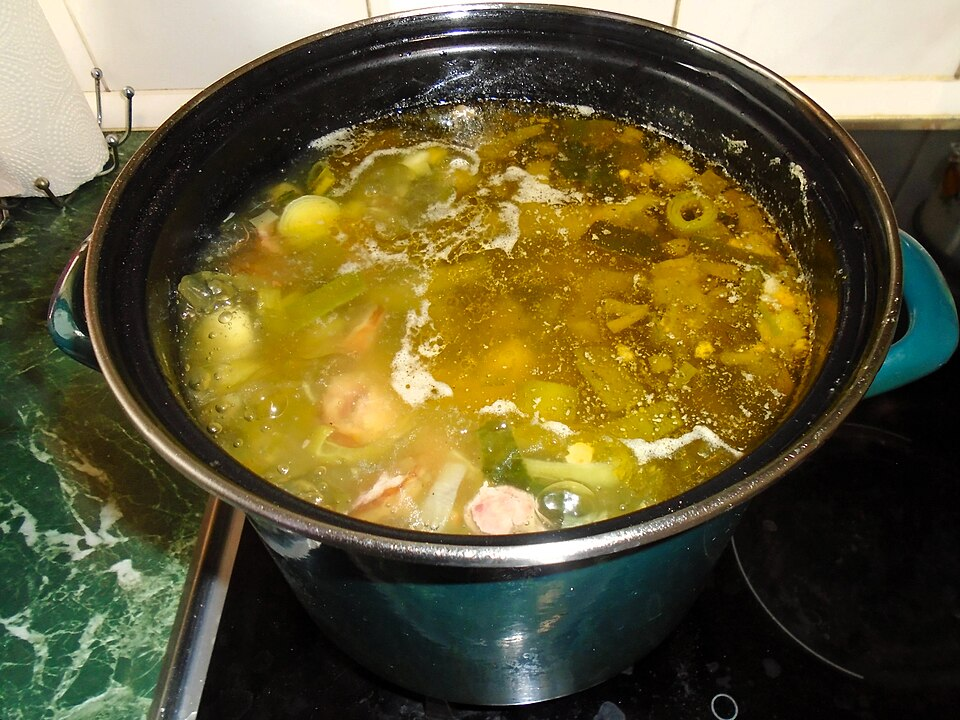
In the kitchen, leeks are generally cut into thin rounds about 5–10 mm thick; due to their layered structure, the slices naturally separate into rings. Cooking methods vary widely. Boiling softens their texture and produces a gentler flavor; in France, whole boiled leeks served chilled with vinaigrette are a classic preparation, earning them the nickname “poor man’s asparagus.” Frying helps retain a firmer bite while maintaining their taste, whereas raw leeks are frequently incorporated into salads, especially when they serve as the principal ingredient.
In Turkish cuisine, leeks are often sliced into larger segments, simmered, separated into layers, and filled—commonly with rice, herbs such as parsley and dill, onion, and black pepper. Variations prepared with olive oil may include currants, pine nuts, and cinnamon, while versions containing minced meat add a richer filling. Other Turkish dishes feature leeks cooked with olive oil, prepared in sour sauces, combined with meat, layered in musakka, baked into börek, or shaped into leek meatballs.
Beyond these preparations, leeks are central to several regional specialties. In Switzerland’s Canton of Vaud, the traditional Papet Vaudois pairs stewed leeks with potatoes. Within Sephardic Jewish cuisine, Keftikas de Prasa (leek patties) are customary during festive occasions such as Rosh Hashanah and Passover. Leeks also form the backbone of soups like cock-a-leekie, leek and potato soup, and vichyssoise, alongside simpler leek-based broths.
Classification of leeks
Leeks are in turn subdivided according to their cultivars. Among these we find:
- King Richard leek
- Tadorna Blue leek
Nutritional facts table of leaves
Since nutritional values can vary slightly depending on the cultivar, the figures provided below represent general averages.
| Nutrients | Per 100 g |
| Calories (kcal) | 61 |
| Total fat (g) | 0.3 |
| ———Saturated fat (g) | 0.04 |
| Cholesterol (mg) | 0 |
| Sodium (mg) | 20 |
| Total carbohydrates (g) | 14.15 |
| ———Dietary fiber (g) | 1.8 |
| ———Total sugar (g) | 3.9 |
| Protein (g) | 1.5 |
Recipes that use this product as an ingredient:
Source(s):
https://en.wikipedia.org/wiki/Leek
Photo(s):
1. Amada44, CC BY-SA 4.0 https://creativecommons.org/licenses/by-sa/4.0, via Wikimedia Commons
2. Silverije, CC0, via Wikimedia Commons