
Leavening agents
Consumption area(s): Earth
Introduction
In cooking, a leavening agents or yeasts are a substances that, when added to doughs or batters, cause the formation of gas bubbles, making the mixture lighter and softer. In addition to chemical or biological leavening agents, air can also be incorporated through mechanical action, such as kneading or whipping.
Description of leavening agents
These agents can be of biological or synthetic origin, and they produce bubbles—usually of carbon dioxide, or in some cases, hydrogen. During the preparation of a dough or batter, the starch in the flour combines with water to form a structure that can be further strengthened by proteins such as gluten, or by polysaccharides like pentosans or xanthan gum. The starch then gelatinizes and solidifies, trapping the gas bubbles produced during leavening.
Steam and air can also act as leavening agents, as they expand when heated. To take advantage of this process, baking temperatures must be high enough to evaporate the water, and the batter must be able to retain the steam until it sets. This effect is typical of products with large air cavities, such as popovers, Yorkshire puddings, pita bread, and most choux pastry preparations. A similar phenomenon can also be observed, to a lesser extent, in tempura.
By using a whisk on certain liquids, especially cream or egg whites, it is possible to create foams through mechanical action. This method is essential in the preparation of sponge cake, where a protein matrix formed by vigorously beaten eggs provides almost the entire structure of the final product.
Classification of leavening agents
Leavening agents are classified according to their type of action into:
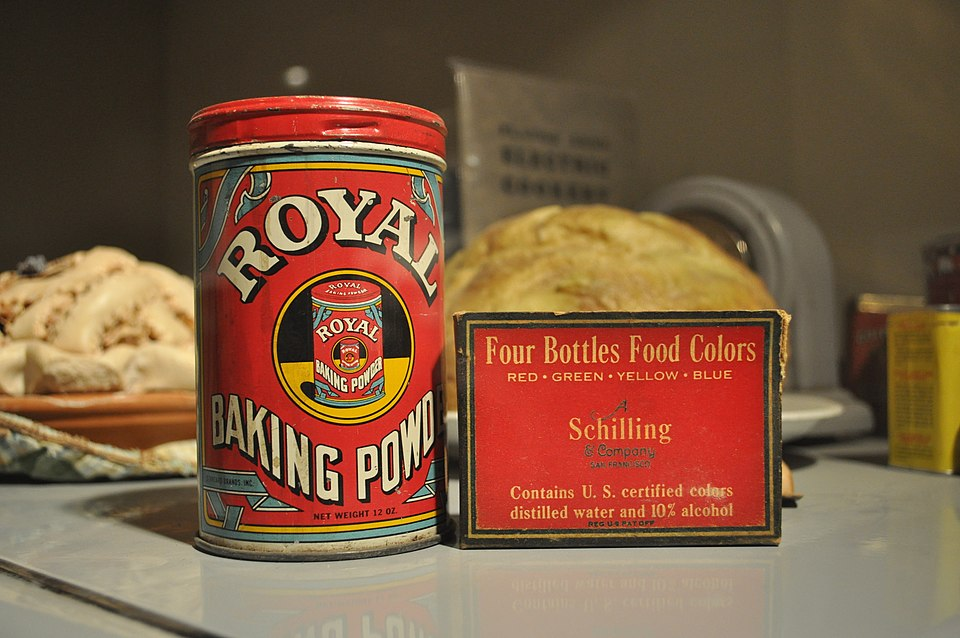
- Baking powder
- Brewer’s yeast (or baker’s yeast)
- Sourdough starter
Source(s):
https://en.wikipedia.org/wiki/Leavening_agent
Photo(s):
1. Joe Mabel, CC BY-SA 3.0 https://creativecommons.org/licenses/by-sa/3.0, via Wikimedia Commons