
Italian-style vegetable broth (Brodo vegetale all’italiana) 🇮🇹 🇸🇲 🇻🇦
Food, Culinary bases, Broths, stocks and liquid preparations
Original name: Brodo vegetale all’italiana
Other names: Brodo di verdura, Brodo di verdure
Nationality: Italy 🇮🇹, San Marino 🇸🇲, Vatican City 🇻🇦
Consumption area(s): Italy 🇮🇹, San Marino 🇸🇲, Vatican City 🇻🇦
Introduction
Italian-style vegetable broth is generally considered lighter and easier to digest than meat-based broths, which is why it is often introduced as one of the first foods during infant weaning. Because of its mild composition and relatively low fat content, it provides a gentle source of hydration and nutrients, making it suitable for individuals with sensitive digestion, including young children.
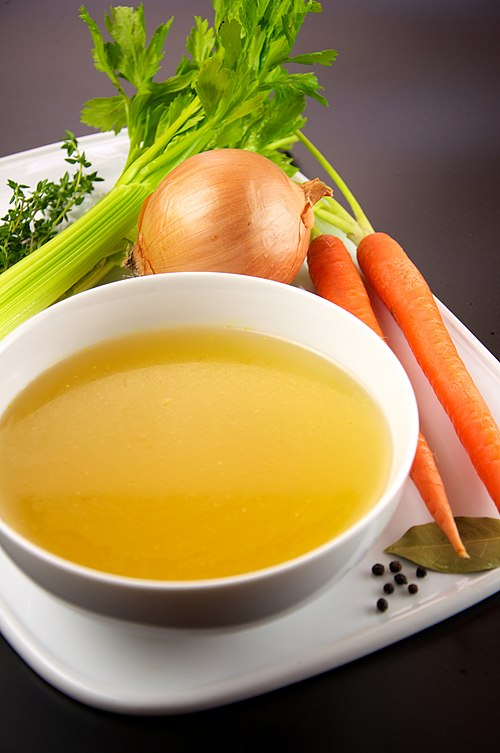
This preparation is produced by simmering a mixture of vegetables in water, allowing their soluble compounds, minerals, and aromas to gradually diffuse into the liquid. Typical ingredients include celery, carrot, onion, garlic, and zucchini, while potatoes are usually avoided, as their starch would alter the clarity and lightness of the broth.
To enhance the aromatic profile, small amounts of bay leaves, cloves, or black pepper may be added during cooking. These spices and herbs contribute subtle flavor complexity without overpowering the delicate taste characteristic of vegetable broth.
Recipe
Italian-style vegetable broth (Brodo vegetale all’italiana)
Іngredients
- 5 l
cold water (5.28 qt) - 1
yellow onion - 1
celery stalk - 1
(western) carrot - 1
zucchini (courgette) - 1
ripe tomato (optional, not always used) - 1/2
leek - 1/2
garlic clove - 1 bunch
(flat-leaf) parsley (optional, not always used) - 1
bay leaf (optional, not always used) - 1 bunch
(sweet) basil leaves - 2
cloves Coarse salt, to taste Ground Black pepper , to taste
Іnstructions
- Cut the onion in half and stick a clove into the round part of each half.
- Next, create a bouquet garni by tying together the bay leaf, parsley, and basil.
- Place the celery, carrot, the zucchini, the two onion halves, garlic, and the tomato pierced with a fork into a large pot, then cover with the indicated amount of cold water.
- Heat the pot over a low temperature between 37°C and 67°C (99–153°F) to ensure maximum flavor extraction (a thermometer can be helpful). Temperatures up to 95°C (203°F) can also be suitable, as long as the water does not boil.
- Cook the broth for about 2 hours, skimming off any foam that forms on the surface from time to time.
- After the cooking time, strain the broth first through a fine-mesh sieve and then through cheesecloth or muslin.
- Finally, adjust with salt and pepper to taste and serve hot.
Notes:
Nutritional facts table
Please note that nutritional values may vary slightly depending on the ingredients used.
| Nutrients | Per 100 g |
| Calories (kcal) | 1.9 |
| Total fat (g) | 0.01 |
| ———Saturated fat (g) | 0 |
| Cholesterol (mg) | 0 |
| Sodium (mg) | 0.9* |
| Total carbohydrates (g) | 0.42 |
| ———Dietary fiber (g) | 0.12 |
| ———Total sugar (g) | 0.2 |
| Protein (g) | 0.1 |
*This sodium content does not include the salt added during preparation, as the amount varies depending on personal preference.
Recipes that use this product as an ingredient:

Source(s):
https://it.wikipedia.org/wiki/Brodo
Photo(s):
1. TheCulinaryGeek, CC BY 2.0 https://creativecommons.org/licenses/by/2.0, via Wikimedia Commons