
Girello di spalla
Food, Animal source foods, Animals (Animalia), Chordates (Chordata), Vertebrates (Vertebrata), Mammals (Mammalia), Therians (Theria), Placentals (Placentalia), Artiodactyls (Artiodactyla), Ruminants (Ruminantia), Bovids (Bovidae), Bovines (Bovinae), Bovini, Bos, Cattle
Species name: Bos Taurus
Consumption area(s): Italy 🇮🇹, San Marino 🇸🇲, Vatican City 🇻🇦. However, it should be noted that similar cuts may also be consumed in other countries.
Local name(s)
Fusello (Milan), Girellino di spalla (Belluno), Girello di spalla (L’Aquila, Mantua, Padua, Parma, Perugia, Rovigo, Trento, Verona), Lacertiello (Naples), Lacertino di spalla (Bari, Foggia), Muscolo di spalla (Treviso), Ovu di spadda (Messina, Palermo, Reggio Calabria), Rollino (Turin), Rotolo di spalla (Mantua), Rotondino di spalla (Genoa), Sbordone (Rome, Vatican City), Soppelo (Florence), Zogia (Venice)
Anatomy of girello di spalla
The girello di spalla is an anatomical cut derived from the anterior portion of the shoulder and is located in the small lateral cavity of the scapula. It is a relatively compact muscular section, mainly composed of two muscles: the supraspinatus and the brachiocephalicus.
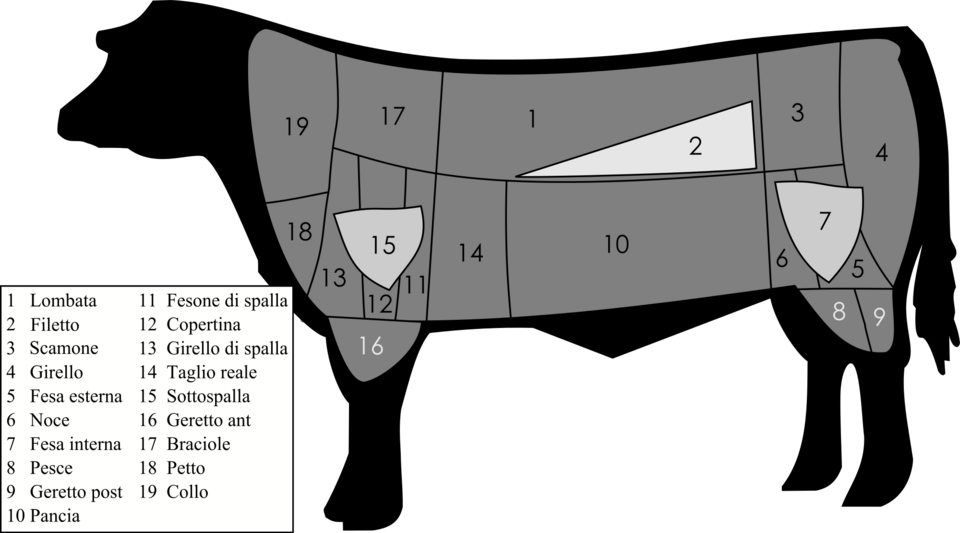
In the image, this cut corresponds to the anterior portion of numbers 13.
Similar cuts aroud the Earth
There are no similar cuts in other countries.
Uses of girello di spalla
The girello di spalla is classified as a second-category cut, although its actual quality is often overestimated, to the point that, based on its structural characteristics, it could more accurately be placed in the third category. This is because it is composed of two notably tough and resistant muscles: the supraspinatus and, in particular, the brachiocephalicus, which is considered in some analyses to be among the most fibrous and sinewy muscles in the entire cattle anatomy.
Unlike other shoulder cuts, which can be surprisingly tender and versatile, the girello is characterized by a rather firm texture and is regarded as the least prized within the group. For this reason, it is used almost exclusively in slow-cooking preparations, such as boiled meats, braises, and stews, or ground for hamburgers and meatballs.
It is strongly unsuitable for quick cooking methods, such as grilling or pan-searing, due to its muscular structure. If it is to be used for roasts or steaks, it is essential to carefully separate the two muscles and use only the supraspinatus, which is better suited for such preparations.
Nutritional facts table
It should be noted that nutritional values may slightly vary depending on the animal.
| Nutrients | Per 100 g |
| Calories (kcal) | 108 |
| Total fat (g) | 2.4 |
| ———Saturated fat (g) | 0.76 |
| Cholesterol (mg) | 60 |
| Sodium (mg) | 55 |
| Total carbohydrates (g) | 0 |
| ———Dietary fiber (g) | 0 |
| ———Total sugar (g) | 0 |
| Protein (g) | 21.5 |
Recipes that use this product as an ingredient:

Source(s):
https://piratasuino.it/wp-content/uploads/2024/04/QUADERNO-1-I-TAGLI-DEL-BOVINO.pdf
Photo(s):
1. Yzmo, Giglio83, CC BY-SA 3.0 https://creativecommons.org/licenses/by-sa/3.0, via Wikimedia Commons