
Garden asparagus
Species of Asparagus
Food, Plant source foods, Plants (Plantae), Flowering plats (angiospermae), Mesangiosperms, Monocots, Asparagales, Asparagaceae, Asparagus
Consumption area(s): We couldn’t find any reliable data on the availability of this product, but it is presumably mainly consumed in: Europe, North America, China 🇨🇳, Japan 🇯🇵
Note: For better understanding, please read the article on flowering plants (angiospermae) first. If you come across unfamiliar words, you can click on any highlighted term to open the glossary with definitions of key botanical terms.
Introduction
Garden asparagus is a long-lived perennial species belonging to the genus Asparagus, originally distributed across Europe and North America. It is extensively farmed for food, and its tender emerging shoots are harvested and consumed as a seasonal spring vegetable.
Description of the plant
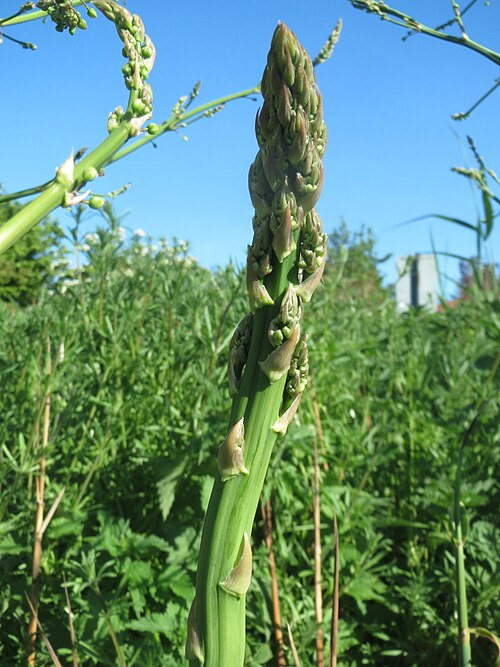
Garden asparagus is an herbaceous, perennial plant that typically reaches 100–150 cm in height, although under favorable conditions it can extend up to 3.5 metres. It develops robust, erect stems covered with finely divided, feathery foliage, giving the plant a soft, airy appearance.
What appear to be leaves are actually needle-like phylloclades—that is, modified stems—positioned in the axils of reduced scale leaves. These structures measure about 6–32 mm in length and roughly 1 mm in width, and are arranged in dense clusters of up to 15 units, often forming a rosette-like configuration. The roots consists of a system of adventitious roots.
The flowers are small and campanulate, displaying greenish-white to pale yellow hues, and measuring approximately 4.5–6.5 mm. They possess six tepals partially fused at the base and are borne either solitarily or in small inflorescences (2–3 flowers) at the nodes of branchlets. The species is predominantly dioecious, meaning male and female flowers occur on separate individuals, although hermaphroditic forms may occasionally be observed. The fruit is a globose red berry, about 6–10 mm in diameter, which is toxic to humans.
Populations occurring along the western coastal regions of Europe—from northern Spain to northwestern Germany, including Ireland and Great Britain—are often classified as Asparagus officinalis subsp. prostratus, a form characterized by its reduced stature (30–70 cm) and frequently prostrate growth habit, along with shorter phylloclades (2–18 mm). In some taxonomic treatments, this variant is elevated to the rank of a distinct species, referred to as Asparagus prostratus.
Description of the edible parts (shoots)
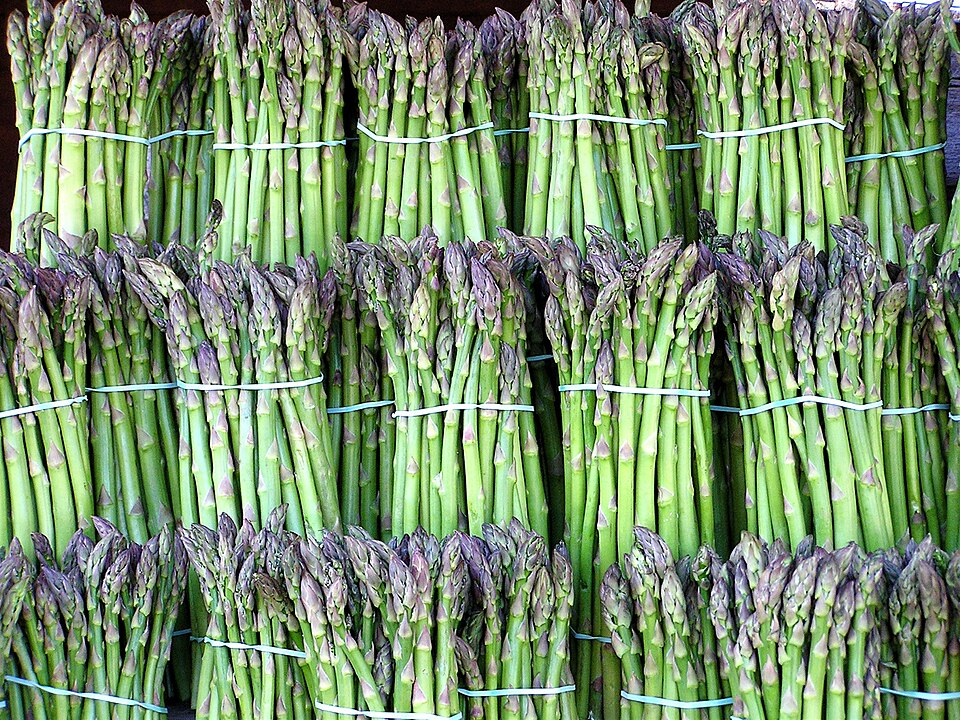
The edible portion of asparagus consists exclusively of the young shoots, which are harvested while still tender and undeveloped. At this stage, the tissues remain succulent and palatable, making them suitable for consumption. However, as soon as the buds begin to open, the shoots undergo rapid become woody, becoming fibrous, tough, and no longer desirable as food.
History of garden asparagus as food
Asparagus has long been valued both as a culinary vegetable, appreciated for its distinctive flavor, and as a medicinal plant, traditionally associated with diuretic effects and a supposed aphrodisiac role. Its use dates back to ancient civilizations, as evidenced by its depiction in an Egyptian frieze (around 3000 BCE). It was also known in regions such as Syria and the Iberian Peninsula, indicating an early and wide geographic distribution.
In the classical world, both the Greeks and Romans consumed asparagus fresh during its growing season and preserved it by drying for later use. Its cultural relevance is reflected in the phrase attributed to Augustus, who used the expression “faster than cooking asparagus” to describe something done with great speed. Several prominent authors—including Theophrastus, Cato the Elder, Pliny the Elder, and Apicius—documented the plant, with detailed accounts not only of its cultivation techniques but also of its culinary preparation. Its importance in Roman society was such that specialized ships, reportedly named after asparagus, were used to collect and transport it.
From the 15th century onward, asparagus cultivation expanded significantly in France, later reaching peak popularity in England during the 16th century. It was subsequently introduced to North America, where Indigenous peoples utilized it by drying it for medicinal applications, demonstrating its continued role beyond simple nutrition.
Production methods for garden asparagus
Asparagus is frequently associated with coastal and maritime environments, where it shows a notable tolerance to saline soils that inhibit the growth of many competing weeds. Historically, farmers exploited this trait by applying salt to control unwanted vegetation, although this practice often rendered the soil unsuitable for other crops. For this reason, regions with marine influence, such as the western coasts of North America and various Mediterranean areas, are particularly favorable for its cultivation.
If not harvested at the appropriate stage, the young shoots elongate into stems up to 1–1.5 meters, gradually becoming tough and fibrous. Additionally, plant sex influences morphology: female plants tend to produce thicker shoots, whereas male plants generate slender ones. Importantly, diameter is not directly correlated with tenderness, as shoot thickness is determined from the moment of emergence.
White asparagus is produced using a distinct cultivation method, which is described in detail on the dedicated page.
Uses of garden asparagus
Asparagus is a low-calorie and low-sodium vegetable, valued for its rich nutritional profile. It provides a solid amount of vitamin B6, calcium, magnesium, and zinc, while being especially abundant in dietary fiber, protein, and key micronutrients such as beta-carotene, vitamins C, E, and K, and several B vitamins including thiamine, riboflavin, niacin, and folate. It also contains important minerals like iron, phosphorus, potassium, copper, manganese, and selenium, along with chromium, a trace element involved in enhancing insulin function and glucose metabolism. Notably, the amino acid asparagine derives its name from this plant, as it was first isolated from it due to its relatively high concentration.
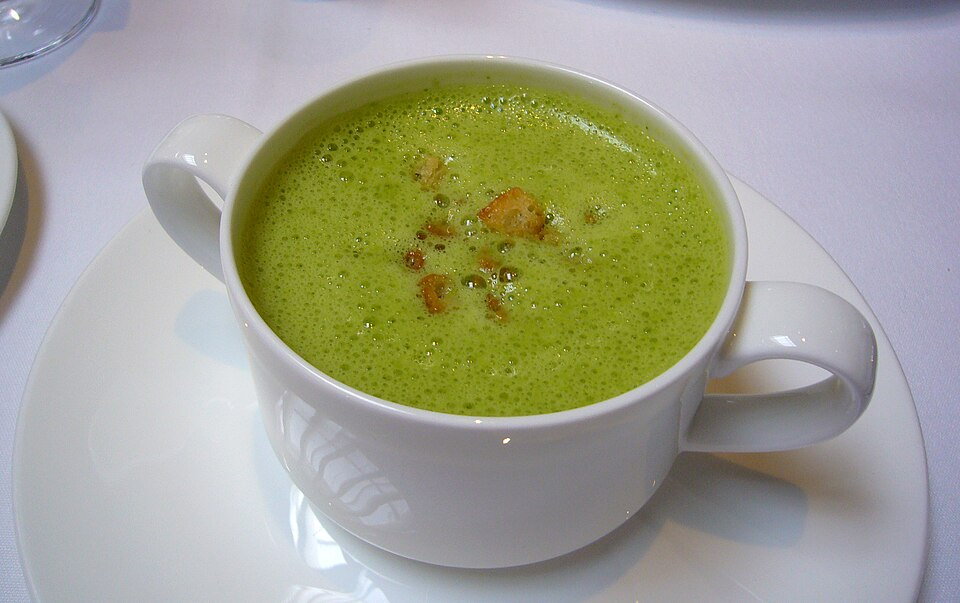
In global gastronomy, asparagus is prepared in a wide variety of ways and is commonly served as an appetizer or vegetable side dish. In many Asian cuisines, it is frequently stir-fried, often combined with ingredients such as chicken, shrimp, or beef. It can also be grilled over high heat, enhancing its flavor, or incorporated into soups and stews. Additionally, asparagus can be pickled and preserved, allowing it to be stored and consumed over extended periods without significant loss of quality.
Classification of garden asparagus
Garden asparagus is classified according to different cultivars, although there is also an additional classification system based on the production method used:
According to the cultivar:
- Asparago viola di Albenga
- Asparago Grosso di Pescia (Gigante)
According to the production methods:
- White asparagus
Nutritional facts table
It should be noted that nutritional values may vary depending on the cultivar.
| Nutrients | Per 100 g |
| Calories (kcal) | 20 |
| Total fat (g) | 0.12 |
| ———Saturated fat (g) | 0.05 |
| Cholesterol (mg) | 0 |
| Sodium (mg) | 2 |
| Total carbohydrates (g) | 3.88 |
| ———Dietary fiber (g) | 2.1 |
| ———Total sugar (g) | 1.88 |
| Protein (g) | 2.2 |
Recipes that use this product as an ingredient:
Photo(s):
1. AnRo0002, CC0, via Wikimedia Commons
2. Muffet, CC BY 2.0 https://creativecommons.org/licenses/by/2.0, via Wikimedia Commons
3. Kent Wang, CC BY-SA 2.0 https://creativecommons.org/licenses/by-sa/2.0, via Wikimedia Commons