
Fesone di spalla
Food, Animal source foods, Animals (Animalia), Chordates (Chordata), Vertebrates (Vertebrata), Mammals (Mammalia), Therians (Theria), Placentals (Placentalia), Artiodactyls (Artiodactyla), Ruminants (Ruminantia), Bovids (Bovidae), Bovines (Bovinae), Bovini, Bos, Cattle
Species name: Bos Taurus
Consumption area(s): Italy 🇮🇹, San Marino 🇸🇲, Vatican City 🇻🇦. However, it should be noted that similar cuts may also be consumed in other countries.
Local name(s)
Ciangolino (Florence), Cotenotto (Florence), Fesa di spalla (Rovigo), Fesone di spalla (Milan, Verona), Fettone di spalla (Mantua), Nosetto di spalla (L’Aquila), Pieno di spadda (Palermo), Punta di spalla (Genoa), Scapìn (Venice), Soprapaletta (Genoa).
Anatomy of fesone di spalla
The fesone di spalla is a cut located near the joint between the scapula and the humerus, set within a natural hollow that supports part of the forelimb’s movement. It is mainly composed of three muscles: the superficial pectoral, the triceps brachii, and the coracobrachialis.
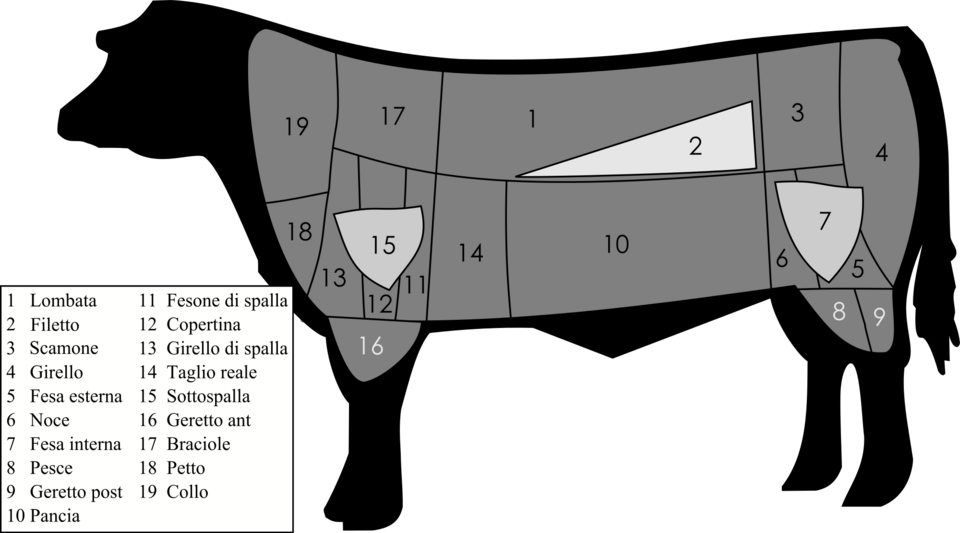
In the image, this cut corresponds to the anterior portion of numbers 11.
Similar cuts aroud the Earth
There are no similar cuts in other countries.
Uses of fesone di spalla
The fesone di spalla is considered an intermediate cut, meaning it is neither particularly high-value nor low-value. Its culinary versatility depends largely on how it is butchered. In fact, this cut includes both tougher portions, such as those from the pectoral region, and more tender muscles, like the triceps brachii, which can yield interesting results when properly handled.
Because of this tissue variability, it is essential that the butcher has a solid understanding of the cut’s anatomy: precise fabrication can make the difference between a portion suited for braising and stews, and one appropriate for quick cooking methods, such as breaded steaks or thin carpaccio slices.
When the more tender part of the fesone is selected, it is possible to obtain a decent roast beef or a grillable steak, provided the meat comes from a high-quality animal. Conversely, the more fibrous portions are better suited to moist-heat preparations, which require time, patience, and slow, steady cooking.
Nutritional facts table
It should be noted that nutritional values may slightly vary depending on the animal.
| Nutrients | Per 100 g |
| Calories (kcal) | 108 |
| Total fat (g) | 2.4 |
| ———Saturated fat (g) | 0.76 |
| Cholesterol (mg) | 60 |
| Sodium (mg) | 55 |
| Total carbohydrates (g) | 0 |
| ———Dietary fiber (g) | 0 |
| ———Total sugar (g) | 0 |
| Protein (g) | 21.5 |
Recipes that use this product as an ingredient:

Source(s):
https://piratasuino.it/wp-content/uploads/2024/04/QUADERNO-1-I-TAGLI-DEL-BOVINO.pdf
Photo(s):
1. Yzmo, Giglio83, CC BY-SA 3.0 https://creativecommons.org/licenses/by-sa/3.0, via Wikimedia Commons