
Ehrhartoideae (Oryzoideae)
Subfamily of grasses (or Poaceae, cereals)
Food, Plant source foods, Plants (Plantae), Flowering plats (angiospermae), Mesangiosperms, Monocots, Poales, Grasses (or Poaceae, cereals)
Consumption area(s): Earth
Note: For better understanding, please read the article on flowering plants (angiospermae) first. If you come across unfamiliar words, you can click on any highlighted term to open the glossary with definitions of key botanical terms.
Introduction
Ehrhartoideae (Oryzoideae) represents a subfamily of herbaceous, seed-producing monocot plants, classified within the grass family (Poaceae), which belongs to the order Poales.
Description of Ehrhartoideae (Oryzoideae)
Species in this subfamily display a mainly herbaceous growth form, either annual or perennial, often developing rhizomes or stolons; in some cases they may even appear slightly woody at the base. Certain taxa are also adapted to aquatic environments. The root system is typically fibrous, ensuring efficient anchorage and absorption.
Leaves are arranged alternately in two ranks along the stem and consist of a sheath, a ligule, and a blade. The blade is usually broad, with shapes ranging from linear to lanceolate and ending in a tapered tip. In some species, leaves may include auricles, or show a pseudo-petiole. The venation follows a parallel pattern, sometimes with faint transverse connections, and a simple central midrib. Leaf tissues may contain silica bodies, enhancing mechanical strength.
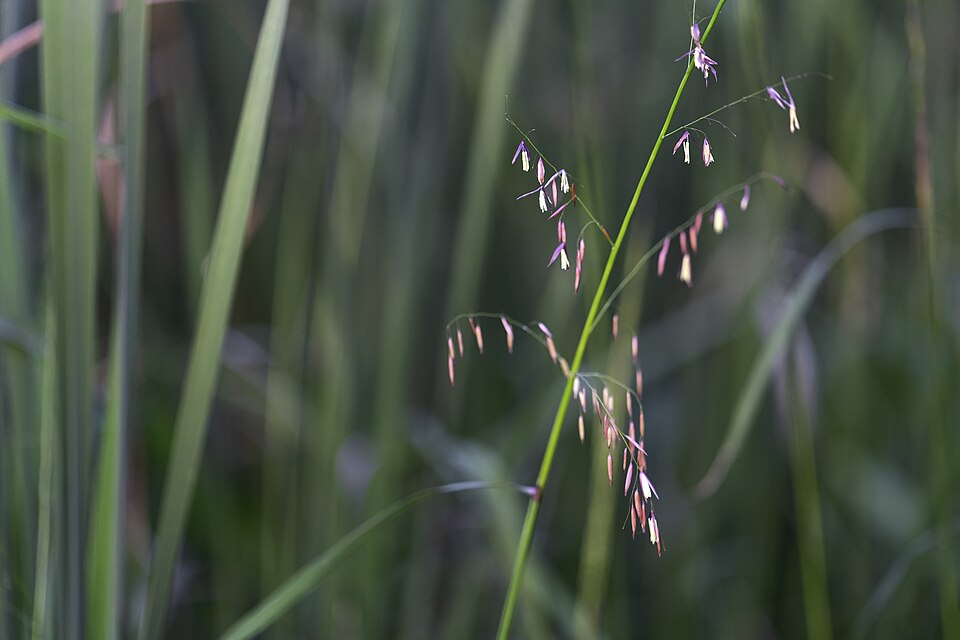
The inflorescences vary from branched to unbranched, typically forming panicle-like structures and only rarely reduced to a single unit. The main axis can occasionally appear flattened or leaf-like. Flower arrangement differs among species: some bear both male and female units within the same inflorescence, while others separate them into distinct structures. Generally, the lower-positioned spikelets are female, while those higher on the inflorescence are male.
Each spikelet is usually pedicellate and laterally compressed, containing a single fertile terminal flower accompanied by sterile elements at the base, or alternatively a mix of sterile male and one fertile flower. The protective bracts (glumes) may be reduced or persistent, and the structural components (lemmas and paleas) vary in texture, sometimes hardened or ridged.
The flowers are radially symmetrical and structurally simplified, consisting of a reduced perianth, an androecium, and a gynoecium. The stamens range in number and produce monocolpate pollen, while the ovary is superior, formed by fused carpels and containing a single ovule. Depending on the species, flowers may be unisexual, bisexual, or cleistogamous.
The fruit is a caryopsis, a dry, indehiscent grain in which the pericarp is tightly fused to the seed. It typically has an elongated, flattened shape, with a firm endosperm and a linear hilum.
Classification of Ehrhartoideae (Oryzoideae)
This subfamily is divided into tribe, including:
- Rice (Oryzeae) (rice, wild rice)
Photo(s):
1. Lorie Shaull, CC BY-SA 4.0 https://creativecommons.org/licenses/by-sa/4.0, via Wikimedia Commons