
Domestic chickens
Domesticated form of Gallus gallus
Food, Animal source foods, Animals (Animalia), Chordates (Chordata), Vertebrates (Vertebrata), Birds (Aves), Neognaths (Neognathae), Galliforms (Galliformes), Phasianidae, Gallus, Gallus gallus
Scientific name: Gallus gallus domesticus
Consumption area(s): Earth
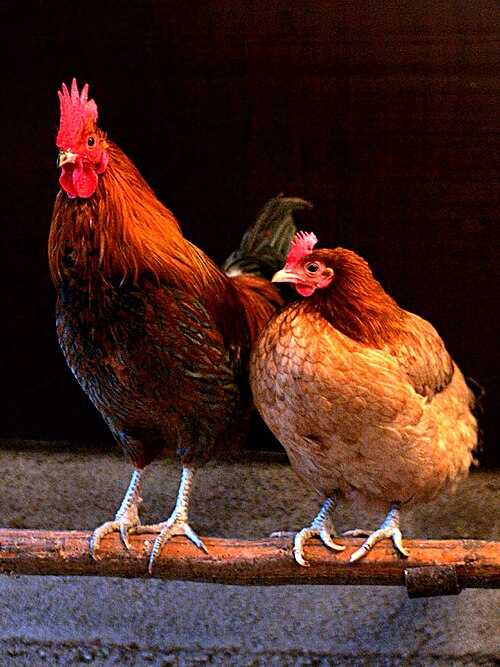
Introduction
Domestic chickens are the domesticated descendants of the red junglefowl, a species originally found in Southeast Asia. Humans first began domesticating chickens approximately 8,000 years ago, making them one of the most ubiquitous and widespread domesticated animals in history. While chickens are primarily raised for their meat and eggs, they are also commonly kept as pets in many households. By 2023, the total global population of chickens exceeds 26.5 billion, with over 50 billion birds produced each year for food consumption. Over time, humans have developed specialized breeds to meet specific needs.
Description of domestic chickens
Chickens are medium to large birds that are primarily active during the day. Their bodies are generally rounded, with short wings and mostly unfeathered legs. While red junglefowl can fly well, domestic chickens are usually too heavy to fly more than short distances. Size and coloration vary greatly across breeds. Newly hatched chicks, whether of modern or heritage breeds, weigh about 1.3 oz (37 g), but modern varieties grow much faster; for example, a Ross 708 broiler may reach 4.0 lb (1.8 kg) by day 35, compared with 2.3 lb (1.05 kg) for a heritage chicken of the same age.
Adult chickens of both sexes possess a fleshy crest on the head called a comb and hanging wattles under the beak, which are more pronounced in males. Certain breeds exhibit a facial feather mutation, producing a beard-like appearance.
Chickens are omnivorous, feeding by scratching the ground for seeds, insects, and small animals such as lizards, small snakes, and young mice. Their lifespan depends on the breed, typically 5–10 years, with exceptional individuals living up to 16 years. Socially, chickens are gregarious, forming flocks where a strict dominance hierarchy regulates access to food and nesting sites. Dominant males may leap and use their claws during disputes, while the flock can collectively mob predators, even small foxes.
Communication is important: rooster crow loudly to mark territory and respond to disturbances, while hens cluck to signal egg–laying or to call their chicks. Chickens use different warning calls to indicate predators approaching from the air or ground, displaying a nuanced social and survival communication system.
Reproductive cycle
To initiate courtship, a rooster may perform a circular dance around a hen, often lowering the wing closest to her. This display can trigger a response in the female. The sequence usually begins with the male approaching while performing a ritualized waltzing movement. If the hen is not receptive, she generally runs away; if she accepts, she lowers her body into a crouched posture, allowing the male to mount her and maintain balance by treading with both feet on her back. After copulation, the rooster often performs a short tail-bending display.
When laying eggs, hens frequently choose nests that already contain eggs, and may even move eggs from nearby nests into their own. Because of this behavior, a flock typically relies on only a few preferred nesting sites rather than having a separate nest for each bird. Under natural conditions, a hen continues laying until the clutch is complete and only then begins incubation. This phase involves the hen remaining on the nest for long periods; if disturbed, she may fluff up her feathers or strike defensively, and she rarely leaves until the eggs hatch.
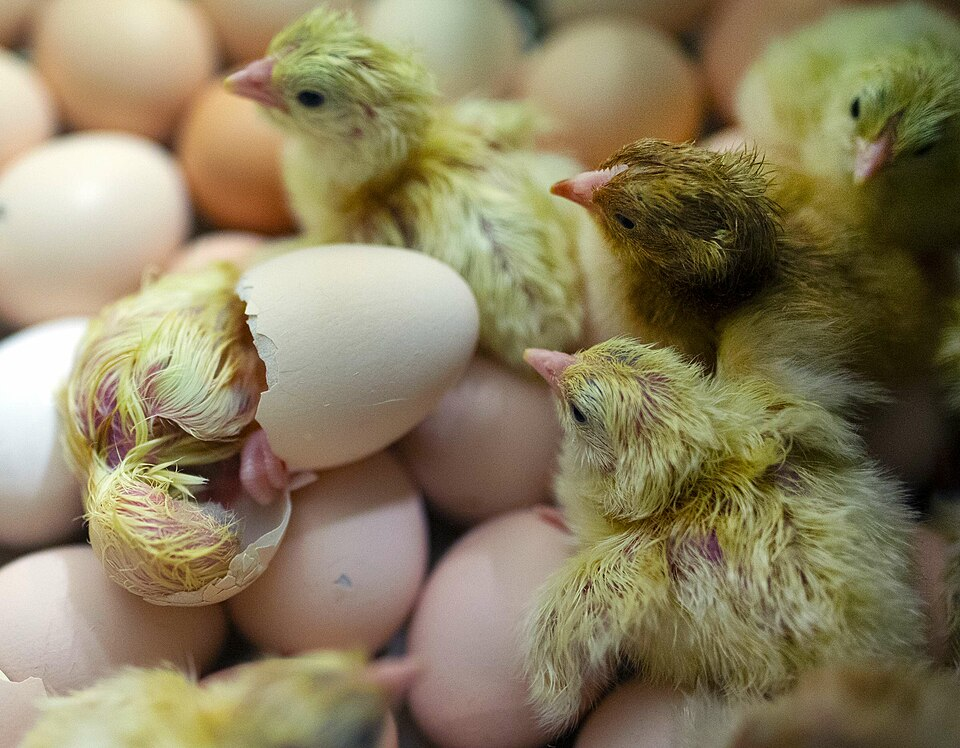
Fertile eggs hatching after an incubation period of about 21 days. The chick breaks the shell using a temporary structure known as the egg tooth. The hen generally remains on the nest for about two days after the first chick hatches, while the newly emerged chicks initially feed by absorbing the internal yolk. She then protects and warms the chicks, guiding them toward food and water and calling them to feeding sites. The chicks can quickly form a strong attachment and following the hen closely, while she continues to care for and defend them for several weeks.
History of domestic chickens as food
The red junglefowl takes advantage of periods of high seed availability to increase its reproductive output. Humans later exploited this ability to breed prolifically when domesticating the chicken, taking advantage of surges in food resources. Evidence from some studies suggests that chickens were domesticated around 8,000 years ago in Southeast Asia, spreading to China and India 2,000–3,000 years later. A single domestication event likely gave rise to modern chickens, which then interbred with local wild junglefowl, creating genetically and geographically distinct populations.
Archaeological findings support these conclusions. Analysis of bones from over 600 sites, with dating from 23, points to the earliest probable chicken bones in central Thailand at Ban Non Wat, around 3,250 years ago. Researchers Joris Peters and Greger Larson propose that the spread of rice cultivation attracted red junglefowl to feed on seeds, nest nearby, and gradually become domesticated.
Production methods for domestic chickens
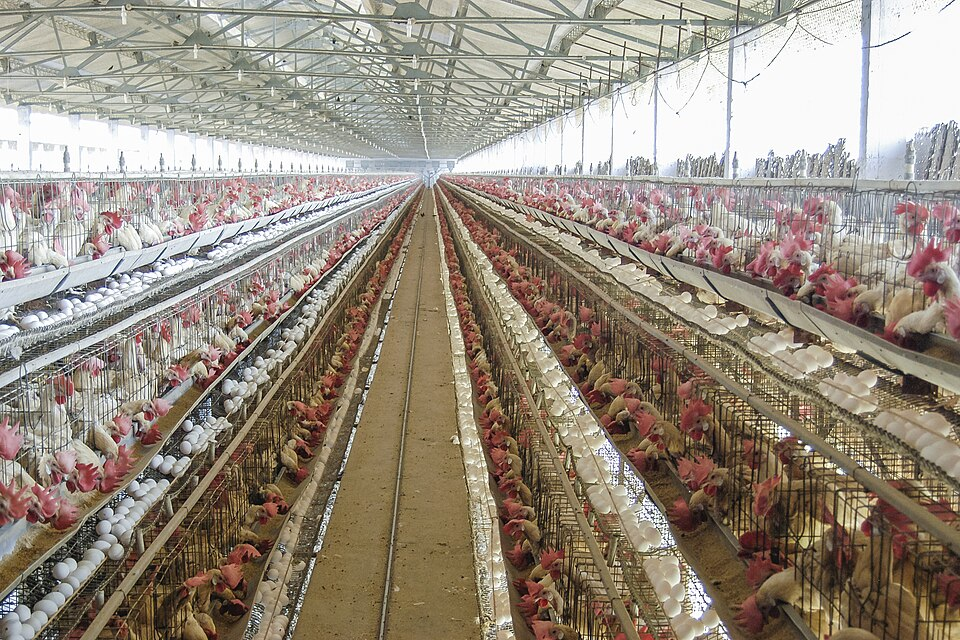
Chickens raised for meat are often kept indoors on bedding in climate-controlled houses. These chickens grow very quickly due to selective breeding, reaching market weight between 5 and 9 weeks. Day-old chicks are placed in large grow-out houses where automated systems provide feed and water, and ventilation and heating maintain a stable indoor environment. The flooring is covered with dry litter, which helps maintain flock health, and watering systems reduce spillage. Indoor housing also protects the birds from predators and allows controlled access to natural light when houses have rollable curtains or tunnel ventilation systems.
Typical indoor flocks consist of thousands of chickens in large houses, with space allotments ranging from 0.5 to 0.8 square feet per bird, adjusted based on bird size. Chickens at this stage are immature and show very little aggression. Their diet is based on corn and soybean meal, enriched with vitamins and minerals, with no hormones or steroids used. Higher welfare indoor systems give chickens more space (around 14–16 birds per square meter) and a richer environment, allowing natural behaviors like foraging. Chickens in these systems grow more slowly and live slightly longer than intensively farmed birds, improving well-being and behavior.
Free-range chickens have access to outdoor areas, at least one square meter per bird in the EU, and grow more slowly than indoor chickens. They can perform natural behaviors like scratching and exercising outdoors, which enhances leg and heart health.
Organic chickens are managed like free-range bird but with stricter rules on feed additives, medications, and synthetic amino acids. They are usually slower-growing traditional breeds reaching slaughter weight around 12 weeks and enjoy larger outdoor spaces, sometimes up to 10 square meters per bird. Organic standards limit flock density both indoors and outdoors to ensure better animal welfare.
Uses of domestic chickens
Chicken can be prepared in a wide variety of ways. It can be skewered, grilled, roasted, baked, breaded and deep-fried, incorporated into salads or curries, or made into sausages. Western cuisines often favor deep-frying, producing fried chicken, nuggets, lollipops, or Buffalo wings, while Eastern cuisines emphasize marination, such as in Philippine adobo.
Chicken bones are dangerous if eaten whole, as they can splinter. However, they are ideal for making stock or soups, simmered with vegetables and herbs. In Asia, bones are commonly sold for soups considered healthy, while in Australia, leftover rib cages and backs are sold as “chicken frames” or “carcasses” for stock or soup preparation.
Raw chicken can harbor Salmonella, a bacterium that may cause foodborne illness. To ensure safety, the U.S. Department of Health & Human Services recommends cooking chicken to a minimum internal temperature of 165 °F (74 °C). Despite this, some cultures, such as in Japan, consume raw chicken dishes like torisashi (sliced raw chicken served sashimi-style) or toriwasa (lightly seared on the outside, raw inside).
Classification of domestic chickens
Domestic chickens are primarily divided into breeds. In this context, only the meat breeds (broiler) and dual-puropose ones are presented, while the only egg-laying breeds are described in the section dedicated to chicken egg.
- Australorp
- Barnevelder
- Brahma
- Braekel (Brakel)
- Buckeye
- Bresse
- California Gray
- Chantecler
- Cornish (a.k.a. Indian Game)
- Cubalaya
- Derbyshire Redcap
- Dominique
- Dorking
- Faverolles
- Holland
- Iowa Blue
- Ixworth
- Java
- Jersey Giant
- Marans
- Marsh Daisy
- Naked-neck
- New Hampshire
- Norfolk Grey
- Orpington
- Poltava
- Plymouth Rock
- Red Shaver
- Rhode Island Red
- Rhode Island White
- Scots Dumpy
- Scots Grey
- Sombor Kaporka (Somborska kaporka)
- Sussex
- Winnebago
- Wyandotte
Another way to classify chickens is by their type, rather than breed. Because terminology and usage vary across regions, this framework focuses on the sex and age of the birds, grouping them into broadly recognizable categories.
- Biddy (a newly hatched chicken)
- Chick (a young chicken)
- Cock/rooster (a fertile adult male chicken)
- Hen (an adult female chicken)
- Pullet (a young female chicken less than a year old)
- Capon (a castrated or neutered male chicken)
Finally, it should be noted that domestic cattle, regardless of breed, sex, or reproductive status, can be classified according to the specific cut of meat:
- Blood
- Breast, which when sold boneless also gives rise to:
- Tenederloin
- Carcass
- Foot
- Giblets, formed by:
- Gizzard
- Heart
- Liver
- Head
- Kidneys
- Leg, formed by:
- Drumstick
- Thig
- Neck
- Oyster
- Pyogostyle
- Skin
- Testicle
- Wing, formed by:
- Drumette
- Wingette (or middle flat segment)
- Wing tip
Nutritional facts table of domestic chickens
Although chickens are sometimes consumed whole, it is not possible to provide even approximate nutritional values, as these vary greatly depending on the specific cut. For this reason, reference should be made to the nutritional tables of individual cuts.
Source(s):
https://en.wikipedia.org/wiki/Chicken
https://en.wikipedia.org/wiki/Chicken_as_food
https://en.wikipedia.org/wiki/Poultry_farming
Photo(s):
1. Andrei Niemimäki from Turku, Finland, CC BY-SA 2.0 https://creativecommons.org/licenses/by-sa/2.0, via Wikimedia Commons
2. Otwarte Klatki, CC BY 2.0 https://creativecommons.org/licenses/by/2.0, via Wikimedia Commons
3. Matthew T Rader, https://matthewtrader.com, CC BY-SA 4.0 https://creativecommons.org/licenses/by-sa/4.0, via Wikimedia Commons