
Cucurbita
Genus of Cucurbitaceae
Food, Plant source foods, Plants (Plantae), Flowering plats (angiospermae), Mesangiosperms, Eudicots, Core eudicots, Superrosids, Rosids, Fabids (Eurosids I), Cucurbitales, Cucurbitaceae
Consumption area(s): Earth
Note: For better understanding, please read the article on flowering plants (angiospermae) first. If you come across unfamiliar words, you can click on any highlighted term to open the glossary with definitions of key botanical terms.
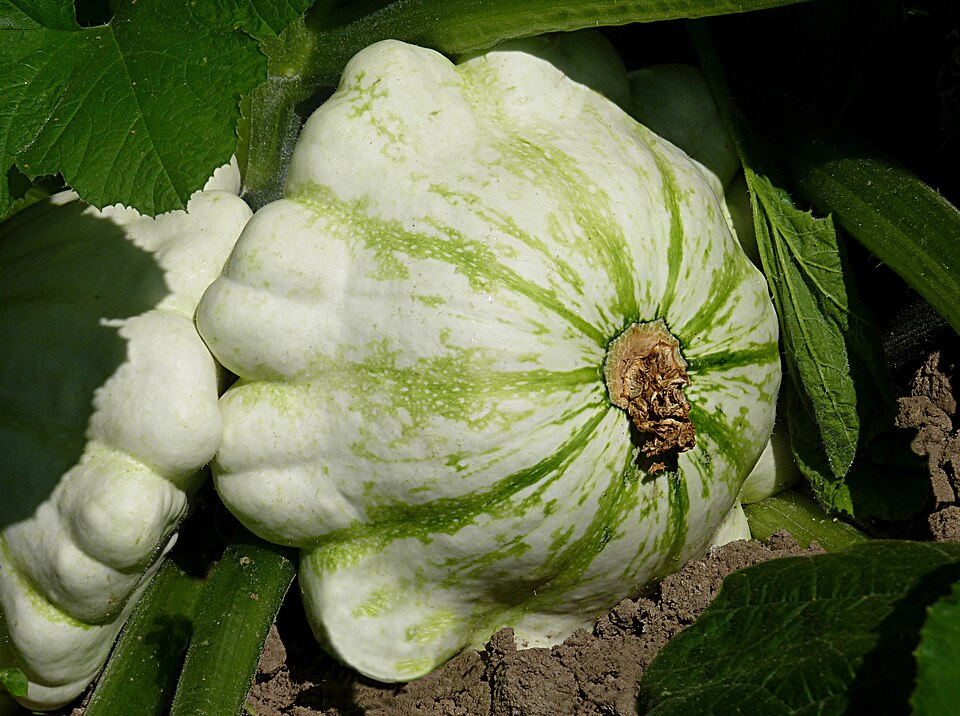
Introduction
Cucurbita is a genus of herbaceous plants in the Cucurbitaceae family, originating from the Andes and Mesoamerica. Several species produce edible fruits and seeds, commonly called squash, pumpkin, or gourd, depending on the variety and local terminology. Related bottle-gourds, native to Africa and belonging to the genus Lagenaria, share the same family and subfamily but differ in tribe; their immature fruits are eaten in a similar way to Cucurbita species.
The taxonomy of Cucurbita is debated, with estimates of accepted species ranging from 13 to 30, but only five species have been widely domesticated. Most of these can be stored for months and are treated as winter squash, though some cultivars of Cucurbita pepo are suited only for summer squash use.
Description of Cucurbita
Cucurbita species can be divided into two main groups. The first group includes annual or short-lived perennial vines and need a consistent water supply. The second group consists of perennials adapted to arid environments and capable of tolerating dry conditions. All cultivated Cucurbita species derive from the first group.
The plants can grow from 15 to 50 feet (5–15 meters), with stems producing tendrils that allow the vine to climb or spread along the ground. Most species rarely root at the nodes, while other plants show this ability to a lesser extent. Fruit size, shape, and color vary widely within and between species. In species like Cucurbita pepo and Cucurbita maxima, morphological variation is so large that different cultivars have sometimes been misidentified as distinct species.
The leaves of cultivated Cucurbita are generally palmately lobed or five-lobed, attached to the stem via long petioles, and arranged alternately. The stems, representing much of the above-ground structure, bear trichomes, which may be hardened or sharp. Tendrils spring from each node and may be branched in some species. Leaf shape varies among species.
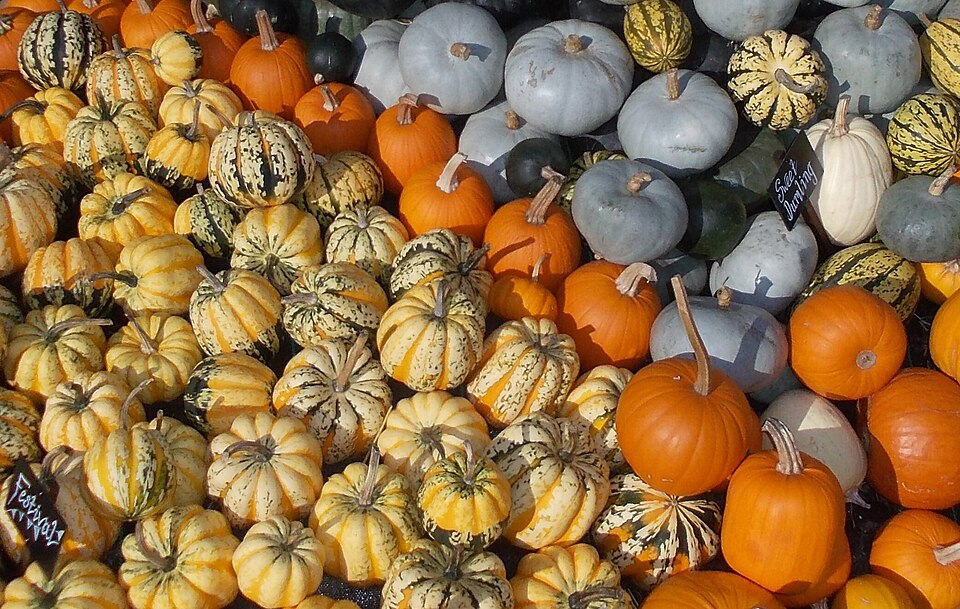
Cucurbita plants are monoecious, producing unisexual flowers on the same individual. Flowers grow singly from the leaf axils, with five fused petals ranging from yellow to orange and a green bell-shaped calyx. Male flowers typically have three stamens, fused so they appear as one, while female flowers have thick pedicels, an inferior ovary, and 3–5 stigmas, each with two lobes. In some species female flowers have larger corollas than males, while in Cucurbita pepo the female calyx is small and Cucurbita moschata male flowers have a comparatively short calyx.
The fruits of Cucurbita are large and fleshy, classified botanically as a special type of berry from an inferior ovary. They have a thick outer rind with hypanthium forming an exocarp around the ovary, and a fleshy mesocarp and endocarp inside. Seeds are attached to the ovary wall and are large and flat, with embryos composed mostly of two cotyledons. Fruit size varies greatly: wild specimens can be as small as 1.5 inches (4 cm), while domesticated fruits may exceed 660 lbs (300 kg). The world record pumpkin, grown by Beni Meier in Switzerland in 2014, weighed 2,323.7 lbs (1,054 kg).
Many Cucurbita species are pollinated by specialist bees, particularly the genera Peponapis and Xenoglossa, although generalist pollinators like honey bees also visit. Higher pollen deposition on the stigma produces larger fruits with more seeds, which is why cultivated specimens are often hand-pollinated. Certain cultivars of Cucurbita pepo can be without seeds.
History of Cucurbita as food
Archaeological findings trace the domestication of Cucurbita back at least 8,000 years, making it older than the early cultivation of maize and beans in the region by roughly 4,000 years. These discoveries emerged from excavations at the Guilá Naquitz cave in Oaxaca, Mexico, carried out in the 1960s and 1970s, possibly starting around 1959.
Clear signs of cultivated Cucurbita pepo were observed in the form of thicker rinds and larger peduncles in the more recent stratigraphic layers. By around 8,000 years BP, the peduncles of Cucurbita pepo consistently exceeded 10 millimeters, whereas wild peduncles remained thinner. Changes in fruit shape and color demonstrate that selective breeding had already begun. During this period, the average rind thickness rose from 0.84 to 1.15 millimeters.
Uses of Cucurbita
The Cucurbitaceae family encompasses a wide variety of species that serve as food for humans, with Cucurbita species ranking among the most widely used. While the stems are often more bitter than the inner flesh, the fruits and seeds of cultivated varieties are generally edible and require minimal preparation.
In addition to the fruit, the flowers, young leaves, and shoot tips are also consumable. Many varieties, especially the sweet winter types with thick, inedible rinds, can be stored for extended periods, whereas summer squashes have a thin, edible skin. Seeds from both types are versatile: they can be roasted, eaten raw, pressed into oil, ground into flour, or otherwise processed. Most squash cultivation targets the fresh food market.
Historically, Cucurbita was a staple food for indigenous peoples of the Americas, long before European contact. It quickly became important for colonial settlers, including the Pilgrims, who featured it at the first Thanksgiving. Today, commercial pumpkin—primarily Cucurbita moschata—is widely used for pumpkin pies, with Libby’s relying on its proprietary Dickinson pumpkin strain.
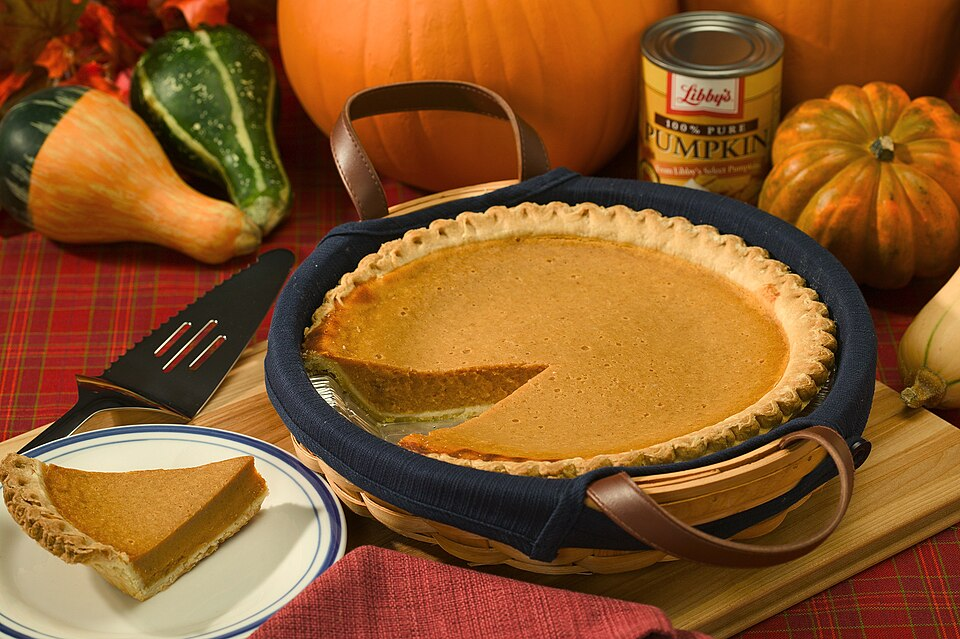
Beyond pies, Cucurbita finds use in numerous foods: biscuits, bread, cheesecake, donuts, granola, ice cream, lasagna, pancakes, puddings, pumpkin butter, salads, soups, and stuffing. In Africa, squash soup is traditional, while some species capable of tolerating dry conditions are increasingly valued for nutritious crops in arid regions. Cucurbita ficifolia, in particular, is used to make soft, mildly alcoholic beverages.
Culinary traditions around the world showcase Cucurbita’s versatility. In India, squashes (ghiya) are commonly cooked with seafood. In France, marrows (courges) are prepared as gratin, sieved and mixed with butter, milk, egg, and spices like nutmeg, or used in soups. In Italy, dishes include cocuzze alla puviredda from Apulia, torta di zucca from Liguria, and torta di zucca e riso from Emilia-Romagna, often made with butter, ricotta, Parmesan, egg, and milk, as well as sauces for pasta, such as spaghetti alle zucchine in Sicily. In Japan, small Cucurbita moschata pumpkins (kabocha) are enjoyed boiled with sesame sauce, fried as tempura, or shaped into balls with sweet potato and Japanese mountain yam.
Classification of Cucurbita
This genus is in turn divided into species. Among these we find:
- Butternut squash (or ‘Dickinson’ pumpkin, golden cushaw)
- Calabacilla (or calabaza de coyote)
- Cucurbita pepo (acorn squash, field pumpkins, summer squashes, vegetable marrows, zucchinis/courgettes)
- Cushaw pumpkin
- Figleaf gourd (or chilacayote, alcayota)
- Fingerleaf gourd
- Stinking gourd (or buffalo gourd)
- Winter squash
Photo(s):
1. Jamain, CC BY-SA 3.0 https://creativecommons.org/licenses/by-sa/3.0, via Wikimedia Commons
2. Chiswick Chap, CC BY-SA 4.0 https://creativecommons.org/licenses/by-sa/4.0, via Wikimedia Commons
3. Peggy Greb, Public domain, via Wikimedia Commons