
Common thyme
Species of Thymus
Food, Plant source foods, Plants (Plantae), Flowering plats (angiospermae), Mesangiosperms, Eudicots, Core eudicots, Superastierds, Asterids, Lamiids (Euasterids I), Lamiales, Lamiaceae, Nepetoideae, Thymus
Species name: Thymus vulgaris
Consumption area(s): Europe, North Africa, and Turkey
Introduction
Common thyme is a perennial aromatic herb belonging to the Lamiaceae family. It is valued for its fragrant leaves and distinctive flavor, making it a staple in both culinary and medicinal applications. Native to Europe and North Africa, thyme thrives in sunny, well-drained habitats.
Description of the plant
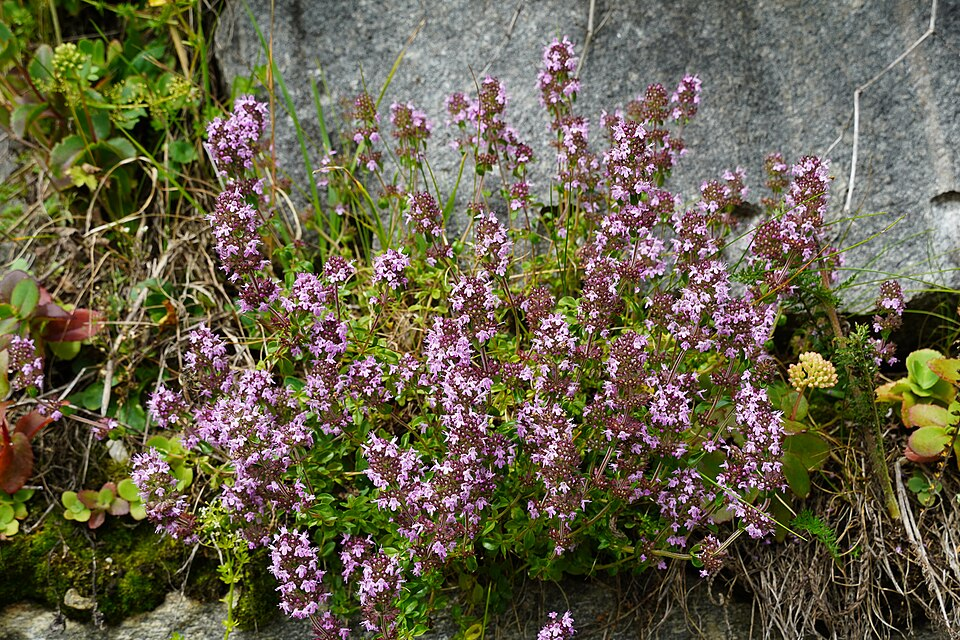
Common thyme is a small, evergreen shrub with slow growth, typically reaching 10–30 cm in height. Its main life form is the fruticose chamaephyte, although suffruticose chamaephytes can also occur. The plant contains numerous essential-oil glands, giving it its aromatic properties. The roots are fibrous. The stems are woody, erect, highly branched, with a brown bark and a quadrangular cross-section due to collenchyma bundles at the four corners.
The inflorescences consist of flowers arranged in verticils, ranging from sub-spherical to elongated (2–3 cm), positioned at the tips of branches and spaced along the stems. The bracts resemble leaves, measuring about 2.5 mm wide and 5 mm long.
The flowers are hermaphroditic, bilaterally symmetrical, and tetramerous, with a five-part perianth. The calyx is gamosepalous and bilabiate, bell-shaped with 10–13 longitudinal veins, measuring 3–4 mm. The corolla is gamopetalous, bilabiate, pinkish-white, with a cylindrical tube, upper lip bent upwards, and lower lip with three oblong lobes, 5–6 mm long.
The androecium has four didynamous stamens, adnate to the corolla, with rounded, two-loculed anthers and tricolpate or hexacolpate pollen. The gynoecium consists of a superior ovary with two fused carpels, four locules, axile placentation, and four tenuinucellate ovules. The filiform style is about the same length as the stamens, ending in a bifid stigma. The nectary forms a disc at the ovary base, richer anteriorly. Flowering occurs from May to June (or October). The fruit is a dry schizocarp of four smooth, glabrous nutlets with minimal or absent endosperm.
Reproduction occurs mainly through insect pollination, involving flies and hymenopterans, and occasionally butterflies. Seeds are first dispersed by wind, and once they reach the ground, they are often further spread by ants.
Description of the edible parts (leaves)
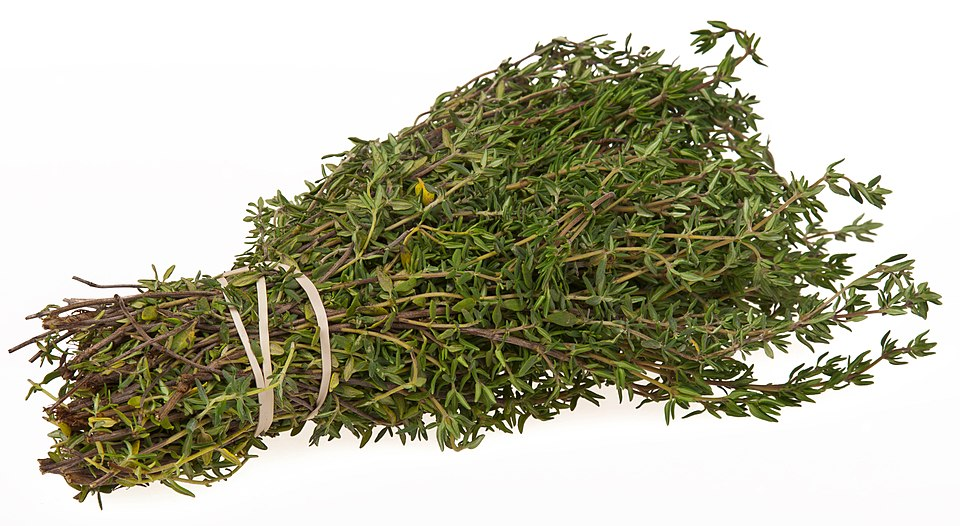
The common thyme leaves are shortly petiolate and arranged oppositely along the stem, typically in pairs, with each successive pair oriented at a right angle to the one below (a decussate pattern). The leaf blades start as lanceolate with slightly rolled edges, eventually becoming fully rolled into a tubular form, giving the impression of linear leaves. Stipules are present at the base. Leaves measure approximately 3 mm wide and 7–9 mm long.
History of common thyme
Wild thyme is native to the Levant, where it may have first been cultivated. In ancient Egypt, Commons thyme was used for embalming, while the ancient Greeks incorporated it into baths and burned it as incense in temples, believing it instilled courage.
The Romans are credited with spreading thyme across Europe, using it to freshen rooms and flavor cheese and liqueurs. During the European Middle Ages, thyme was placed under pillows to promote sleep and ward off nightmares, and women often gave thyme leaves to knights and warriors as a symbol of bravery. It was also used as incense and laid on coffins, thought to ensure safe passage to the afterlife.
Production methods for common thyme
Common thyme grows best in hot, sunny sites with well-drained soil. It is usually planted in spring and develops as a perennial herb. The plant can be propagated by seeds, cuttings, or by dividing established roots. It is drought-tolerant and benefits from pruning after flowering to prevent the stems from becoming too woody.
Uses of common thyme
Thyme is a key ingredient in bouquet garni and herbes de Provence. It is available both fresh and dried. While naturally seasonal in summer, greenhouse-grown fresh thyme can be found year-round. The fresh form offers stronger flavor but has a short shelf life, usually less than a week, unless carefully frozen, which can preserve it for several months. Thyme also retains flavor well when dried, better than many other herbs.
Fresh thyme is typically sold in bunches of sprigs, with each sprig consisting of a woody stem and paired clusters of leaves or flowers, spaced about 15–25 mm apart. Recipes may call for thyme by the bunch, sprig, tablespoon, or teaspoon. In Armenian cuisine, dried thyme is commonly used in herbal infusions (tisanes).
When cooking, a whole sprig may be used, or the leaves removed and stems discarded, depending on the dish. Whole sprigs are usually indicated by the recipe mentioning a bunch or sprig, while spoons refer to leaves only. Leaves can be removed by scraping with a knife, pinching with fingers, or using a fork. Dried thyme can easily substitute for fresh sprigs when needed.
Nutritional facts table for the leaves
Please note that nutritional values may vary slightly depending on the specific cultivar, but they differ mainly between fresh and dried products.
| Nutrients | Fresh leaves (100 g) | Dried leaves (100 g) |
| Calories (kcal) | 101 | 276 |
| Total fat (g) | 1.5 | 7.43 |
| ———Saturated fat (g) | 0 | 2.73 |
| Cholesterol (mg) | 0 | 0 |
| Sodium (mg) | 9 | 55 |
| Total carbohydrates (g) | 24 | 63.94 |
| ———Dietary fiber (g) | 14 | 37 |
| ———Total sugar (g) | 1 | 1.71 |
| Protein (g) | 6 | 9.11 |
Recipes that use this product as an ingredient:
Photo(s):
1. Naturpuur, CC BY 4.0 https://creativecommons.org/licenses/by/4.0, via Wikimedia Commons
2. Evan-Amos, CC0, via Wikimedia Commons