
Common onions
Species of Allium
Food, Plant source foods, Plants (Plantae), Flowering plats (angiospermae), Mesangiosperms, Monocots, Asparagales, Amaryllidaceae, Allium
Species name: Allium cepa
Consumption area(s): Earth
Note: For better understanding, please read the article on flowering plants (angiospermae) first. If you come across unfamiliar words, you can click on any highlighted term to open the glossary with definitions of key botanical terms.
Introduction
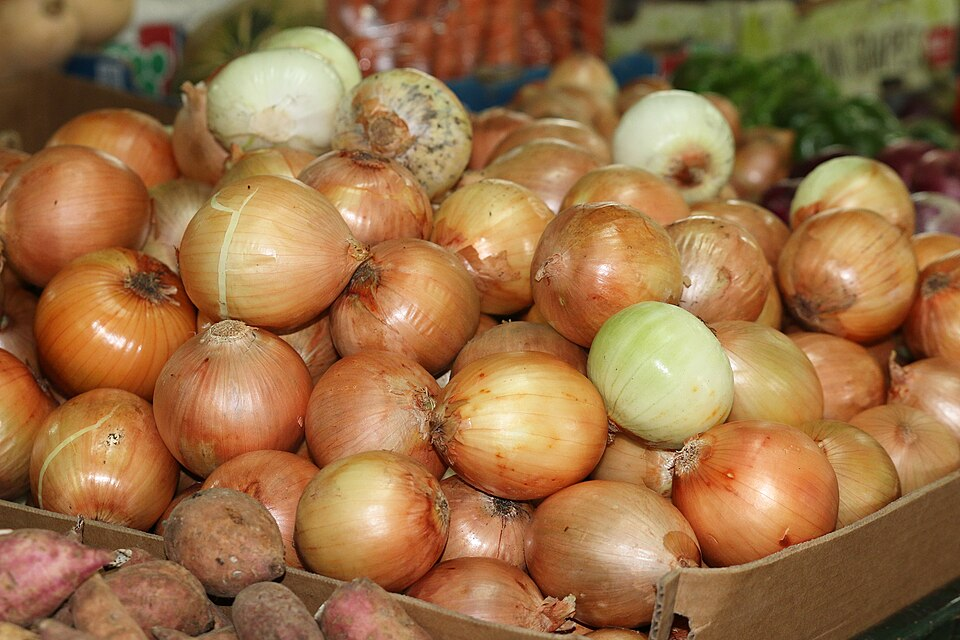
Common onions are widely grown vegetable and the most common species in the Allium genus. A close relative, the shallot, was once considered a distinct species until 2011. Several other species within the Allium genus are also cultivated for food and sometimes referred to as onions, such as the Japanese bunching onion, the tree onion, and the Canada onion. While the term wild onion applies to various species, A. cepa itself is known only through cultivation. Its original wild ancestor remains unknown, though some escaped plants have become naturalized in different areas.
Description of common onions
The onion is naturally a biennial plant, but it is most often grown as an annual. Modern cultivars generally reach a height ranging from 15 to 45 cm, adapting well to different growing conditions.
Its leaves are bluish or yellow-green and grow alternately in a flattened fan-like arrangement. They are succulent, hollow, and cylindrical, with one flattened side. The leaves widen toward about one-fourth of their total length before tapering to rounded tips. At the base, each leaf forms a flat sheath, typically white, that originates from the bulb’s base. From the underside of this sheath, a cluster of fibrous roots extends a short distance into the soil. As the plant matures, nutrient reserves accumulate in the leaf bases, causing the bulb to swell.
By autumn, the foliage begins to wither, and the outer scales of the bulb become dry and fragile, signaling that it is time for harvest. If left in the ground over the winter, the central growth point of the bulb resumes activity in spring. New leaves emerge, accompanied by a long, hollow stem topped with a protective bract surrounding the developing inflorescence. This inflorescence forms a rounded umbel of white flowers, typically arranged in clusters of six. The seeds produced are shiny black with a triangular cross-section.
History of common onions as food
Humans have cultivated and selectively bred onions for at least 7,000 years, making them one of the oldest domesticated vegetables. The precise origin of the onion is uncertain, with historical evidence pointing to both eastern and western Asia. Its domestication likely occurred in West or Central Asia, with regions such as Iran, western Pakistan, and broader Central Asia cited as potential birthplaces.
Ancient culinary records attest to the early use of onions and related plants. Around 2000 BC, recipes were inscribed in cuneiform on clay tablets in Mesopotamia, many of which are preserved in Yale University’s Babylonian collection. The Assyriologist and gastronomist Jean Bottero described these dishes as demonstrating remarkable richness, refinement, and artistry. Onions also appear in the Hebrew Bible, and archaeological evidence from Chalcolithic Nahal Mishmar and Bronze Age Jericho confirms their presence in ancient Israel.
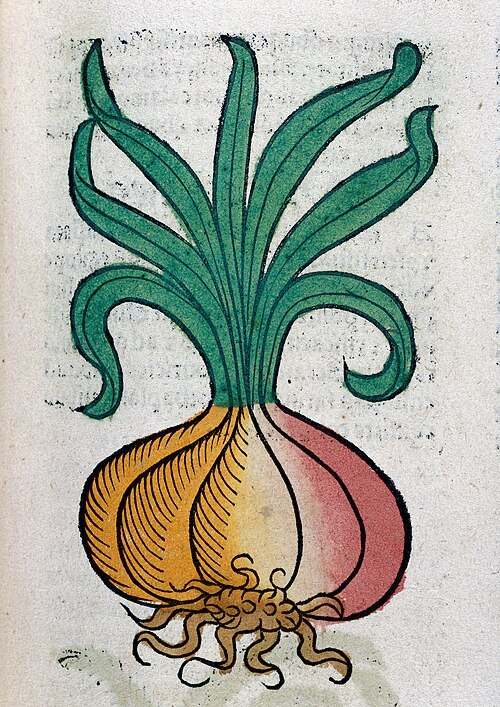
In ancient Egypt, the onion bulb held symbolic importance. Its round shape and concentric layers represented eternal life, and onions were even placed in burials, as seen in the eye sockets of Ramesses IV. In the first century AD, Pliny the Elder documented Roman uses of onions and cabbage in Pompeii, noting their supposed medicinal benefits for eye ailments, sleep, oral sores, toothaches, dog bites, back pain, and digestive issues. Archaeological excavations in Pompeii have revealed gardens resembling Pliny’s descriptions. Later, in texts compiled under the name Apicius in the fifth and sixth centuries AD, onions were recorded as ingredients in many Roman recipes.
During the Age of Discovery, European settlers introduced onions to North America as part of the Columbian exchange. Historical diaries indicate that Pilgrim settlers prioritized planting bulb onions among their first crops. From 1883 to 1939, inventors in the United States patented 97 innovations aimed at improving onion cultivation through mechanization and automation, reflecting the crop’s economic and agricultural importance.
Production methods for common onions
Onions thrive best in fertile, well-drained soils. Sandy and loamy soils are preferred due to their low sulfur content, whereas clay-rich soils often contain higher sulfur, resulting in strong-flavored bulbs. These plants demand soils rich in nutrients. While phosphorus is generally present in adequate amounts, it may be added before planting because cold soils reduce its availability. Nitrogen and potassium are usually supplied at intervals during the growing season, with the final nitrogen application taking place at least four weeks before harvest.
Bulb development in onions is highly sensitive to day length. Bulbs start to form only after the minimum required hours of sunlight have been reached. Traditional European onions are classified as long-day varieties, forming bulbs after roughly 14 or more hours of daylight. Onions from southern Europe and North Africa are generally intermediate-day types, needing only 12–13 hours of light to trigger bulb formation. More recently developed short-day onions are planted in regions with mild winters during autumn and begin bulbing in early spring, requiring just 11–12 hours of daylight.
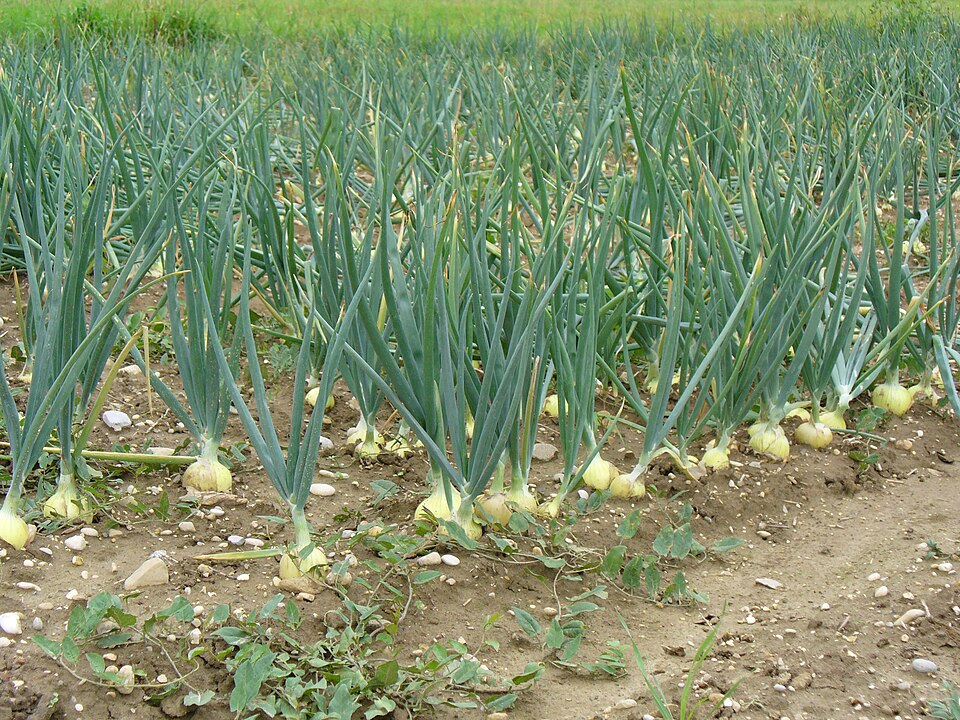
Onions can be propagated from seeds or partially grown starter bulbs. Onion seeds have a short shelf life, and fresh seeds germinate most effectively when planted in shallow rows spaced 30–45 cm apart. In suitable climates, some varieties can be sown in late summer or autumn to overwinter and produce early crops the following year.
Bulb production begins by sowing seeds densely in early summer, harvesting them in autumn while still small, then drying and storing them. These starter bulbs are planted the following spring, eventually producing mature bulbs later in the growing season. Some cultivars intended for bulb production and storage may not have the same storage qualities as those grown directly from seeds.
Bulbing usually occurs after 12–18 weeks, and bulbs can be harvested as needed for fresh consumption. For storage, bulbs are collected after the leaves have naturally withered, sometimes left on the soil surface for a few days to dry. They are then placed in nets, tied in braids, or stacked in shallow crates for storage in a cool, well-ventilated location.
Uses of common onions as food
Although the mature onion bulb is the most commonly consumed form, onions can also be eaten at earlier stages of growth. Young plants may be harvested before the bulb forms and used whole as spring onions or scallions. When onions are harvested after bulbing has begun but before full maturity, they are sometimes called “summer onions”.
Some varieties are bred to produce smaller bulbs, referred to as pearl, boiler, or pickler onions; these differ from true pearl onions, which belong to another species. Pearl and boiler onions are often cooked as a vegetable, while pickler onions are typically preserved in vinegar for long-term storage. Vinegar-pickled onions are commonly served as a side with traditional pub meals, such as a ploughman’s lunch.
Onions are frequently chopped and added to hearty cooked dishes, but they can also serve as the main ingredient, as in French onion soup, creamed onions, or onion chutney. They are highly versatile and can be baked, boiled, braised, grilled, fried, roasted, sautéed, or consumed raw in salads. Onions are a key component in some curries, including the Persian-style dopiaza, whose name means “double onion”, highlighting its use in both the sour curry sauce and as a garnish. Onion powder, made from finely ground, dehydrated onions, is widely used as a seasoning in spice blends and seasoned salts.
Classification of common onions
There are primarily two varieties of the common onion:
- Allium cepa var. aggregatum (shallots)
- Allium cepa var. cepa (which in this case corresponds to the type of onion described on this page)
Additionally, for culinary reasons rather than biological ones, onions are often categorized by color. It should be noted that the various cultivars of common onions are listed on the page corresponding to the color of each cultivar:
- Red onions
- White onions
- Yellow onions
Nutritional facts table of the bulb
Since nutritional values can vary slightly depending on the cultivar or the subspecies, the figures provided below represent general averages.
| Nutrients | Per 100 g |
| Calories (kcal) | 42 |
| Total fat (g) | 0.08 |
| ———Saturated fat (g) | 0.026 |
| Cholesterol (mg) | 0 |
| Sodium (mg) | 3 |
| Total carbohydrates (g) | 10.11 |
| ———Dietary fiber (g) | 1.4 |
| ———Total sugar (g) | 4.28 |
| Protein (g) | 0.92 |
Recipes that use this product as an ingredient:
Source(s):
https://en.wikipedia.org/wiki/Onion
Photo(s):
1. CHK46, CC BY-SA 4.0 https://creativecommons.org/licenses/by-sa/4.0, via Wikimedia Commons
2. See page for author, CC BY 4.0 https://creativecommons.org/licenses/by/4.0, via Wikimedia Commons
3. Rainer Haessner, CC BY-SA 3.0 http://creativecommons.org/licenses/by-sa/3.0/, via Wikimedia Commons