
Common grapes (Vitis vinifera)
Species of Vitis
Food, Plant source foods, Plants (Plantae), Flowering plats (angiospermae), Mesangiosperms, Eudicots, Core eudicots, Superrosids, Rosids, Vitaceae, Vitis
Species name: Vitis vinifera
Consumption area(s): Afghanistan 🇦🇫, Albania 🇦🇱, Algeria 🇩🇿, Andorra 🇦🇩, Argentina 🇦🇷, Armenia 🇦🇲, Australia 🇦🇺, Austria 🇦🇹, Azerbaijan 🇦🇿, Bahrain 🇧🇭, Belgium 🇧🇪, Bosnia and Herzegovina 🇧🇦, Brazil 🇧🇷, Bulgaria 🇧🇬, Canada 🇨🇦, China 🇨🇳, Croatia 🇭🇷, Cyprus 🇨🇾, Czech Republic 🇨🇿, Denmark 🇩🇰, Egypt 🇪🇬, Estonia 🇪🇪, Finland 🇫🇮, France 🇫🇷, Georgia 🇬🇪, Germany 🇩🇪, Greece 🇬🇷, Hungary 🇭🇺, Iceland 🇮🇸, Iran 🇮🇷, Iraq 🇮🇶, Ireland 🇮🇪, Israel 🇮🇱, Italy 🇮🇹, Kazakhstan 🇰🇿, Kuwait 🇰🇼, Kyrgyzstan 🇰🇬, Latvia 🇱🇻, Libya 🇱🇾, Liechtenstein 🇱🇮, Lithuania 🇱🇹, Luxembourg 🇱🇺, Malta 🇲🇹, Moldova 🇲🇩, Monaco 🇲🇨, Mongolia 🇲🇳, Montenegro 🇲🇪, Morocco 🇲🇦, Netherlands 🇳🇱, New Zealand 🇳🇿, North Macedonia 🇲🇰, Norway 🇳🇴, Oman 🇴🇲, Peru 🇵🇪, Poland 🇵🇱, Qatar 🇶🇦, Romania 🇷🇴, Russia 🇷🇺, San Marino 🇸🇲, Saudi Arabia 🇸🇦, Serbia 🇷🇸, Slovakia 🇸🇰, Slovenia 🇸🇮, Spain 🇪🇸, Syria 🇸🇾, United Arab Emirates 🇦🇪, United Kingdom 🇬🇧, United States of America 🇺🇸, Sweden 🇸🇪, Switzerland 🇨🇭, Tajikistan 🇹🇯, Tunisia 🇹🇳, Turkey 🇹🇷, Turkmenistan 🇹🇲, Ukraine 🇺🇦, Uzbekistan 🇺🇿, Vatican City 🇻🇦, Yemen 🇾🇪
Introduction
Common grapes (Vitis vinifera) are produced by a flowering plant species originally from the Mediterranean, Central Europe, and southwestern Asia, ranging from Morocco and Portugal in the west to southern Germany and northern Iran in the east. This species includes thousands of grape varieties—estimates range between 5,000 and 10,000—though only a small number are widely grown for commercial wine production or as table grapes. The fruits can be eaten fresh, or dried to create raisins, sultanas, or currants, while the leaves are used in culinary traditions across many cultures.
Fresh grapes are also processed into juice, which can be fermented to produce wine or vinegar. Cultivated varieties of Vitis vinifera serve as the foundation for most of the world’s wines, with all well-known wine types belonging to this species. It is grown on every continent except Antarctica and dominates the major wine-producing regions globally.
Description of the plant
The grapevine is a climbing shrub whose natural shape varies depending on its training system. Wild forms of the subspecies sylvestris grow irregularly with sparse, elongated branches that intertwine with surrounding vegetation, while feral vinifera (the common one) plants may have more developed stems with climbing branches. The trunk is often twisted and uneven, with persistent bark that peels in strips. Young one-year-old branches are grayish, turning brown as the bark matures.
Branching arises from three types of buds. Dormant buds produce new shoots the following spring, ready buds give rise to secondary shoots in the same year, and latent buds can remain inactive for several years, eventually generating water shoots. Young herbaceous stems are called shoots or tendrils and then they become woody. These woody shoots have swollen nodes, short internodes, and longitudinal striations, and at each node of the year’s growth, three organs may develop: tendrils, leaves, and inflorescences.
Tendrils are leaf-opposed support organs that coil helically to anchor the vine to any structure. In Vitis vinifera, tendrils are branched and appear discontinuously, detaching after about a year. Tendrils and inflorescences share a common origin, but inflorescences usually grow near the base of the shoot, while tendrils appear from the 8th–10th nodes onward. Occasionally, mixed organs develop, partly forming tiny clusters that resemble tendrils due to irregular pollination.
Flowers grow in panicle-shaped inflorescences, initially upright but later hanging in clusters. Each cluster has a main rachis, branching into lateral axes, which themselves can branch up to four orders. Pedicels, the higher-order branches, carry the floral receptacles at their tips. Flowers are mostly hermaphroditic, though secondary male or female flowers may appear due to organ dysfunction. The calyx has five light sepals, and the corolla consists of five small, greenish petals that eventually detach during bloom.
The androecium has five stamens with dorsifixed anthers that open longitudinally, positioned to favor mostly cross-pollination, while the gynoecium has a bicarpellary superior ovary with four ovules, topped by a stigma with two lobes. Petals and reproductive structures give flowers a yellow-green to citrus yellow hue. The flowers are visited by bees for both pollen and nectar, playing a role in pollination and supporting local ecosystems.
Description of the edible parts (grapes and leaves)
The leaves are generally palmate, with a blade either entire or divided into three to five lobes, occasionally reaching seven or nine. Their overall shape varies by variety but is often asymmetric and roughly circular, meaning there is no dominant growth in length or width. Leaf size and vigor are influenced by both the vine variety and the rootstock. The margins are irregularly toothed, and at the petiole insertion they form a petiolar sinus, which can be absent, U-shaped, or lyre-shaped, varying in width and depth.
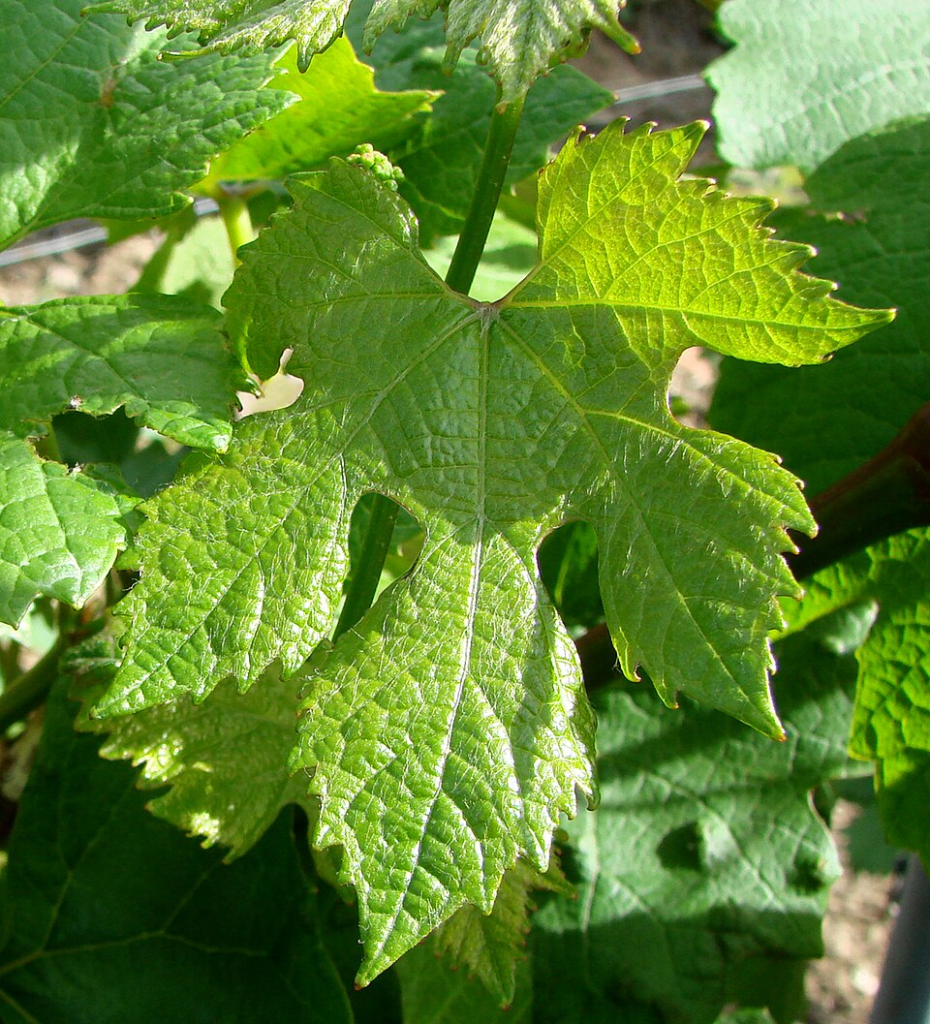
The surface may be smooth or covered with trichomes of varying density. Typically, the upper surface is smooth while the underside can range from sparse to densely woolly. The degree of hairiness depends on both genetic factors and environmental conditions. In autumn, leaves lose chlorophyll, turning yellow or red depending on the variety, and may persist on the vine for variable periods.
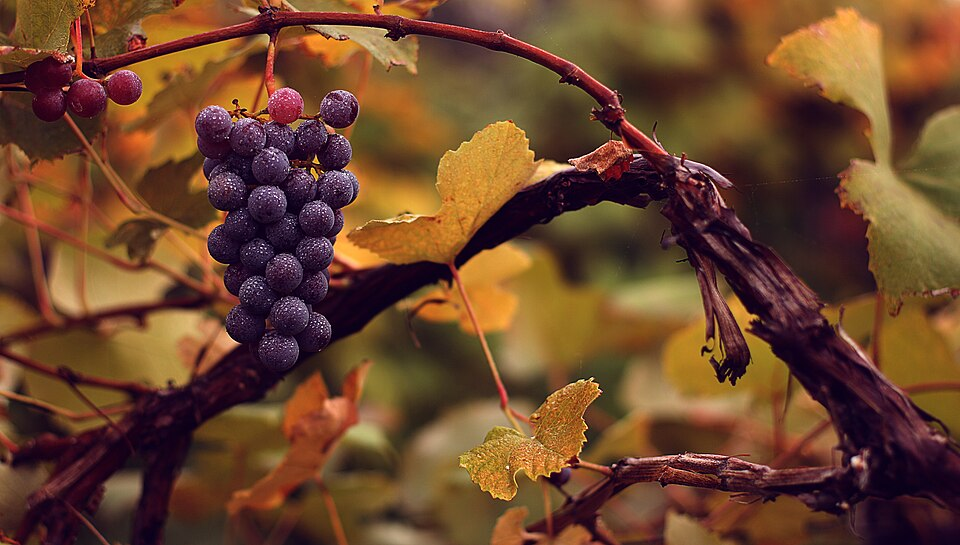
The fruit is a berry, known as a grape, with mature color ranging from green to yellow, pink to red-violet, or dark blue to black, influenced by variety and environmental factors, especially light exposure. The epicarp or skin is usually smooth while berry shape varies from spherical, elliptical, or ovoid.
Clusters vary according to varietal and environmental conditions, particularly nutrient availability. Cluster shape is commonly cylindrical, conical, or pyramidal. Clusters are described as simple when only the central rachis develops, winged when a basal lateral branch forms a secondary cluster, and bifid when a lateral branch grows parallel to the main rachis with equal length.
Cluster size and weight are highly variable. Average weight ranges from 150–300 g for wine grapes and 200–500 g for table grapes, with extremes from 100 g (small varieties) up to 2 kg in some cultivars like Regina dei vigneti or Trebbiano Toscano. Length ranges from less than 10 cm to several decimeters. Another key feature is cluster density: loose clusters have widely spaced, free berries that shift position easily, whereas compact clusters have tightly packed berries that may deform under pressure.
History of Common grapes (Vitis vinifera) as food
The changes observed in seed shape and distribution suggest that grape domestication may have occurred between 4100 and 3000 BCE in the region encompassing Southwestern Asia, Armenia, Georgia, Bulgaria and Romania. The earliest evidence of domesticated grapes was found at Gadachrili Gora in Georgia, dated around 6000 BCE. The oldest known winery, dating to 4100 BCE, was discovered in the Areni-1 cave in Armenia. Wild grapes were gathered by Neolithic populations and early farmers, valued for their nutritional and medicinal properties, and their history is closely linked to winemaking.
The cultivation of domesticated grapes spread throughout various parts of the ancient world. The earliest written references to grapes and wine appear in the Epic of Gilgamesh, a Sumerian text from the 3rd millennium BCE, and numerous references exist in ancient Egyptian sources. According to Egyptian inscriptions, wine was reserved for a select elite, including priests, officials, and pharaohs. In the Hebrew Bible, the vine is mentioned 55 times, symbolizing the chosen people and the promised land, with the Book of Isaiah providing instructions on vineyard management.
Over the centuries, viticulture evolved, with Hesiod and Homer describing harvesting and winemaking techniques, which were later spread by Greek colonists, particularly in southern Italy. The Etruscans refined these methods and expanded wine trade, while the Romans further developed viticultural practices, as documented by authors such as Cato the Elder, Virgil, and Columella. However, during the 3rd and 4th centuries CE, the crisis of the Roman Empire reduced viticulture, concentrating it mainly around urban centers.
During the Middle Ages, viticulture persisted mainly in monasteries, maintained by the Benedictines and other religious orders, who also helped spread it northwards. In France, grape cultivation became a symbol of aristocratic prestige. In the 7th century, the expansion of Islam led to a decline in viticulture in the Middle East, but production revived between the Late Middle Ages and the Renaissance, becoming economically sustainable due to growing demand.
With the arrival of European colonies in the New World, grapes were introduced to North America, Africa, South America, and Australia, leading to the development of hybrids with local Vitis species. From the second half of the 20th century, viticulture transformed into a scientific discipline, incorporating microbiological and chemical approaches.
Production methods for Common grapes (Vitis vinifera)
In hilly vineyards, soil management is crucial. Managing vineyards on slopes aims to reduce the time and labor required for agricultural operations, which can take three times longer than in flat areas. Although more difficult to work, hilly soils tend to produce higher-quality wines. Traditional hillside viticulture includes various planting methods, such as planting parallel to the slope and planting perpendicular to the slope. Some vineyards use modern techniques, like terracing, which allow for partial mechanization, although machine access remains limited.
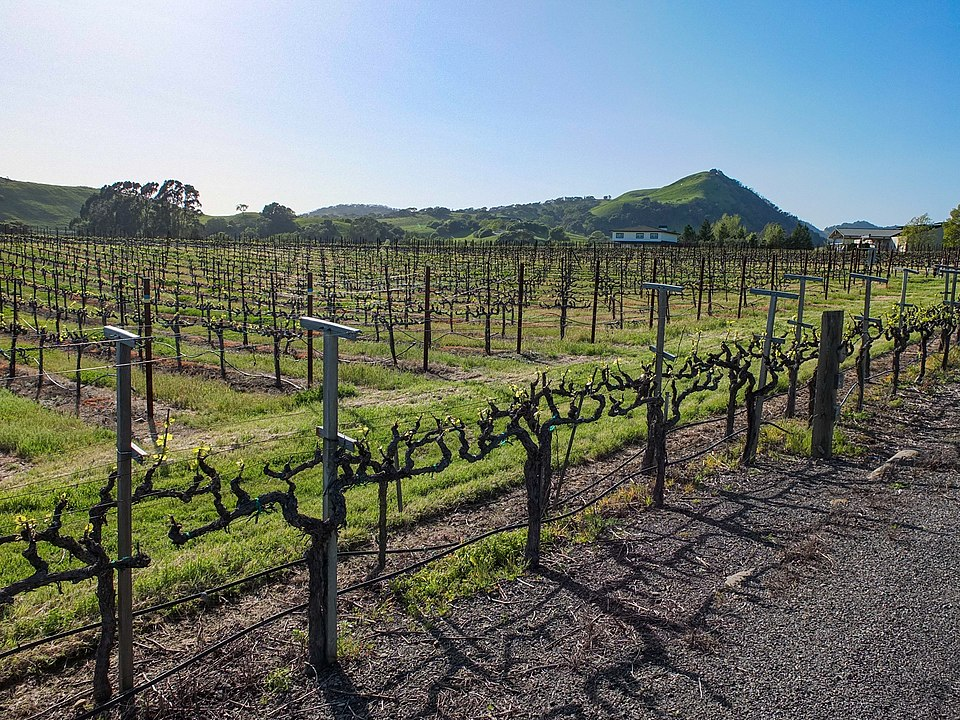
The planting season depends on the climate. In warm regions, autumn is ideal because young vines can root before winter and are more resistant to summer drought. In colder regions, where winter conditions are harsher, spring planting is preferable. Before planting, it is essential to analyze the soil and its properties to select the most suitable vine varieties. The spacing layout of the vineyard must be carefully planned, as it becomes difficult to modify once the vines have matured.
Pruning is a fundamental practice during vine growth. This term encompasses several different operations: training pruning, production pruning, and green pruning. Training pruning, performed in the first two years, is crucial for shaping the plant and preparing it for future production. Production pruning is carried out in winter, removing last year’s shoots and leaving only selected buds (future shoots) to ensure good yields the following year. Green pruning, done in summer, regulates vegetative growth, removing excess shoots to promote healthy grape ripening.
Fertilization is another important aspect, beginning with mature manure before planting and continuing with autumn and spring applications. Proper irrigation is essential, especially in arid areas. While irrigation can increase yield, in some regions it is regulated by law to preserve wine quality.
Classification of Common grapes (Vitis vinifera)
As Vitis, from a culinary and oenological point of view, common grapes are mainly classified according to their colour. We therefore find:
- Black (red) grapes
- White grapes
Regardless of colour, grapes are also classified according to their intended use. Thus, a distinction is made between:
- Table grapes
- Wine grapes
It should also be noted that there are many grape-derived products, including:
- Wine
- Wine vinegar
Nutritional facts table of the fruit
Since nutritional values can vary slightly depending on the cultivar, the figures provided below represent general averages.
| Nutrients | Per 100 g |
| Calories (kcal) | 69 |
| Total fat (g) | 0.16 |
| ———Saturated fat (g) | 0.05 |
| Cholesterol (mg) | 0 |
| Sodium (mg) | 2 |
| Total carbohydrates (g) | 18.1 |
| ———Dietary fiber (g) | 0.9 |
| ———Total sugar (g) | 15.48 |
| Protein (g) | 0.72 |
Recipes that use this product as an ingredient:

Source(s):
https://it.wikipedia.org/wiki/Vitis_vinifera
https://en.wikipedia.org/wiki/Vitis_vinifera
Photo(s):
1. eflon (Alex from Ithaca, NY), CC BY 2.0 https://creativecommons.org/licenses/by/2.0, via Wikimedia Commons
2. Vassil, Public domain, via Wikimedia Commons
3. Fred Hsu on en.wikipedia, CC BY-SA 3.0 https://creativecommons.org/licenses/by-sa/3.0, via Wikimedia Commons