
Chili peppers
Classification of Capsicum
Food, Plant source foods, Plants (Plantae), Flowering plats (angiospermae), Mesangiosperms, Eudicots, Core eudicots, Superastierds, Asterids, Lamiids, Solanales, Solanaceae (nightshades), Capsicum
Consumption area(s): Earth
Note: For better understanding, please read the article on flowering plants (angiospermae) first. If you come across unfamiliar words, you can click on any highlighted term to open the glossary with definitions of key botanical terms.
Introduction
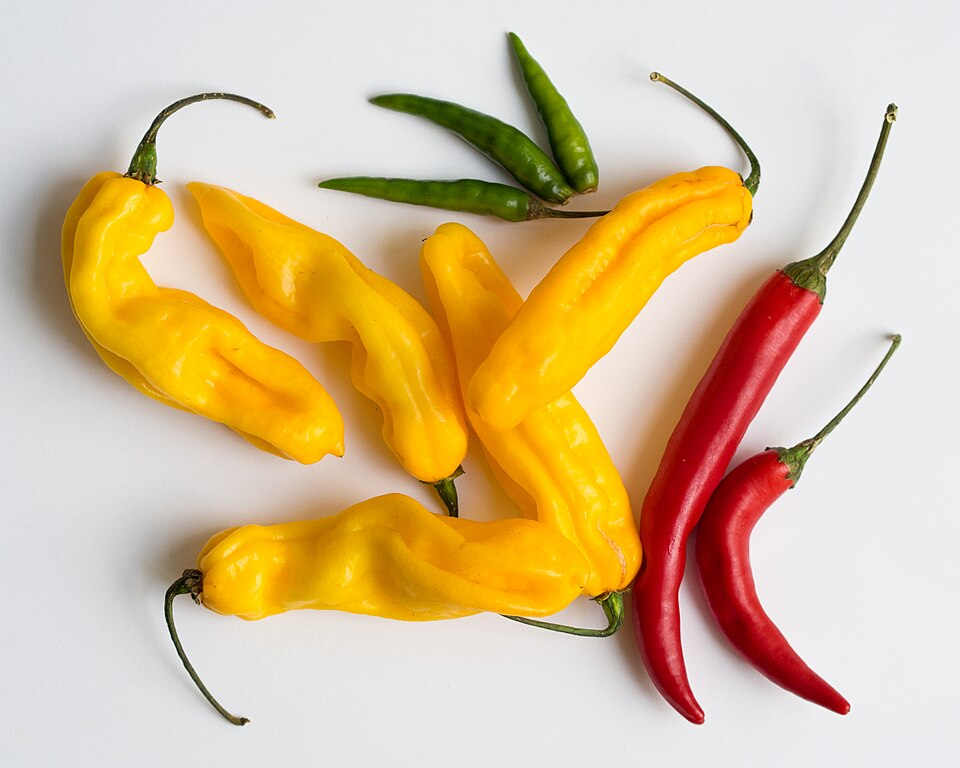
Chili peppers (also written as chile or chilli) are the fruit of plants belonging to the Capsicum genus, part of the Solanaceae (nightshade) family. Botanically classified as berries, these fruits are cultivated primarily for their characteristic spiciness.
They are widely used as a culinary spice, adding varying degrees of heat to dishes across numerous food traditions. Their pungent sensation is produced by capsaicin and other related capsaicinoids, chemical compounds that trigger the burning feeling when consumed or even when applied to the skin. Chili peppers differ greatly in both heat intensity and flavor profile. This natural variation explains why there are many kinds of chili powders, each distinguished by its own specific level of spiciness and unique taste characteristics.
History of chili peppers as food
Capsicum plants originated in what is now Peru and Bolivia and have been consumed by humans since around 7500 BC, making them among the earliest domesticated crops in the Americas. Archaeological evidence shows that chili peppers were cultivated in east-central Mexico approximately 6,000 years ago, while separate domestication processes also occurred in highland Peru and Bolivia, central Mexico, and the Amazon basin.
When Christopher Columbus reached the Caribbean, his expedition encountered Capsicum fruits for the first time from a European perspective. The explorers referred to them as “peppers” because their pungency reminded them of black pepper (Piper nigrum), a spice already familiar in Europe. Following Columbus’s voyages, sponsored by Spain, chilies were transported to Europe during the early phase of the Columbian Exchange, the large-scale transfer of plants, animals, and culture between the New and Old Worlds. Spanish records mention chilies as early as 1493.
Unlike Piper vines, which thrive only in tropical climates, chili plants adapt well to temperate environments. By the mid-16th century, they were commonly cultivated in Spain and had become integrated into local cuisine. Their diffusion across Europe was rapid: they appeared in Italy by 1526, in Germany by 1543, and reached the Balkans by 1569, where they were processed into paprika.
During the 16th century, Portuguese and Spanish maritime trade networks facilitated the swift spread of chilies to Africa and Asia, although documentation of the exact routes is limited. The Portuguese introduced them to Africa and Arabia, and subsequently to their Asian territories such as Goa, Sri Lanka, and Malacca. From these hubs, chilies disseminated through regional trade and natural propagation across South Asia and western Southeast Asia. Meanwhile, the Spanish carried them to the Philippines, from where they expanded into Melanesia, Micronesia, and other Pacific islands via the Manila galleon trade system.
Their arrival in East Asia in the late 16th century is less precisely documented, but it likely occurred through Iberian trading posts in Canton (China) and Nagasaki (Japan) or through regional commerce. The earliest known written reference to chili peppers in Chinese sources dates to 1591, though historical evidence suggests they entered China during the 1570s.
Production methods for chili peppers
Chili peppers are the glossy, vividly colored fruits produced by plants of the Capsicum genus. From a botanical standpoint, these fruits are classified as berries. The plants themselves are relatively compact, typically growing between 20 and 60 centimeters tall, depending on the variety. Their modest size makes them well suited for cultivation in pots, greenhouses, or commercial polytunnels. When shielded from low temperatures, they can behave as perennials.
The fruits display considerable diversity in both color and shape. They may appear green, orange, red, or purple, and range from rounded and irregular forms to smooth, elongated varieties. Harvest timing affects both yield and flavor. Picking peppers while still green and unripe encourages the plant to produce additional flowers and therefore more fruit. Leaving them on the plant until full maturity allows them to develop their final color and often a stronger heat, though this typically reduces overall production.
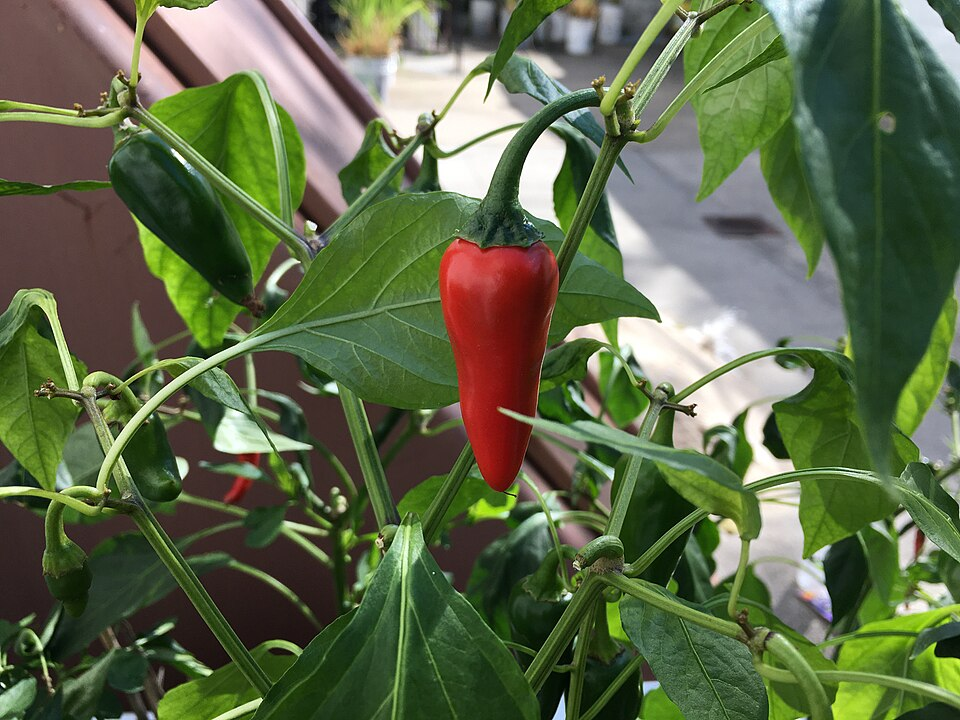
Successful cultivation depends on specific environmental conditions. Peppers thrive in a sunny location with warm, well-drained loamy soil, ideally maintained between 21 and 29 °C. The soil should remain moist but not saturated. Seed germination requires warmth, close to 21 °C, and while mature plants prefer heat, they can tolerate temperatures as low as 12 °C, though they are sensitive to frost. The flowers are capable of self-pollination, and Capsicum is not dependent on day length for flowering. However, when temperatures rise above roughly 30–38 °C, pollen viability declines, reducing the likelihood of fruit development.
After harvest, chilies can be used either fresh or dried. In warmer climates, drying is common and allows for the production of various products. In temperate regions, drying preserves peppers for winter use. At home, they can be strung together and hung in a warm, dry environment until fully dehydrated. Processed forms include whole dried chilies, flakes, and powdered spice. Both fresh and dried peppers are used to prepare hot sauces, typically bottled as condiments, as well as chili-infused oils, which transfer their heat and flavor into oil.
Uses of chili peppers
Because of their distinctive pungency, chili peppers are fundamental to numerous culinary traditions worldwide. They play a central role in Chinese cuisine (notably Sichuanese cooking), as well as in Mexican, Thai, Indian, Yoruba, New Mexican, Caribbean, South American, and East Asian food cultures. In contemporary Asian gastronomy, their use is widespread across many regions. Chilies are especially important in the preparation of curries, where they determine the level of heat; milder versions may rely more heavily on other spices and sometimes exclude chili entirely.
Beyond the fruit, the leaves of Capsicum plants are also edible. They have a mild bitterness and lack the intense heat of the peppers themselves. In Filipino cuisine, known as dahon ng sili, the leaves are cooked as greens and commonly added to the chicken soup tinola. In Korean cuisine, they may be incorporated into certain types of kimchi.
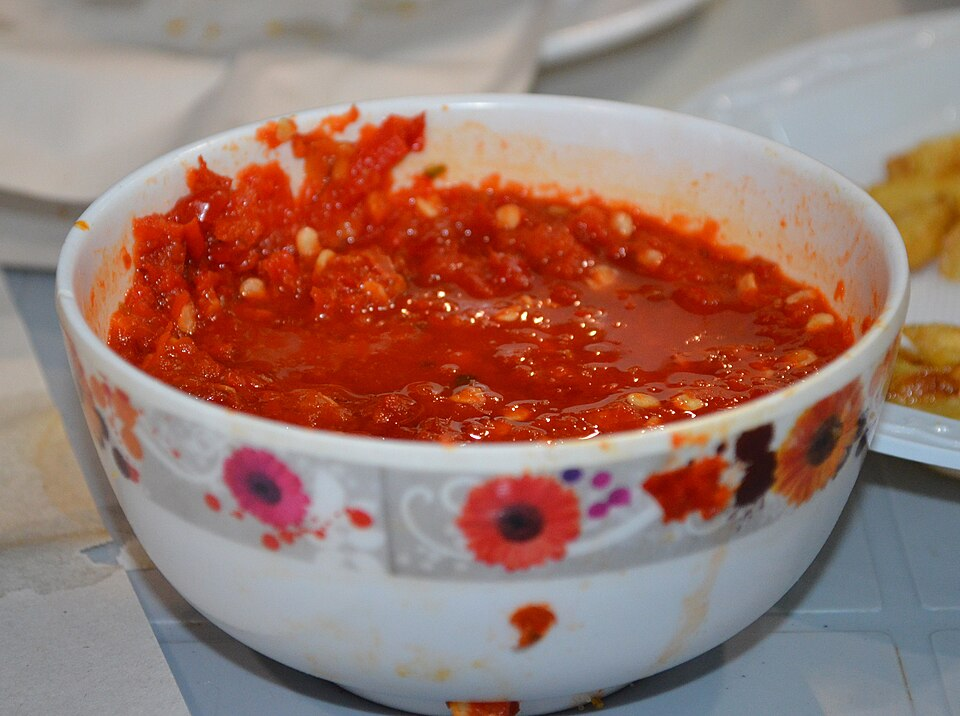
Chilies appear in iconic dishes across the globe. In Peru, Papa a la huancaína pairs potatoes with a sauce made from cheese and ají amarillo peppers. In Thailand, kaeng tai pla curry combines fish with a sauce flavored by garlic, shallots, galangal, kaffir lime, turmeric, fish paste, and bird’s eye chilies. Jamaican jerk chicken relies on the intense heat of habanero peppers alongside allspice. In Goa (India), vindaloo may incorporate the extremely hot ghost pepper (bhut jolokia), creating one of the country’s spiciest dishes. In Bhutan, the national dish ema datshi consists primarily of chilies cooked with local cheese.
Mexican gastronomy makes particularly extensive use of diverse chili varieties, including jalapeño, poblano, habanero, serrano, chipotle, ancho, pasilla, guajillo, de árbol, cascabel, and mulato. Each contributes distinctive flavor notes—ranging from citrus and fruity to earthy and grassy—and they are essential components of sauces such as mole and various salsas. In Yoruba cuisine, chilies are integral to dishes such as Ewa Agoyin and Obe ata, further demonstrating their global culinary significance.
Classification of chili peppers
Chili pepper is initially classified according to the species. Among these we find:
- Capsicum annuum (jalapeño, cayenne pepper)
- Capsicum baccatum (aji)
- Capsicum chinense (habanero, scotch bonnet)
- Capsicum frutescens (piri piri, tabasco)
- Capsicum pubescens (rocoto)
Nutritional facts table of the fruits
Please note that nutritional values may vary slightly depending on the species, but they differ mainly between fresh and dried products.
| Nutrients | Fresh fruits (100 g) | Dried fruits (100 g) |
| Calories (kcal) | 40 | 324 |
| Total fat (g) | 0.32 | 5.81 |
| ———Saturated fat (g) | 0.03 | 0.08 |
| Cholesterol (mg) | 0 | 0 |
| Sodium (mg) | 8 | 91 |
| Total carbohydrates (g) | 9.14 | 69.86 |
| ———Dietary fiber (g) | 1.5 | 28.7 |
| ———Total sugar (g) | 5.2 | 41.06 |
| Protein (g) | 1.94 | 10.58 |
Recipes that use this product as an ingredient:

Source(s):
https://en.wikipedia.org/wiki/Chili_pepper
Photo(s):
1. Takeaway, CC BY-SA 4.0 https://creativecommons.org/licenses/by-sa/4.0, via Wikimedia Commons
2. Ashoka Jegroo, CC BY-SA 4.0 https://creativecommons.org/licenses/by-sa/4.0, via Wikimedia Commons
3. Elph, Public domain, via Wikimedia Commons