
Cattle tail
Food, Animal source foods, Animals (Animalia), Chordates (Chordata), Vertebrates (Vertebrata), Mammals (Mammalia), Therians (Theria), Placentals (Placentalia), Artiodactyls (Artiodactyla), Ruminants (Ruminantia), Bovids (Bovidae), Bovines (Bovinae), Bovini, Bos, Cattle
Species name: Bos Taurus
Consumption area(s): Not finding precise data on the consumption of this product, it is considered reasonable to assume that its use is almost global (with the exception of Africa and some tropical regions), but primarily developed in poorer areas or for the preparation of traditional ancient dishes.
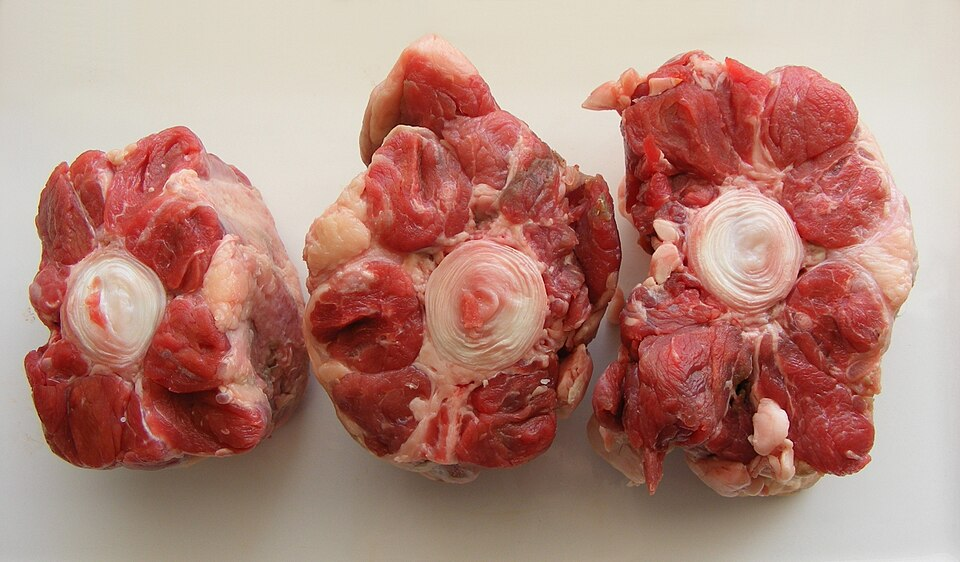
Anatomy of cattle tail
It is essentially the tail of the animal.
Uses of cattle tail
Cattle tail is a particularly gelatinous cut, ideal for slow cooking such as stews or braises. Its rich collagen content makes it perfect for preparing thick broths, also used in oxtail soup. Traditionally, it requires long hours of cooking, but today a pressure cooker is often used to shorten the time. Usually, the whole tail weighs about 3.5 kg and is sold already cleaned and cut into smaller pieces.
One of the most famous dishes is Coda alla Vaccinara, a specialty of Roman cuisine cooked with tomato, red wine, and aromatics. In the United Kingdom and Ireland, its flavor is used to enrich commercial soups, both powdered and canned.
In the Caribbean islands, particularly in Jamaica, it is cooked with butter beans or broad beans and served with white rice or rice and peas. In South Africa, it is cooked in a potjie, a three-legged cast-iron pot placed directly over the fire. In Zimbabwe, it is eaten with sadza, a maize porridge served with vegetables. In Cuba, the tail is the base of rabo encendido, a spiced stew, while in the Philippines it is used for kare-kare, a peanut-based stew.
In Iran, the tail replaces the shank in the traditional dish baghla-poli-mahicheh, served with flavored rice and fresh herbs. In India, it is called dumghazah and is considered a local specialty in the Lucknow region.
In the Americas, Spain, West Africa, and Asia, it is often used for traditional soups. In Chinese cuisine, it is transformed into niúwěi tāng (牛尾汤), while in Korea it is the main ingredient of kkori-gomtang (꼬리곰탕), a hearty soup served with rice.
Nutritional facts table
It should be noted that nutritional values may slightly vary depending on the animal.
| Nutrients | Per 100 g |
| Calories (kcal) | 160 |
| Total fat (g) | 9.3 |
| ———Saturated fat (g) | 2.9 |
| Cholesterol (mg) | 65 |
| Sodium (mg) | 60 |
| Total carbohydrates (g) | 0 |
| ———Dietary fiber (g) | 0 |
| ———Total sugar (g) | 0 |
| Protein (g) | 19.1 |
Recipes that use this product as an ingredient:
Source(s):
https://en.wikipedia.org/wiki/Oxtail
Photo(s):
1. FotoosVanRobin, CC BY-SA 2.0 https://creativecommons.org/licenses/by-sa/2.0, via Wikimedia Commons